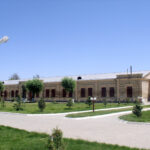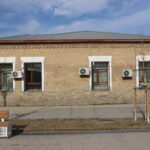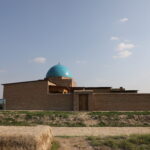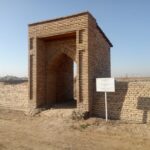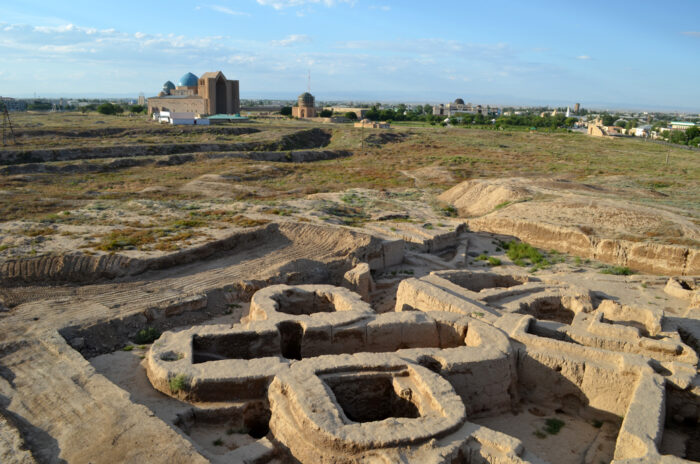
Yasy-Kultobe is one of the most ancient archaeological sites in Kazakhstan. It is located just 350 meters south of the Mausoleum of Khoja Ahmed Yasawi. Coordinates: 43˚17.597΄, 068˚16.268΄. This site is of republican significance. Archaeologists believe that the earliest architectural structures in Kazakhstan, dating back to the 3rd century BC, were built here. In some sources, the site is referred to as Kultobe-Yasy. The name “Yasy” first appears in the travel notes of Armenian King Hetum I, who passed through southern Kazakhstan in the 13th century on his way to the court of Möngke Khan, the Great Khan of the Mongol Empire.
The origin of the city’s name goes back to the history of the tribes that inhabited the land between the Karatau Mountains and the Syr Darya River. From the 3rd century BC to the 4th century AD, these lands were inhabited by the Saka and Sarmatians, as well as the As tribes (also known as Yasy, Asy, Asha, Aras) and Sauran (Savran, Sagran). Later, in the 1st–4th centuries AD, during the fourth Great Migration of Peoples, the As-Yasy and Sauran tribes joined the Huns, who were moving from East to West (from Asia to Europe), and migrated to Eastern Europe. Evidence of this is found in the names of places such as Yași — the second largest city in Romania after Bucharest and the nearby town of Kang-as (Kang being the ancient name of the Syr Darya River), as well as several settlements in Hungary: Ács, Jászapáti, Jászberény, Jászladány, along with the town of Savran and the Savranka River in southwestern Ukraine. At that time, settlements were often named after the tribes that lived there. Thus, it can be concluded that around 2,000 years ago our ancestors, together with the Huns, migrated to Eastern Europe.
As for the age of the city, within the Turkistan oasis and on the slopes of the Karatau Mountains, nine ancient settlements dating to the Early Antique period (6th–4th centuries BC – 3rd–4th centuries AD) have been identified, as well as twelve settlements from the Late Antique period (2nd–1st centuries BC – 4th–5th centuries AD). The cities of the Late Antique period were closely linked to the Silk Road, which began to take shape in the 2nd–1st centuries BC. Along this route, eight cities of the Turkistan oasis were located on a single line, roughly equidistant from one another (10–12 km). These include: Maibalyk, Ancient Tashnak (Tortkul), Yasy, Okzhetpes, Sidak-ata, Ancient Shornak, Karatobe-Sauran, and Aktobe-Sauran. The period of their existence mostly began in the 2nd–1st centuries BC. Five of these cities ceased to exist in the 4th–6th centuries AD, while three others — Maibalyk survived until the 8th century, and Yasy-Kultobe and Karatobe-Sauran until the 14th century. Among them, only Yasy, which moved in the late 14th century to the territory of Old Turkistan, continued to exist and has survived to the present day. Thus, Yasy originated as a settlement around the 3rd century BC, became a fortified point on the Silk Road in the 2nd–1st centuries BC, developed into a fortified town in the 5th–6th centuries AD, and from the 14th–15th centuries grew into a major city known as Yasy-Turkistan.
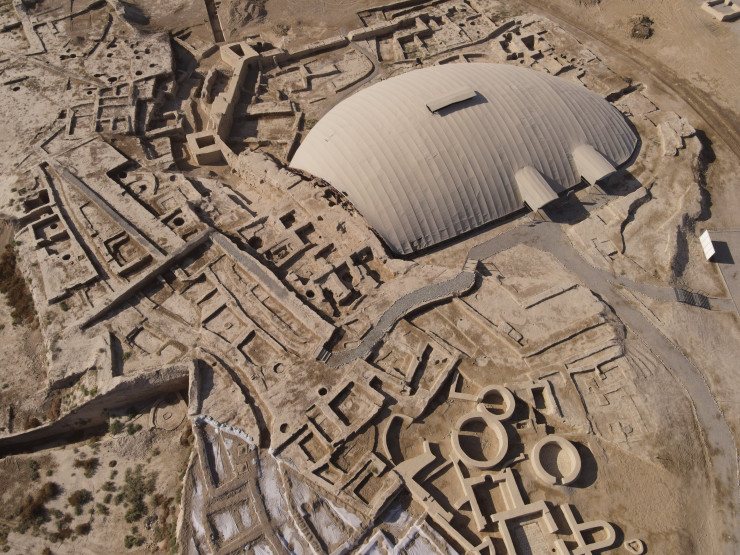
Archaeological excavations of the citadel of the “Kultobe” site began in 2010 within the framework of the “Cultural Heritage” program. The research was carried out under the leadership of the A. Margulan Institute of Archaeology (project director — B. A. Baitanaev) and conducted by the institute’s specialists E. A. Smagulov and A. O. Erzighitova. Staff members of the National Historical and Cultural Museum-Reserve “Azret Sultan” (M. K. Tuyakbayev, T. S. Oserov) also participated in the work.
The main objectives of the project are the full uncovering and restoration of the citadel of the Kultobe site, its conservation, transformation into an open-air museum, and its inclusion in the UNESCO World Heritage List.