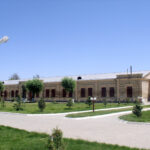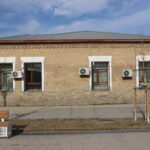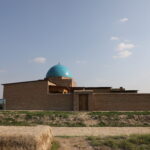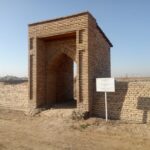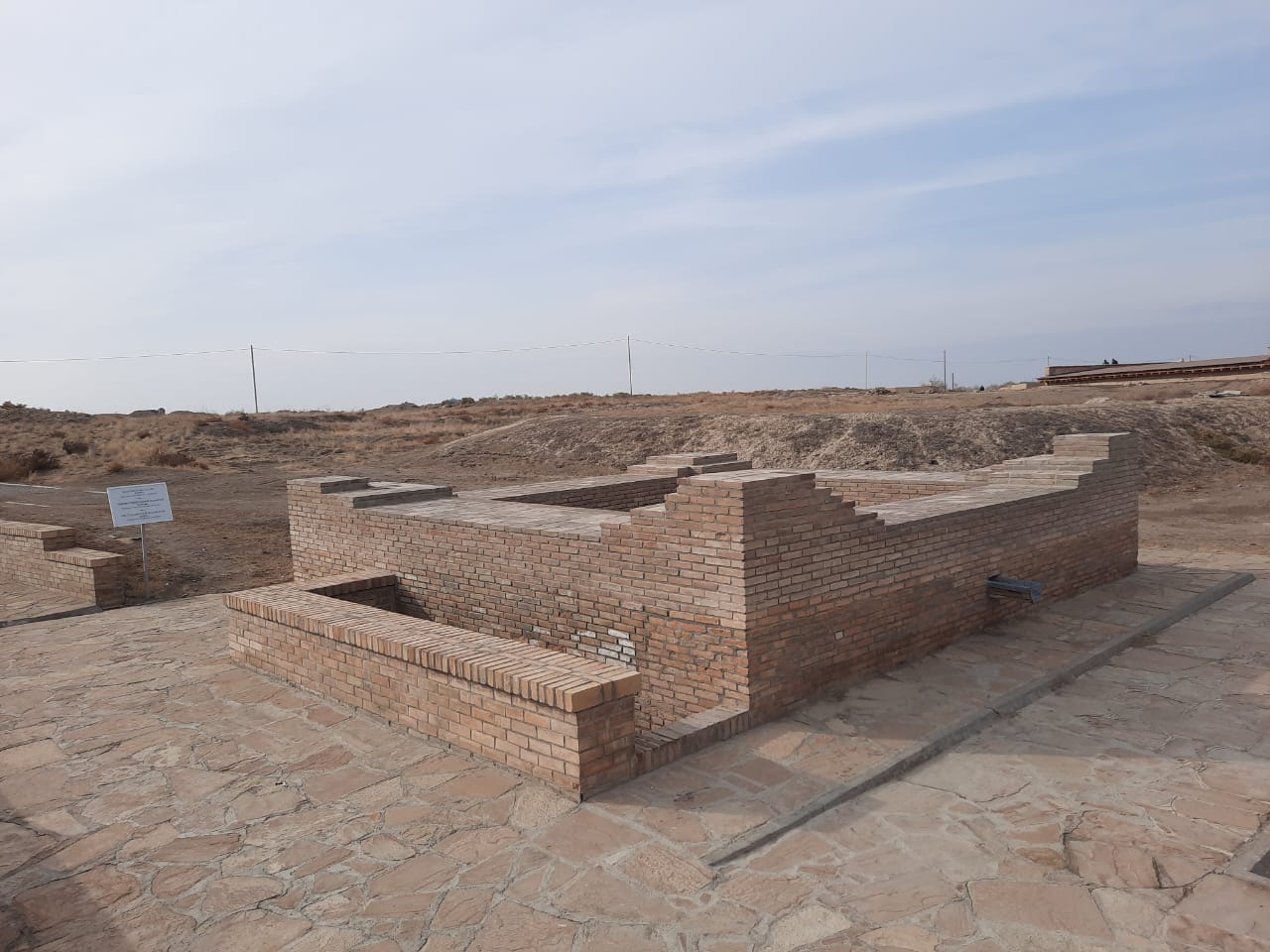
The site is located 45 meters southwest of the Mausoleum of Khoja Ahmed Yasawi and is classified as a monument of national significance. Coordinates: 43˚17.830΄, 068˚16.226΄. The upper part of the structure has not survived, however the underground burial chamber has been preserved in good condition. The interior walls not plastered, and the floor is made of clay. On the floor lie open wooden boxes containing the remains of seven adults and one child. Since the identities of the buried individuals remain unknown, the monument has been given the provisional name “Unnamed Mausoleum”. The site is listed in the Historical and Cultural Monuments of Kazakhstan under No. 590.8 in the publication Compendium of Monuments of History and Culture of Kazakhstan for the South Kazakhstan Region (1994). The designation “sagana” (a rectangular enclosure around a tomb), found in some sources, is considered inaccurate. According to architectural terminology, a “sagana” refers to an open-top quadrangular structure surrounding a burial. In contrast, this object is an underground structure covered with a dome. Inside, there are four arched niches measuring 0.8 m deep, 4.33 m wide and 2.8 m high. The mausoleum served both as a family burial vault and as a funerary mausoleum. It is likely that the deceased were not buried underground but were instead laid on the floor wrapped in shrouds, a common practice for crypt burials. The terms “lahat”, “murdekhana” or “meyithana” (burial chamber or crypt) would be more accurate for describing this structure. Only the 0.6 m high foundation, which corresponds to the underground room (6.76 m in length), has been preserved from the above-ground part of the mausoleum. The overall dimensions of the structure are 9 x 8.75 m. The entrance is located on the southwest side, with a height of 2.5 m, a width of 0.8 m, and a depth of 1.2 m. The dome has subsided over time, and its height from base to top is only 1.16 m, indicating a settlement of at least 35 cm. The structure was discovered accidentally in 1975 during earthworks to leveling the site. Archaeologists L.B. Yersakovich and B. Nurmukhanbetov, along with architect A. Ordabayev, subsequently examined it. According to restorers’ recollections, the human remains were sent to Almaty for anthropological analysis. Based on the researchers’ conclusions, the mausoleum functioned as both a family burial vault and a cultic funerary chamber. Archaeological data indicate that the monument was built in the 16th century and was in use until around the mid-17th century, serving for about 150 years.
References:
1.Ерзакович Л.Б., Нурмаханбетов Б. Ордабаев А. Подземное погребальное сооружение в Туркестане // Археологические раскопки в Отраре. – А-Ата, 1977. – С.59-72.
2.Мазар безымянный, ХҮІ в. // Свод памятников истрии и культуры Казахстана. Южно-Казахстанская область. Алматы, 1994. –С. 279. №590. 8.
3.Тұяқбаев М.Қ. Ескі Түркістан пантеоны // М.Елеуовтың 70 жылдығына арналған конференция материалдары. А., 2016. 191-197 бб.
4.Словарь иностранных слов. М.,1998.- С.358.