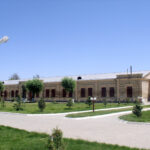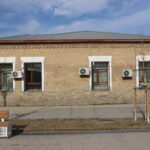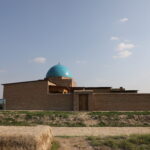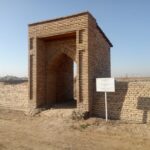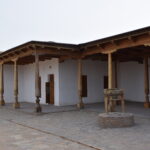
Complex is located 120 m south of the Mausoleum of Khoja Ahmed Yasawi. Coordinates: 43˚17.776΄, 068˚16.247΄. Monument of republican significance. This is one of the medieval religious structures built in the 12th century and continuously functioning until the first half of the 20th century. The complex is partially underground. According to scholars, the word “Khilvet” derives from the Arabic “khalwatun” (“seclusion, solitude”) and denotes a place for worshiping the Creator in detachment from worldly life and in isolation. Here, one of the main ritual practices performed was dhikr. Researchers mention that Khoja Ahmed Yasawi, upon reaching the age of the Prophet (63 years), deliberately built the khilvet and spent the rest of his life here. It was also here that he trained many of his disciples and composed such works as “Diwani Hikmet”, “Mirat al-Qulub”, “Faqirnama”, and others. The complex originally consisted of 18 rooms.
In the now-restored underground mosque, there are three entrances. During construction, all conditions were provided for both religious rites and everyday needs. The premises included a Jamaatkhana (gathering hall), a mosque, utility rooms, rooms for heating water, for ablutions, and a dining room.
Moreover, here Khoja Ahmed Yasawi’s “Ghar” chamber, located four meters underground, has been preserved in its original form. This room designed for a single person has square walls and a square dome, built of fired brick and covered using the “Balkhi” technique.
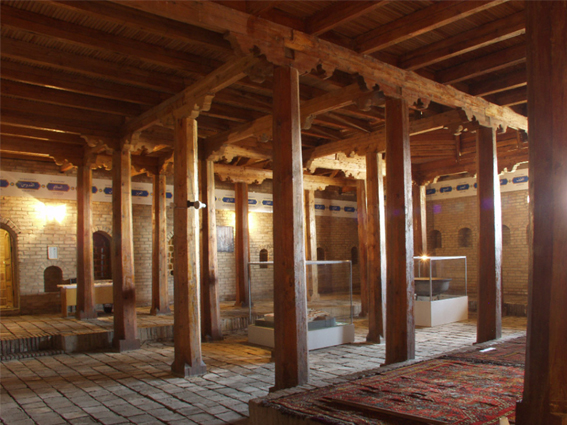
The largest room of the complex is the Jamaatkhana, the only chamber with a window. It is also here that the khilvet dome was erected. The ceiling of the underground structure is made of wood, while the roof is covered with tin (tunke). Special supporting pillars were installed to hold it in place. Niches for lamps are found in all rooms. The interior height of the building is 4.8 m; its length is 20.9 m, width 14.7 m, height of the columns 3.8 m, and the total height together with the dome 6.4 m.
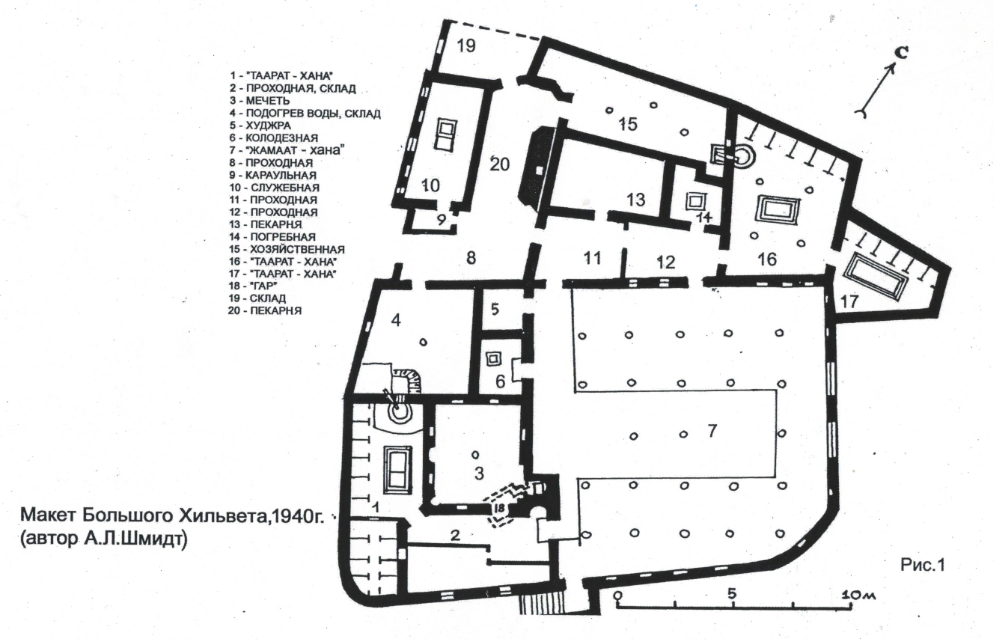
During the Great Patriotic War, the building was destroyed, and its bricks were used for constructing an oil mill. In 1972–1973 T. N. Senigova, and in 1979 E. A. Smagulov, carried out archaeological studies which established the location of the 15th–16th-century khilvet. It was reconstructed according to a model designed by architect A. L. Schmidt in 1942. Research and restoration revealed that the complex had been built in several stages. In 1994, it was included under no. 590.11 in the Historical and Cultural Monuments of Kazakhsta for the South Kazakhstan Region and taken under state protection.
Based on the studies of T. N. Senigova and E. A. Smagulov, it was established that the construction of the khilvet occurred in two phases. The earliest part (rooms no. 1–7) was built in the 15th–17th centuries, while the northeastern sector (rooms no. 8–20) dates to the 18th–20th centuries. Only the “Ghar” chamber no. 18 (located under the room no. 3) dates back to the time of Ahmed Yasawi, i.e., the 12th century. In 1996, the Turkistan Archaeological Expedition (E. Smagulov, M. Tuyakbaev) excavated the mosque (room no. 3), beneath the floor of which lay the “Ghar”. It was revealed that the walls of the “Ghar” do not align with those of the mosque, indicating different construction periods. The walls of the “Ghar” are set at an angle of 15 degrees, placing it directly under the mosque entrance. In the original plan, the hatch leading into the “Ghar” was located outside the northeastern wall of the mosque (as confirmed by A. L. Schmidt’s 1942 model). However, during the 1980s reconstruction, northeastern wall of the mosque was shifted about one meter, and the hatch ended up inside the room.
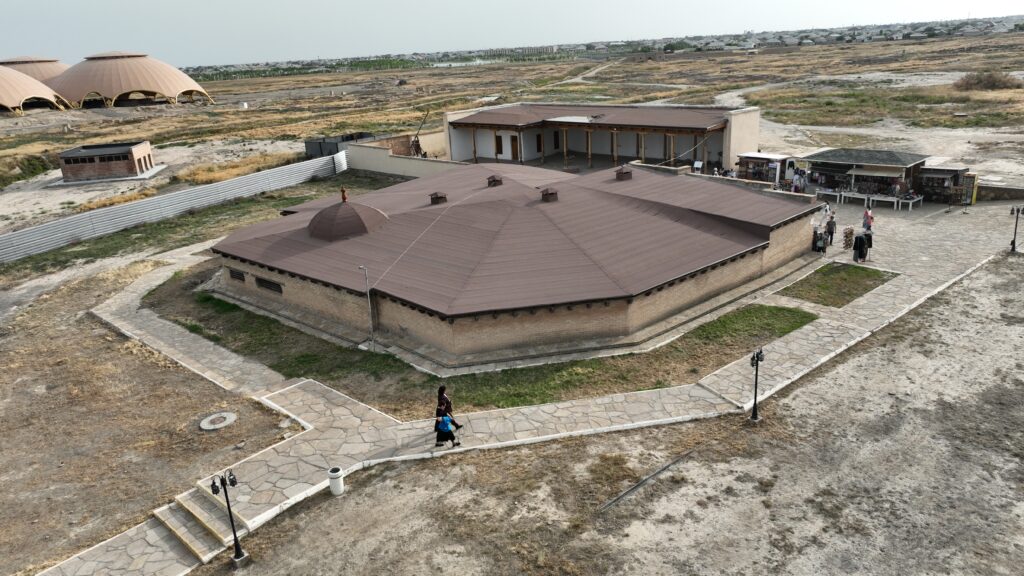
Excavations conducted outside the “Ghar” chamber showed that the mosque was originally built of mudbrick, and its southern wall constructed above the “Ghar”. Consequently, the mudbrick mosque appeared later than the “Ghar”, but earlier than the brick mosque. Above the “Ghar”, a fragment of the earliest mosque floor has been preserved. This space may have served either as a mosque or as a place for dhikr. In the Kumchik Ata complex, the dhikr hall and the “Ghar” are located side by side, whereas here the dhikr hall was most likely erected above the “Ghar”. In the 15th–16th centuries, when the khilvet was expanded, the large room no. 7 — the Jamaatkhana — fulfilled the function of the dhikr hall. Stratigraphic excavations near the outer wall of the “Ghar” at a depth of 315 cm uncovered fragments of Karakhanid-era ceramics (11th–12th centuries). This proves that when constructing the “Ghar” a deep pit was dug first then built chamber inside and refilled with soil which containing pottery fragments. The northern part of the khilvet was built in the late 19th–early 20th centuries. Here, in addition to the local square brick, the so-called “Russian brick” of rectangular shape is used (especially in rooms Nos. 16 and 17).
In winter, during the “shildeh” period (from December 22 to February 2), preachers of Yasawi’s teachings gathered in Turkistan from across Central Asia, the Caucasus, and Kazakhstan. They performed a forty-day “dhikr”. It is believed that this tradition arose in commemoration of Ahmed Yasawi’s passing, which occurred during the winter “shildeh”. The scholar V.A. Gordelevsky noted that the complex also contained guesthouses and stables, and that during the winter “shildeh” 20–25 thousand people would gather in Turkestan to perform “dhikr” and recite his Hikmets by heart. On the western side of the mausoleum, there was also another complex, the “Small Khilvet”, which was likewise destroyed during the war.