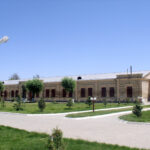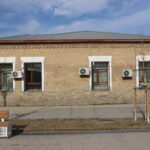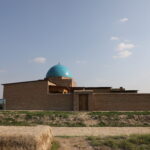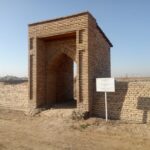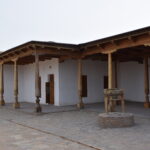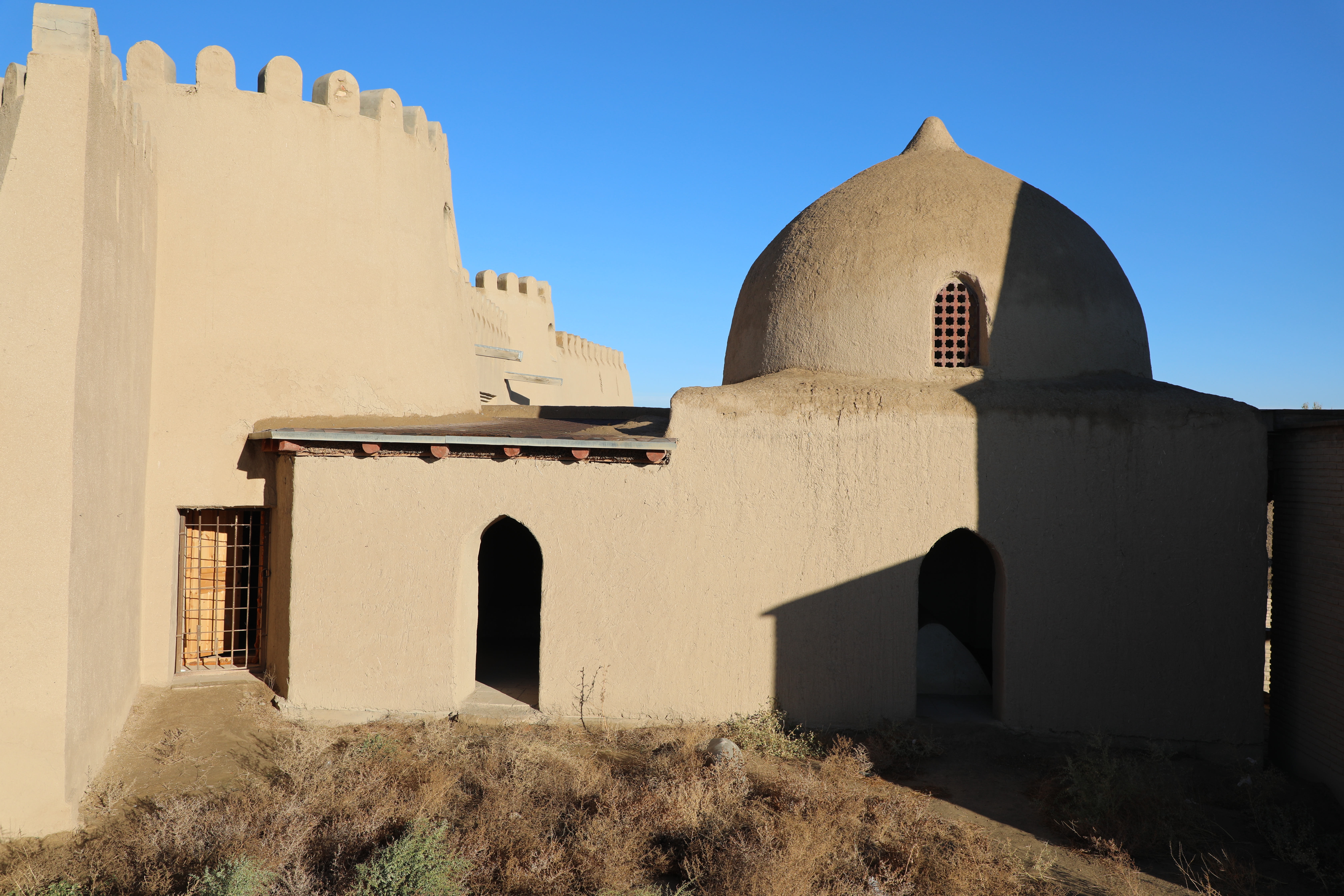
Undemes Ata lived in Turkistan in the 1880s. His mausoleum is located near the “Zheti Ata” Gate. Coordinates: 43.2966064, 068.2620776. During the 2009–2010 archaeological excavations carried out by the Turkistan Archaeological Expedition, the site was carefully studied. An old photograph of the mausoleum from 1910 has been preserved. In 2019, the mausoleum underwent a complete restoration.
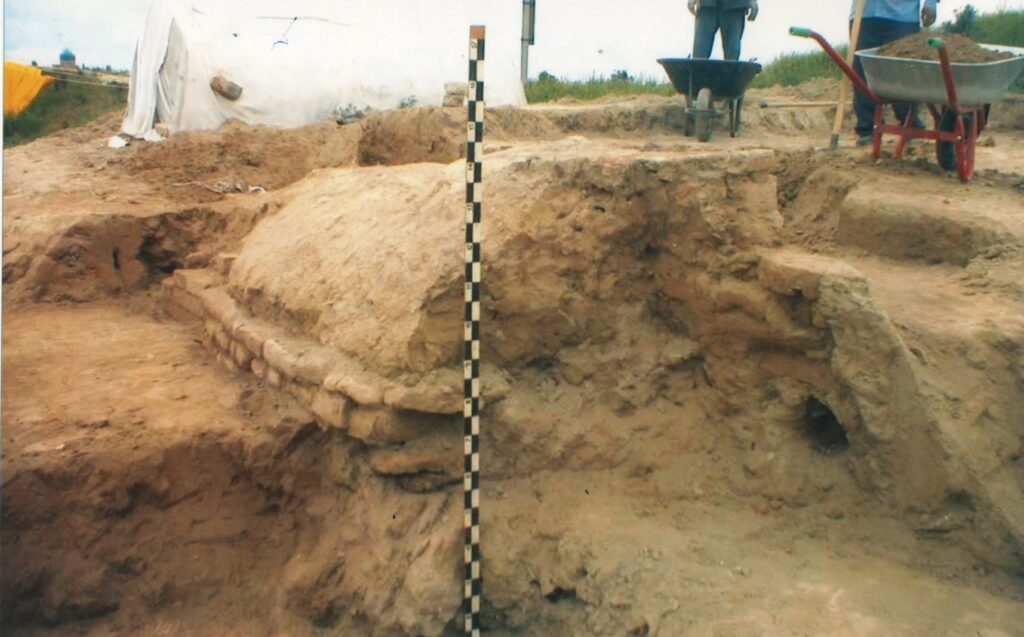
He got the name — Undemes (The Silent One) because he never spoke to anyone. During the day, he would sit quietly by the entrance of the Khoja Ahmed Yasawi Mausoleum, and at night, he would stay in an old mazār (grave). According to local legends, if a misfortune such as an epidemic or other disaster threatened the people, he sensed it in advance and spent the entire night weeping and praying. For this reason, he was called “qutyp” — “hidden saint”. One night, he died inside a grave that he had dug for himself. Local people buried him there and erected a sagana (rectangular funerary enclosure) over the grave. Over time, the site became a place of pilgrimage. There is a special tradition here, visitors would remain silent, coming and leaving without saying a word. Even the “shyraqshy” (caretaker) recited the Quran silently, without uttering a single word aloud. Until the 1930s, continued another custom, travelers passing the shrine by cart would get out, walk past on foot, and leave coins as a sign of respect to Undemes ata. During the excavations near the “Zheti Ata” Gate in 2009–2010, archaeologists discovered the remains of several ancient structures, including the mausoleums of Bab Arab and Undemes Ata (Fig. 1, Nos. 1–2). The mausoleum of Undemes Ata (Object No. 2) has an asymmetrical shape. Its western corner extended due to the building was constructed along the uneven line of the old city wall. An interesting feature is the orientation of the burials: the head of Undemes ata is directed toward the Mausoleum of Khoja Ahmed Yasawi, whereas the neighboring burial of Bab Arab (chamber No. 1) is strictly oriented to the northwest, in accordance with Islamic burial traditions. Researchers believe this unusual position is explained by the fact that Undemes Ata dug his own grave and created a small cell-like chamber for solitude. After his death, his followers might have decided to leave the body in its original position — they washed him, performed the “janaza” prayer, and buried him in same position. The original tomb structure of the mausoleum was built of fired brick. Today, six visible courses of brickwork remain. During the latest restoration, the surface was covered with a 5–10 cm layer of clay plaster. The dimensions of the tomb structure are approximately 1 meter high, 3.2 meters long and 1.6 meters wide at the base. As for the mausoleum itself, its northeast wall is shared with the neighboring Bab Arab Mausoleum. Its length is 6.4 m, thickness — 0.5 m. The southeast wall measures 4.5 m long, with a thickness varying from 0.5 to 0.8 m. The northwestern wall is poorly preserved, it is about 6 meters long and 0.5 meters thick. In the central part of the southwest wall, there is a doorway: wall length — 6.4 m, thickness — 0.7 m, entrance width — 0.9 m. The internal dimensions of the chamber also vary: NE — 5 m, SE — 3.5 m, NW — 4.4 m, SW — 5.4 m. Overall, the plan of the mausoleum is close to trapezoidal in shape. An old photograph from 1910 showing both mausoleums. The image indicates that structures were built simultaneously from adobe bricks and coated with a thick layer of high-quality clay plaster.
References:
- Мұсабаев Қ. Үндемес ата кесенесі. // «Ұстаз» газеті., 2015ж., 20 қазан. 6 бет.
- Тұяқбаев М., Өсеров Т., Күмісбеава Ұ., Мұсабаев Қ., Мүтәшев Е. Ескі түркістан қаласының Жеті ата қақпасының орынында 2009ж. жүргізілген археологиялық зерттеу жұмыстарының есебі. «Әзірет Сұлтан» қорық музейінің архиві.
- Тұяқбаев М. Төрт қақпалы Түркістан // «Ясауи мұрасы» газеті. №1 (13), қаңтар, 2018ж.
- Үндемес ата // «Әзірет Сұлтан» энциклопедиясы, І-том. Түркістан, 2021ж. 334-335 бб.