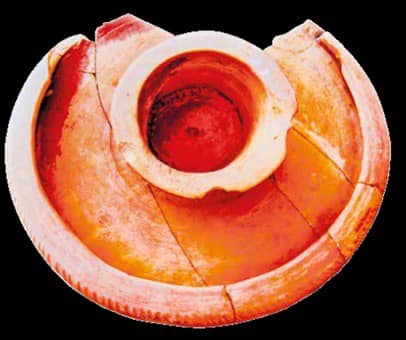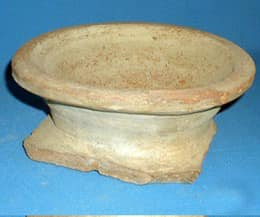
During archaeological excavations in the cultural layers of the ancient cities of Otrar, Shaugar, and Karatobe, numerous examples of ceramic dishes were discovered. The fragments found indicate that these products were widely used in these regions. Such countertops were used in everyday life for specific purposes and reflected the unique features of the local material culture of that period. The design of ceramic countertops consists of two parts: the first is a round, heavy tabletop with a diameter of approximately 50–80 cm; the second is a cylindrical pedestal with a height of 9–15 cm. The products were made on a wheel (ceramic wheel), and the outer surface was often covered with pink or yellow engobe (shiny clay coating). The upper surface is smooth and shiny, and the lower surface is decorated with various decorative patterns. These patterns were created in different ways — by pressing in a mold, finger painting, or gluing.
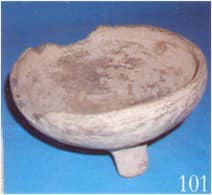
A three-legged tabletop found in the citadel of the city of Zhuantobe deserves special attention. At the depth there is a mark similar to the letter «zh». The legs are oval. Similar tabletops with round legs have already been found in this area. According to researcher N.P. Ostroumov, a surveyor named K.D. Baronin from Zhuantobe was one of the first to discover such a tabletop made of clay. In Central Asia, such tabletops are often found among monuments characteristic of the urban culture of the 8th-9th centuries. Studying models of tabletops found in medieval cities of Central Asia and Kazakhstan, G.I. Bogomolov and O.A. Papakhristou note that during this period, tabletops with legs and a cup-shaped base were widespread.
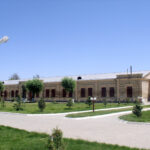
The collection of the National Museum-Reserve «Aziret Sultan» contains partially restored, but consisting of two parts, ceramic and three-legged tabletops. They were found in the cities of Zhuinek, Shaugar and Karatobe. The diameters vary from 20 to 37 cm, the height from 8 to 12 cm. The outer part of these samples was covered only with red engobe and left without further processing. The shape of the tabletops is round, in the middle there is a cup-shaped stand. The upper surface is smooth, without decorative elements. Some examples have thread-like marks, grooves and conical rosettes. Similar samples of dishes were found at the sites of Otyrar and Kuyryktobe, dating back to the 8th-10th centuries.
The tabletops found in the Karatobe settlement date back to the 10th–12th centuries. They are made of high-quality, carefully kneaded clay. The diameter of the tabletop is 66 cm, the outer diameter of the stand base is 28 cm, and the height is 9.5 cm. The edge is bent inward, making it convenient to hold and carry. On the inner surface there are three round conical rosettes, one of which is located in the central part of the stand.
Ceramic tabletops are objects of special cultural and social significance in the lives of people. Their low height is due to the sufa (low seat) system inside the house. Such tables are often placed along the wall, showing off the decorations underneath. Because of their flat tops, they were used as places to eat. It is assumed that such tabletops were used not only in everyday life, but also when receiving honored guests or on special occasions.