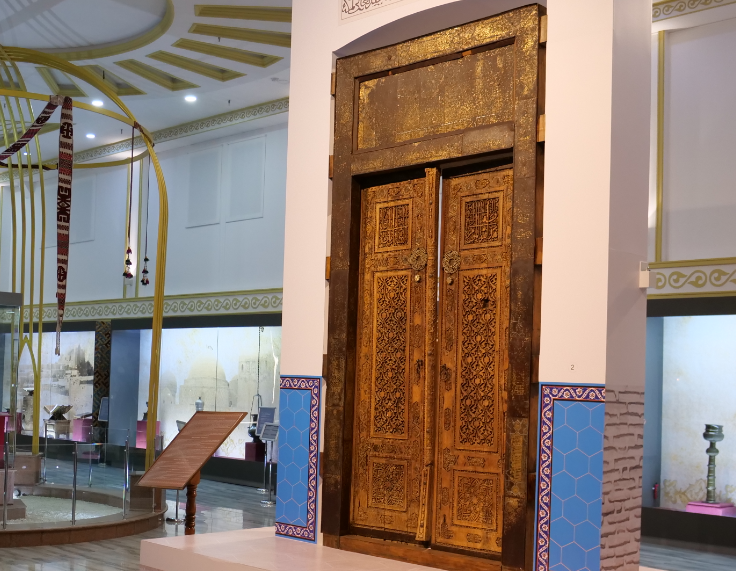
One of the two doors of the mausoleum that has survived since the 14th century is the door to the mausoleum’s burial chamber (kabyrkhana). This door represents an outstanding example of medieval carved art. The door is double-leafed, decorated with inlays of small bone elements; its jambs are covered with metal sheets on which inscriptions are engraved and gilded. The Arabic and Persian inscriptions on the door were first fully read, scientifically described, and translated into Kazakh by the textologist researcher Saipulla Mollakanaqatuly. In the upper part of the door, within two square frames, among carved floral and leaf ornaments, there is a hadith of the Prophet (peace be upon him) written in sulus script (Arabic calligraphy). In the middle part of the door, on a half-column, there is a phrase written in Persian in kufic script: “May it be blessed.” On two bronze plates located on the surface of the door, inscriptions are written in sulus script along a circular path. On the metal overlays framing the door jamb, the texts are also inscribed in sulus within geometric medallions that encircle the entire door.
Tomb Door