In 1227, when Genghis Khan divided his vast empire, which was under Mongol rule, between his four sons, the city of Yasi passed into the possession of his second son, Chagatai. The lands that went to the eldest son, Jochi, later formed a state known as the Golden Horde, which at its height included Western Siberia, Northern Khorezm, Volga Bulgaria, the Northern Caucasus, Crimea and vast territories from the Irtysh River to the Danube. The city of Yasi, located on the southeastern border of this great empire, was not part of it. Given this historical fact, it is not surprising that Golden Horde coins are extremely rare during excavations in Turkestan and its environs.
Today we present information about the Golden Horde pool, stored in the numismatic collection of the National Historical and Cultural Museum-Reserve «Aziret Sultan». The coin was donated to the museum fund in 2004 by N.Dosmetov, a resident of the city of Turkestan. There is no information about where and under what circumstances this coin was found.
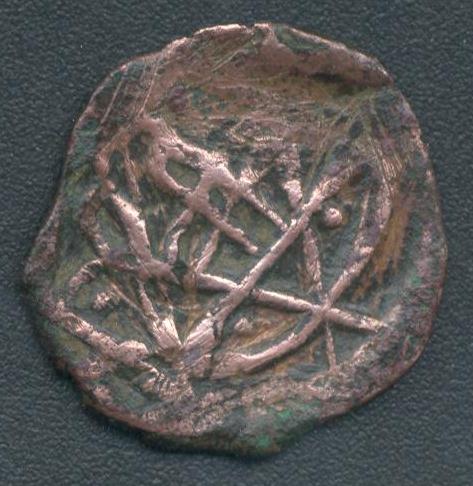
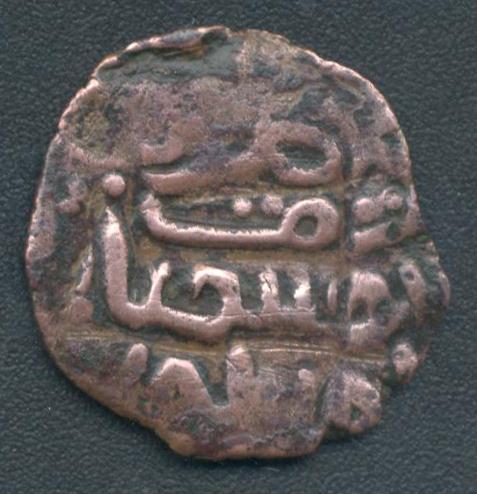
The coin is a White Horde pul, cast from copper. This coin was minted at the Sygnak mint. The state of preservation is poor. The edges of the round coin are chipped and nicked, the shape is deformed. On a significant part of the obverse, the relief images are erased. On the lower rim, the numbers indicating the year of minting are partially lost. The reverse pattern is almost indistinguishable. Based on the remains of the inscriptions and ornamentation, the coin typologically corresponds to the puls minted at the Sygnak in 727, 728 and 738 Hijri.
On the obverse, in the center of the coin’s circle, in a square cartouche in 3 rows is the inscription: «Zarb / Syganа / k» (the mark of the Syganak mint). In the lower part of the cartouche are engraved the numbers of the year of minting. No other relief signs are discernible.
On the reverse there are traces of a relief drawing, which cannot be completely separated from the entire circle of the coin. Apparently, this is a drawing of a five-pointed star with dots between the rays, minted at the Syganak Mint in 727, 728 and 738 Hijri. However, the coin we are describing has many additional linear reliefs in addition to the drawing of a five-pointed star.
Examples of this type of Syganak coins are found in the works of R.Z.Burnasheva, S.M.Yusupov, A.V.Pachkalov. In our opinion, the abundance of traces of extra lines in the described sample of the pool is caused by a defect made during the double strike of the stamp when minting the coin. The trace of the strike left by the double strike is also visible on the obverse of the coin. Such defects were common in coin minting in the Middle Ages.
T.Zholdasov, Junior Researcher