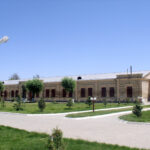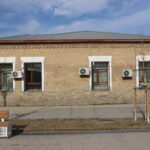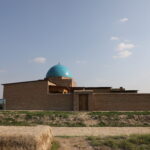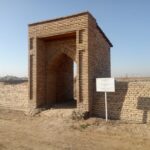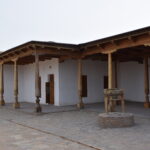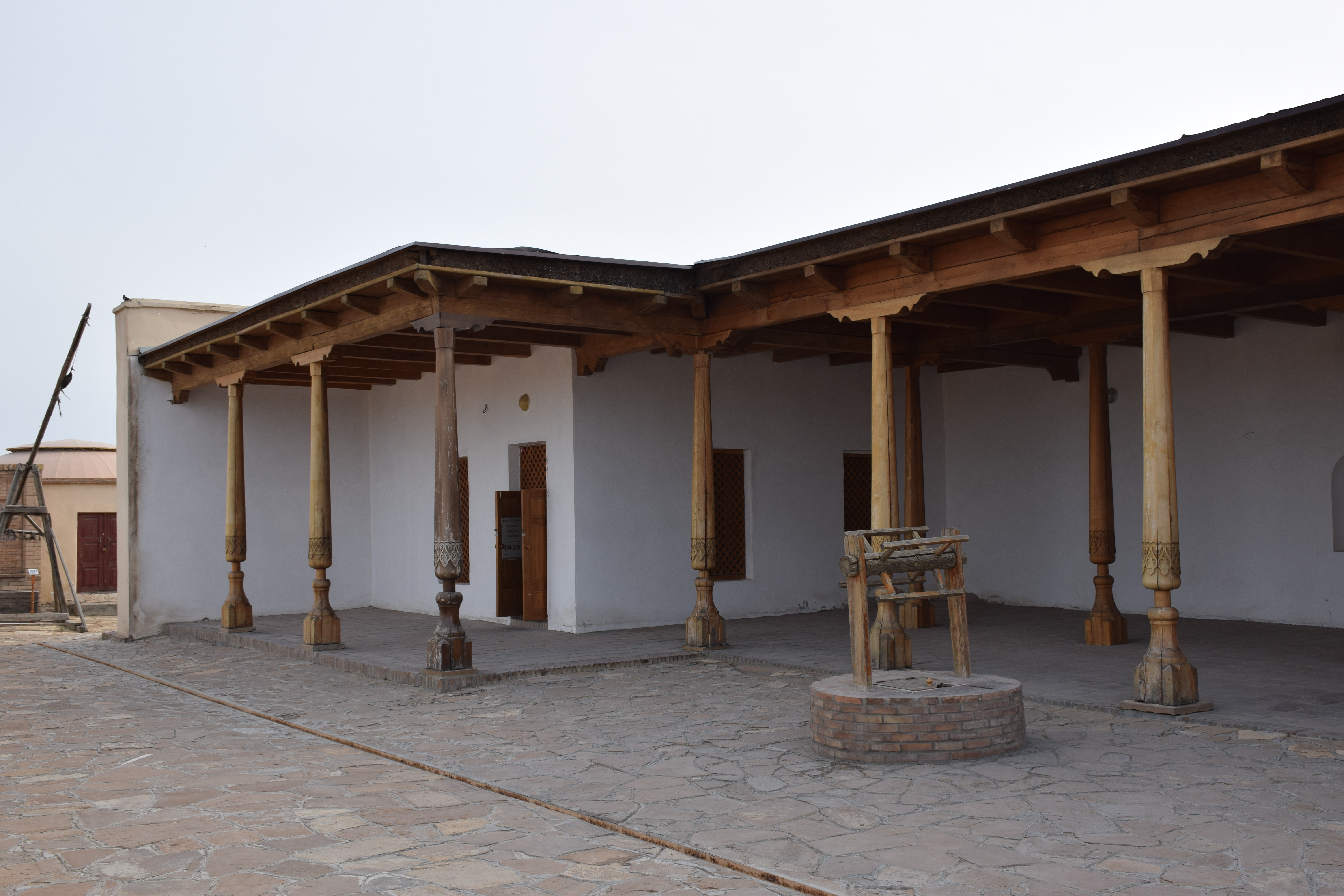
The mosque Juma (jumu’ah) of Turkistan is located 120 meters from the Mausoleum of Khoja Ahmed Yasawi, next to the underground mosque Kyluiet. It is a monument of republican significance. Coordinates: 43˚17.767΄, 068˚16.244΄. The mosque is a single-room structure with an annex adjoining its northern and northeastern façades. According to legend, this was the house where Khoja Ahmed Yasawi lived with his family. The interior height of the building is 4 meters, and the height of the mihrab is 2.3 meters. The walls of the mosque are 6.2 meters long. In the second half of the 19th century, the building was reconstructed and used by the local population as a mosque. From 1982 to 1998, the premises of the Juma Mosque housed the Archaeological Finds Museum. In 2000, the mosque was restored and reconstructed in the form it had in the 19th century. The exhibition was renewed as well, and today it displays artifacts from the museum’s collection related to the mosque’s history and other archaeological objects.
Until the 1960s, the mosque was known as Kyluiet Mosque. At that time, it was the largest and main mosque of the town. In the 1960s, after a large mosque was built on the road leading to Shymkent, the functions of the central mosque were transferred there, along with the name (the new building is now being reconstructed with a circular plan). After the transfer, the mosque Juma (jumu’ah) served for a time as a mahalla (neighborhood) mosque. In the 1970s, when restoration of the Yasawi Mausoleum began, the mosque was closed, repaired, and the building was used to house the design department of the Turkistan Special Scientific Restoration Workshop. After the department moved to a new location, restoration work was carried out here, and on the initiative of Uzbekali Zhanibekov, was opened the Museum of Archaeological Finds. Despite numerous destructions and reconstructions since the 12th century, the mosque’s artistic features retained characteristics typical of the Sufi tradition. A distinctive feature of Sufi mosques is the absence of Quranic inscriptions in and around the mihrab, instead, pomegranate branches with nightingales—symbols of paradise, were depicted on both sides. Until the 1980s, such images were preserved on both sides of the mihrab and on three small niches of the rear wall of the large annex in the courtyard. All the paintings were made in blue paint. After the relocation of the mosque, their photographs and tracing-paper copies were preserved in the archive of the “Kazproektrestavratsiya” Institute. The ceilings and annex beams were decorated with ornamental painting, and the supporting columns and doors featured carved designs. However, during the restoration and complete reconstruction of the mosque in 2000, all these elements were lost. The complete rebuilding became necessary because the wooden structures and walls had been damaged by termites and were in an emergency condition. Nevertheless, based on the archival materials of “Kazproektrestavratsiya”, specialists are confident that the mosque can be fully restored in its 19th-century appearance.
Литература:
- Жұма мешіті, ХІХғ. // Түркістан өңіріндегі тарихи – мәдени ескерткіштер. А., 2016. 14-15 бб.
- Жұма мешіті // «Әзірет Сұлтан» энциклопедиясы, І-том. Түркістан, 2021. 151-152 бб.
- Мечеть Джума // Свод памятников истории и культуры Казахстана. Южно-Казахстанская область.
- Жұма мешіті // Түркістан энциклопедиясы. Астана, 2023. 81-82 бб.