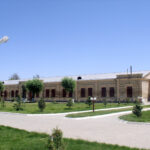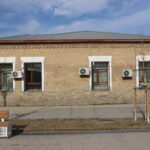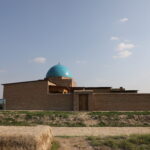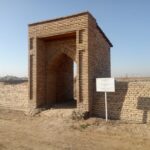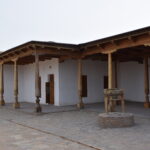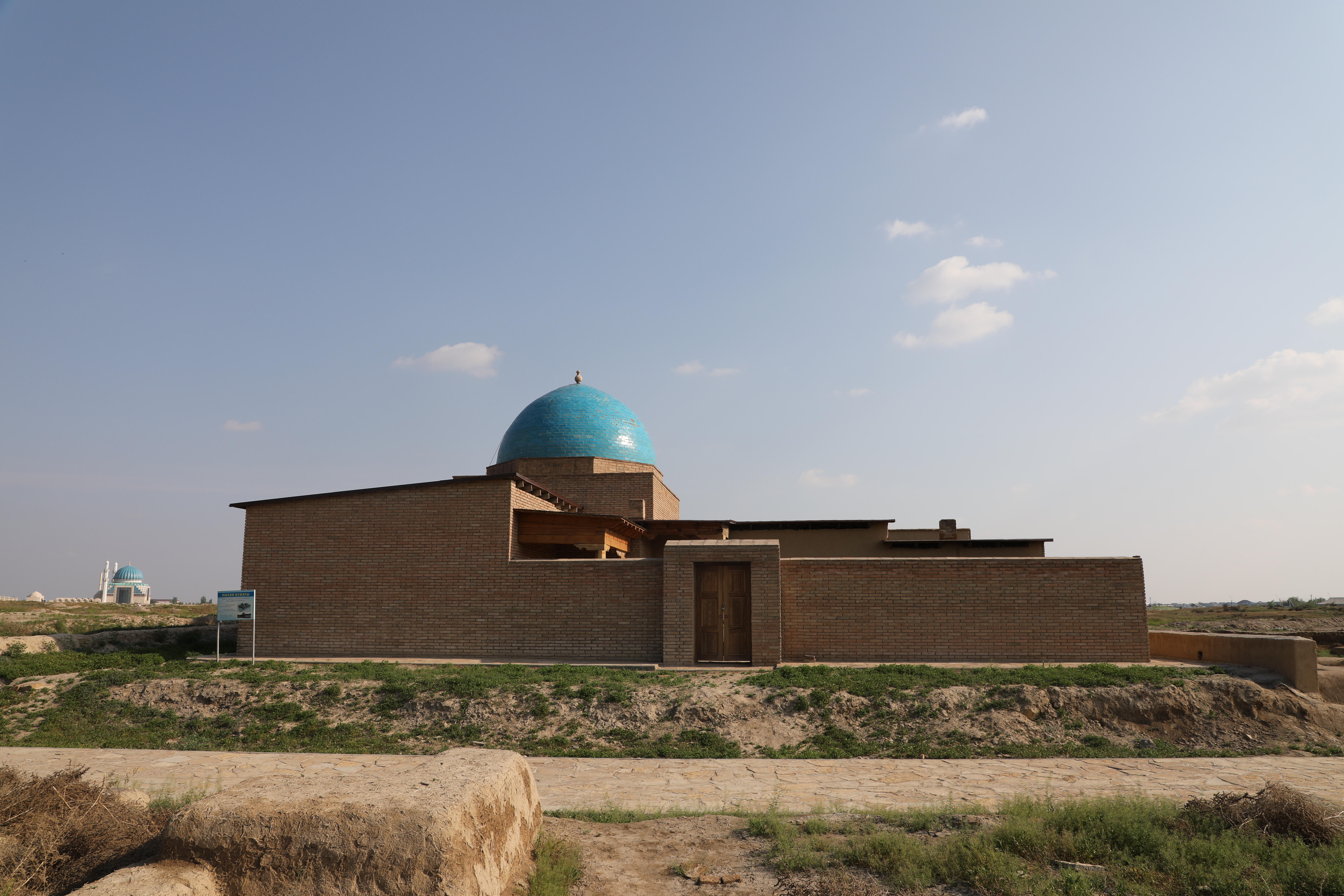
The Khan Mosque is located 300 meters west of the Mausoleum of Khoja Ahmed Yasawi. Coordinates: 43.2968824, 068.2660215. It was considered the place of prayer for Kazakh khans, their relatives, close associates, servants, and guests. In addition to the main Jami mosque, which served the local residents, on its street-facing side there were separate rooms and a courtyard for the prayers of high-ranking individuals — the Maksura. This section had its own mihrab and a separate imam, as well as a private taharatkhana (place for ablutions). The khans and their entourage entered the mosque through special gates leading from the khan’s palace complex and performed the five daily prayers here.
Archaeological research uncovered and studied the mosque, the adjacent street, a heating room, a two-room dwelling, a courtyard, and a taharatkhana (ablution area). The complex was fully restored in 2015.
Let us now turn to a brief overview of the earliest mosques of Turkistan. The earliest mosque of Yasi (12th century) was located on the site of the present time Juma Mosque. Here stood the house of Ahmed Yasawi and his family, which, after his passing, his disciples transformed into a “mosque of the Sufis.” Unlike ordinary mosques, the mihrab of this mosque was decorated with depictions of pomegranate bushes with fruits and paradise nightingales painted in blue. There were no inscriptions, but a mihrab was also present in the courtyard.
The ruins of the second oldest mosque were believed to be a niche (a deep recess) in front of the entrance to the burial chamber of Hazrat in the “Qabirkhana” room. This was the central part of the 12th-century mosque, which occupied the space between the two corridors of the mausoleum (12–14 m). The “Kazandyk” room served as the mosque’s courtyard, with a well located in its center under the cauldron, which has survived to this day. In 1997, the well was excavated, and gypsum tiles that once decorated the mausoleum’s walls, along with other artifacts, were discovered. However, at a depth of 7.5 meters, excavations had to be stopped due to rising groundwater. Later, a structure was built above the well, where the cauldron was placed.
Kyluet, Small Kyluet, Shildekhana, and Kumchik Ata were not considered mosques, they were places for Sufi rituals. A man named Haji Akhmet built the Zhaudir Ana Mosque at the same time as the Mausoleum of Yasawi in 15th century. Moreover, between 1500 and 1510, the khan Muhammad Shaybani also built a mosque in Turkistan. The Bukhara khan Abdullah II (from the Shaybanid dynasty) erected another mosque in 1583–1598. The Kokand khan Khudoyar (1845–1875) built a mosque near the mausoleum of Alkhodzha Ata, known as the Khan Mosque.
Even more opposite the Zhaudir Mosque were existed Blue Mosque. In the Togan district there were the Seyitmurat, Kalmet, Zhabagy, and Amir-Paluan mosques. In the Kultobe area stood the Bazaar Mosque and the Kultobe Mosque. Near the Zheti Ata Gate was the The mosque of Bab Arab .
According to the research of A. I. Dobromysslov, in the city and its surroundings there were: in 1864 — 20 mosques; in 1896 — 41 mosques; in the 1920s — more than 60 mosques.
Литература:
- Тұяқбаев М., Өсеров Т., Мұсабаев Қ. Түркістан археологиялық отрядының 2013ж. «Хан мешіті» орынында жүргізген қазба жұмыстарының есебі. Түркістан, 2013. «Әзірет Сұлтан» қорық музейінің Археология және ескерткіштерді қайта қалпына жаңғырту бөлімінің архиві.
- Тұяқбаев М. Түркістан археологиялық отрядының 2013ж. қазба жұмыстары // «Марғұлан оқулары -2014», Алматы-Павлодар, 2014. 229-237 бб.
- Хан мешіті, ХҮІІІ-ХХғғ.// «Әзірет Сұлтан» энциклопедиясы. І-том. Түркістан, 2021. 340 б.
- Хан мешіті // Түркістан энциклопедиясы, І-том. Астана, 2023. 201 б.
- Фазлаллах ибн Рузбихан Исфахани. «Михман-наме-ий Бухара» М.,1976. – С.140-143.
- Добромыслов А.И. Города Сыр-Дарьинской области. Чимкент, Туркестан… Таш.1912. – С.34-36.