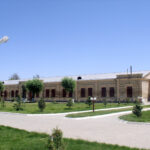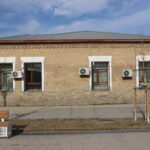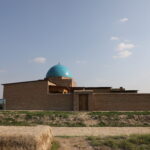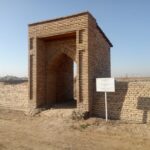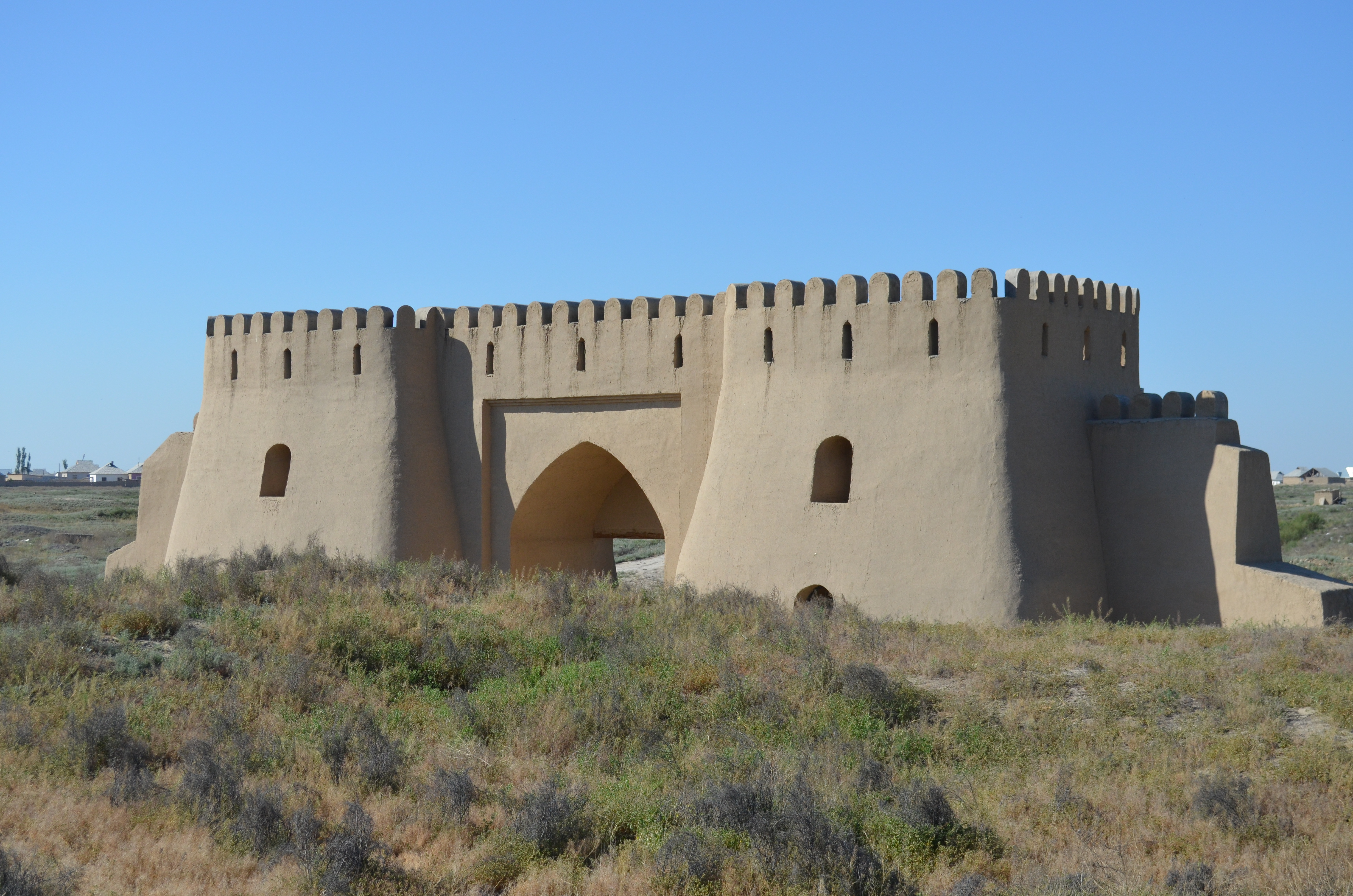
The gate Takia is located 800 m from the mausoleum of Khoja Ahmed Yasawi. Coordinates: 43.2928147, 068.2660778. These gates, called “Takiya” or “Ishan”, are marked on a map of 1864, which indicates that they were situated to the southwest of the city and surrounded by a moat filled with water. Information about the gates was collected during the excavations of the Turkestan Archaeological Expedition in 2009. A distinctive feature of the gate is that its towers are not round but quadrangular. Moreover, the corners of the towers are not sharp but rounded. The towers of the gate built in square or rectangular form are also found in earlier periods. For example, in the city of Begram in northern Afghanistan, the towers were rectangular (2nd century BCE – 4th century CE). In the city of Kampyrtepe in Uzbekistan, the towers also had square and rectangular shapes (3rd century BCE – 3rd century CE). Moreover, an ancient Nisa in Turkmenistan was completely surrounded by massive fortress walls strengthened with half-rectangular towers (3rd century BCE – 3rd century CE). Along the Syr Darya, the gates of the city of Altyn Asar had square towers, while the towers of the city of Alyp were built in the form of squares with rounded corners (1st–6th centuries). In Kulan, the castle towers were rectangular in plan at the corners and projected outward (7th–8th centuries). Similar gates are also encountered in the Late Middle Ages (15th–18th centuries). One of such gates dated to the 18th century has survived in Bukhara. Consequently, the Kokand Khanate might be employed master builders from different regions during the construction of the 3.5 km-long fortifications around Turkestan, After all, in other Uzbek cities, apart from Bukhara, gates are with quadrangular towers not found. The foundation of the gate has been preserved very well, and the additional rooms attached to the inner side and the fortress walls converging from both directions (width — 2.5 m, height — 6 m) were studied. The name of the gate “takiya” is interpreted in the Arabic–Persian dictionary as a “place where dervishes, Sufis, and their murids gather to perform dhikr”. The well-known scholar A. Mashanov explained “takiya” as a “guest house” (for example, the “takiya” of Kunanbai in Mecca). In Arabic–Kazakh explanatory dictionary are given several meanings by N.D. Ongdasynov: 1. a dwelling for wanderers and travelers (which coincides with Mashanov’s interpretation “guest house”); 2. a residence for dervishes; 3. support, foundation. In the Tatar “Muslim Terminology Dictionary” two meanings are provided: 1. “takiya” is concealment of one’s faith in case of danger; 2. residence (monastic dwelling). In the Azerbaijani dictionary of Arabic and Persian words published in Baku, “takiya” has three meanings: 1. support, foundation; 2. gathering place for dervishes and murids to perform dhikr; 3. “takiyanshin” — one who staying in a takiya. Therefore, although the dictionaries present different versions of meaning, the main sense is the same — “a dwelling of dervishes and murids, a place for dhikr”. Consequently, “takiya” is a type of “khilvet”, “tekke”, or “zawiya”. From this, we can conclude that by the time of the city gates construction in the 19th century (1843–1849), a structure of the “takiya” type already existed in this area, and such Sufi abode were traditionally located near mazars. In the 1952 map of Turkestan, opposite to the gates, on their eastern side, was a large “Ishan” mazar, which explains the double name of the gate — “Takia” and “Ishan”. Lets try to determine under which Kokand ruler the gates and fortress wall were built. Uzbek archaeologists believe that the 3.5 km-long fortifications and four large gates were constructed in 1843–1849. Turning to history, we see that during this period Shirali (Sherali) Khan (1842–1845) and Khudoyar (Kudayar) Khan (1845–1858) ruled Kokand. The Kokands had captured Turkestan from the Bukhara Emir under the Kazakh Khan Togai (1801–1816/20) and lost it during the reign of Aliken Khan (1858–1860).
Литература:
- Тұяқбаев М., Өсеров Т., Күмісбаева Қ., Мүтәшев Е. Ескі Түркістан қаласының Такия қақпасының тарихи орынында 2009ж. жүргізілген археологиялық зерттеу жұмыстарының есебі. Түркістан, 2009. Қорық – музейдің архиві.
- «Қырық қақпалы Қарашық», «Төрт Қақпалы Түркістан» атауларының шығу тегі жайлы. // «Ясауи мұрасы» газеті. 2019ж., шілде, №7, 3-бет.
- Тәкиә қақпасы // «Әзірет Сұлтан» энциклопедия. І-том. Түркістан, 2021ж. 314 – бет.
- Сөздіктер: Оңдасынов Н.Д. Арабша-қазақша түсіндірме сөздік. 1-том. А., 2011. 143-144 бб; Сафиулина Р.Р. Словарь мусульманской теминологии. Казан, 2006. 48 б,. – С. 105 (Татарско-русский вариант); Әрәб вә фарс сөзләри лүғәти. Бакы, 1966. 607б, 533б.
- Великий Шелковый Путь. Таш., 1999. – С.197, 221, 238.
- Байпаков К.М. Древние города Казахстана. А., 2005. – С. 33-35; 119-121