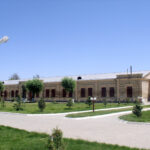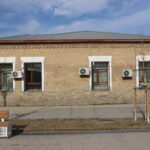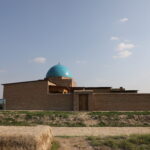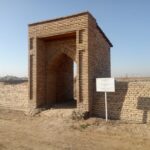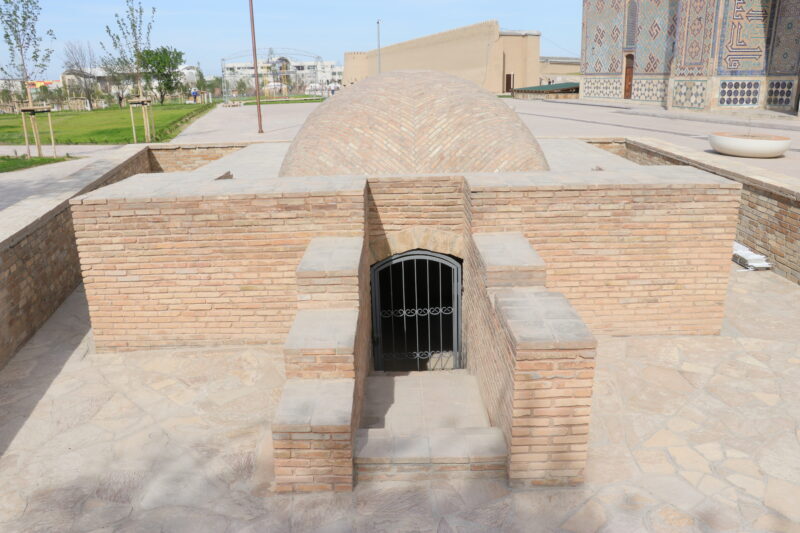
The structure is located 22 meters northwest of the Mausoleum of Khoja Ahmed Yasawi. It is a monument of republican significance. Coordinates: 43˚17.864΄, 068˚16.220΄. The word “Shildekhana” derives from the Persian “chehel”-“forty” and “khana” “house, room”, which together mean “the house where forty days are spent”. In 1958, a researcher N. B. Nemtseva was first investigate this religious and spiritual structure by the decision of the Council of Ministers of the Uzbek SSR, and was studied again in 1972–1973 by the Kazakhstani archaeologist T. N. Senigova, who obtained new data. During the first excavations, two stratigraphic trenches were laid along the eastern and western walls. Based on the results, it was concluded that the Shildekhana had been built in the 11th century. The excavations also uncovered walls preserved to human height, remnants of arches on all four sides, and the entrance doorway. However, the interior of the structure was filled with a layer of earth containing human and animal bones as well as fragments of bricks and pottery, and was therefore not studied at that time. This task was carried out during the repeated excavations of 1972–1973. The excavation measured 12 x 12 m and was located 22 m north of the mausoleum. After the 1958 works, the site was reburied, with construction debris from restoration works dumped into it: brick fragments, alabaster, lime, sand, stones, and clay. The southeastern wall was identified only with considerable effort; it was 1 to 1.1 meters thick. The bricks were laid with clay mortar, their dimensions being 25 x 25 x 5 cm and 26 x 26 x 5 cm. The interior of the wall was covered with a thick (2.5–3 cm) layer of alabaster plaster (gypsum). It gradually became clear that the building had a rectangular plan, measuring 6.78 x 5.04 m, with preserved walls up to 1 m in height. It is oriented west to east. In the corners of the rectangle were pylons, 95 cm wide and 1 m thick (vertical supports holding the arches on two sides). A dome rested on four arches. In 1958, the height of the western and eastern walls was 2.37 m, while the southern wall reached 1.96 m. At that time, the dome still rose 30–40 cm, but by 1973, this part had already collapsed. In the center of the western wall, was found a doorway 1.06 m wide, designed as a corridor 3 m long, which ending with a step leading outside and the threshold of the entrance door.
During excavations along the northern wall, were discovered reburied human bones and pottery fragments mixed with animal bones. All of this was covered by the collapsed northwestern wall. The vessels originate from the cultural layer of the 15th–16th centuries, characteristic of Turkestan and Otrar, while the structure itself was built in the 15th century. Initially, it served for religious rites, but from the 16th century onwards it was used as a burial place for the deceased brought from afar. In the 17th century here began to be dumped animal bones of slaughtered livestock prepared for “halim aba”; probably by that time the dome had already collapsed and the building had lost its original function. In the 1980s, local residents recounted that the Shildekhana had been built to test disciples who embarked on the Sufi path: here they underwent a forty-day trial. A person who had accepted Sufism spent forty days under the supervision of a mentor, perfecting his knowledge without leaving the underground chamber—performing prayer, reciting the Qur’an, studying hikmets, and engaging in dhikr. Only those who endured this ordeal could continue studying with a shaykh. Based on this, most likely the Shildekhana was built underground from the beginning. One of the elders said that in the 1930s–1940s there was an underground passage leading from the Shildekhana to the mosque of the mausoleum. As a child, he and others would descend into it and emerge through an opening in the floor of a small room in the western corner of the mosque’s mihrab, where they used to play. According to M. E. Masson and other Russian orientalists, in the evenings many people would gather in the mosque of the mausoleum to perform the loud dhikr (jahr). Authors’ of 19-century noted that the powerful sound of “Allah-hu”, uttered by the dhikr practitioners, could be heard throughout the entire city. Perhaps this tradition began as early as the 15th century, and the forty-day disciples of the Shildekhana may have joined the “jahr dhikr” in the mosque through the underground passage. In 1975, however, when drainage channels and wells were dug around the mausoleum, this passage was destroyed, and apparently, no traces of it remain.
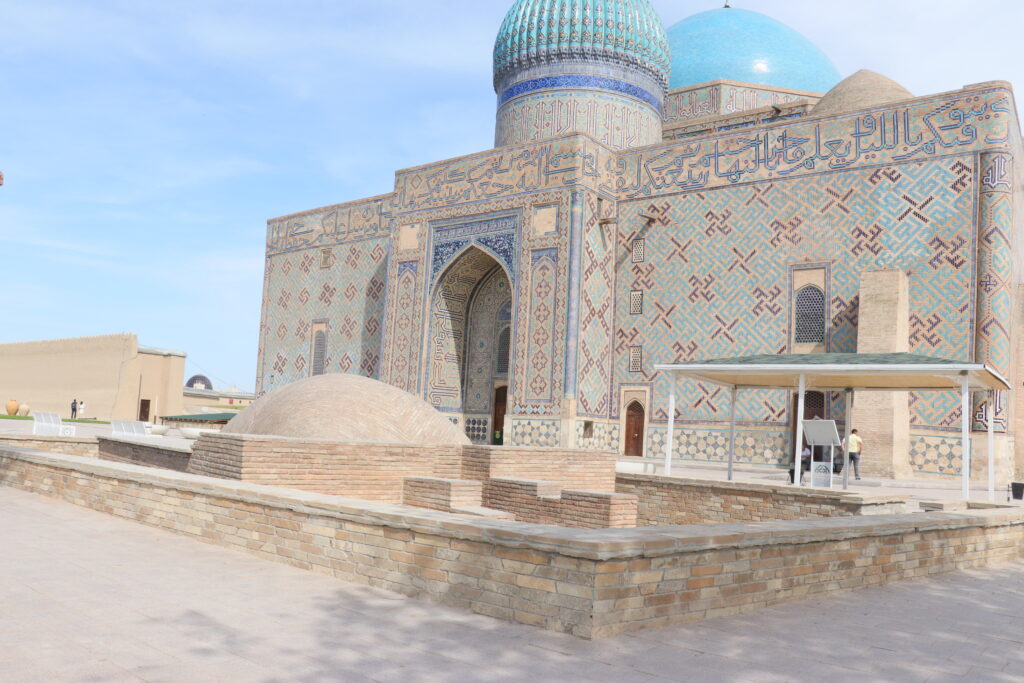
Regarding the forty-day trial, the Prophet Muhammad (peace be upon him) said: “Whoever spends forty days and nights in worship and service to Allah with sincere intention for His pleasure, Allah will cause streams of wisdom to flow from his heart to his tongue”. Following this instruction of the Prophet, the followers of Khoja Ahmed Yasawi once built cultic structures for secluded worship. Over time, the religious-architectural structure was completely ruined but was restored in the 1980s. The building has a rectangular plan and is partially buried into the ground. In the 12th–14th centuries it was constructed specifically for religious rites. In plan, the building is rectangular, located opposite the mausoleum. The walls were plastered with gypsum plaster, traces of which have also survived on the floor.