Today, at the “Aziret Sultan” National Historical and Cultural Reserve-Museum, the presentation of the carved wooden door of the Khoja Ahmed Yasawi Mausoleum — “Kapsyrma” — took place. Preserved in the Qabirkhana chamber since the 14th century, the door had undergone recent restoration at a scientific restoration laboratory in Almaty.
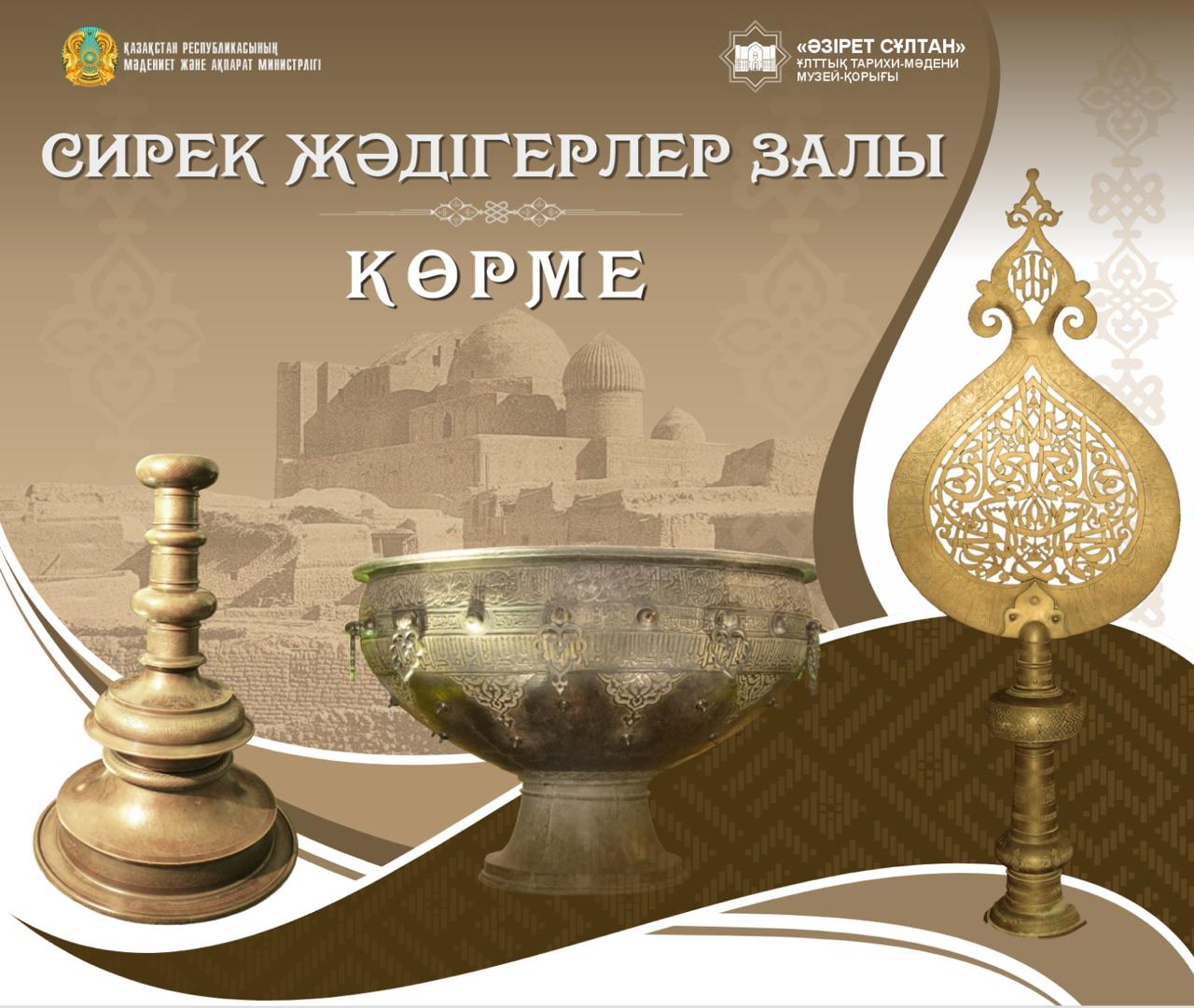
Following its restoration, the Qabirkhana door has now returned to Turkistan and has been placed on display in the “Museum of Rare Artifacts” exhibition of the “Aziret Sultan” National Reserve-Museum.
During the event, Omarkhan Abdullayuly, Head of the Department for the Protection of Historical and Cultural Values of the Turkistan Regional Department of Culture, and Murat Meirbekuly, Deputy Director for Scientific Work of the “Aziret Sultan” National Reserve-Museum, emphasized the importance of the restored door for the museum. Restorer Nurzhan Alimkhanuly from the Department of Architectural Restoration Works explained the details of the restoration process. Saipulla Mollakanagatuly, Head of the Yasawi Studies Scientific Center at the museum, provided an interpretation of the inscriptions found on the door.
Scientific research, launched in 2018, revealed that the sacred door, used for more than six centuries, had begun to deteriorate severely due to internal damage caused by pests. As a result, in 2021 the door was transferred to the “Ostrov Krym” Scientific Restoration Laboratory in Almaty.
The restoration was carried out under the guidance of Krym Altynbekov, a renowned artist-restorer and head of the laboratory. The project applied modern technologies such as 3D scanning, radiography, and neutron tomography.
As a result of meticulous work over five years, the door was thoroughly cleaned of centuries-old dust and pest damage, termite-eroded cavities were restored, and it was reconstructed in accordance with modern restoration standards. This not only ensures the further preservation of this sacred artifact but also allows for the study of the craftsmanship and spiritual worldview of its era, as well as the reading of inscriptions that had remained undeciphered until now.