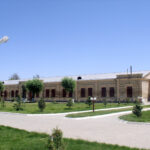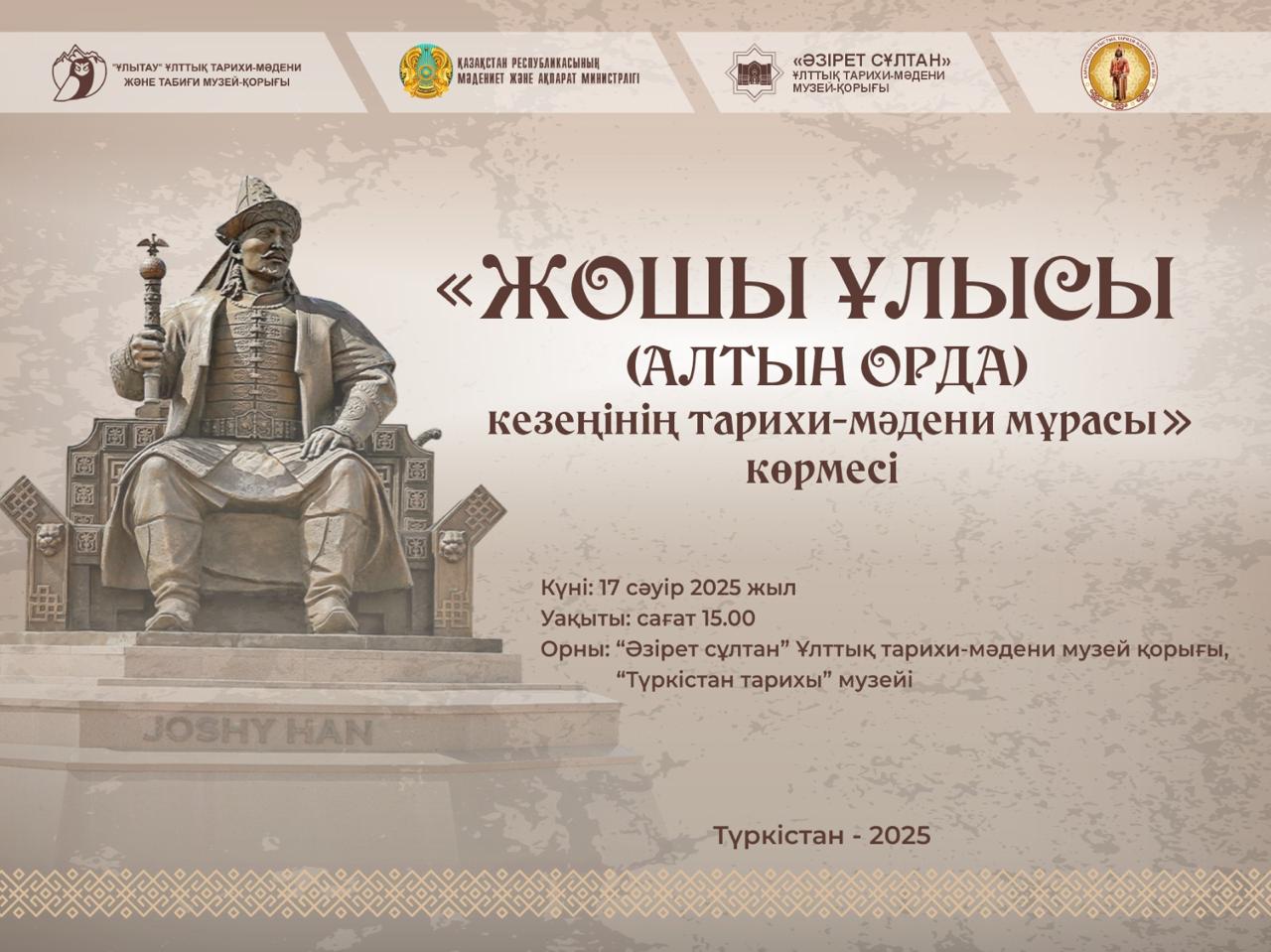
At the Turkistan History Museum of the “Aziret Sultan” National Historical and Cultural Reserve-Museum, the official opening of the exhibition “Historical and Cultural Heritage of the Golden Horde (Juchi Ulus)” took place. The event was jointly organized by the Committee of Culture of the Ministry of Culture and Information of the Republic of Kazakhstan, the “Ulytau” National Historical, Cultural and Natural Reserve-Museum, the Karaganda Regional Museum of History and Local Lore, and the “Aziret Sultan” National Reserve-Museum.
The ceremony was opened by Murat Tastanbekov, Deputy Director for Scientific Work of the “Aziret Sultan” National Reserve-Museum, Yerzhan Nurlanuly, Director of the Karaganda Regional Museum of History and Local Lore, and Aibolat Rakhmaniauly, Deputy Director of the “Ulytau” National Reserve-Museum. They highlighted the significance of the exhibition.
The main purpose of the exhibition is to present Kazakhstan as the rightful heir of the Golden Horde (Juchi Ulus) and as a state preserving the rich historical and cultural heritage of that era.
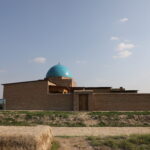
Currently, more than 10 historical and cultural monuments dating back to the Golden Horde period are preserved on the territory of the “Ulytau” National Reserve-Museum. Among them are the mausoleums of Zhoshy Khan, Bolgan Ana, Qulan Ana, Ayaqqamyr (Qutlyq Temir), Talmas Ata, Kelintam, Edige, as well as the sacred hill Altynshoqy and other significant sites.
Previously, the exhibition “Historical and Cultural Heritage of the Golden Horde (Juchi Ulus)” was presented in Astana, Almaty, and Zhezkazgan. Its opening in the sacred city of Turkistan, the former capital of the Kazakh Khanate — heir to the Golden Horde — carries special historical and cultural significance.
The exposition features ornamented bricks from Golden Horde mausoleums, wax figures of historical figures, the dome of the Zhoshy Khan Mausoleum, unique medieval coins, ancient maps, and other historical artifacts. In total, more than 120 exhibits from the three aforementioned museums are presented. The exhibition will remain open to visitors for one month.