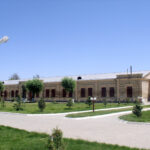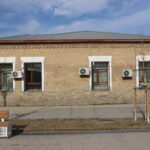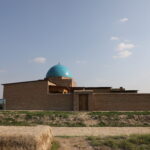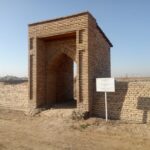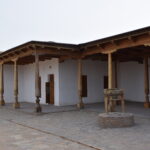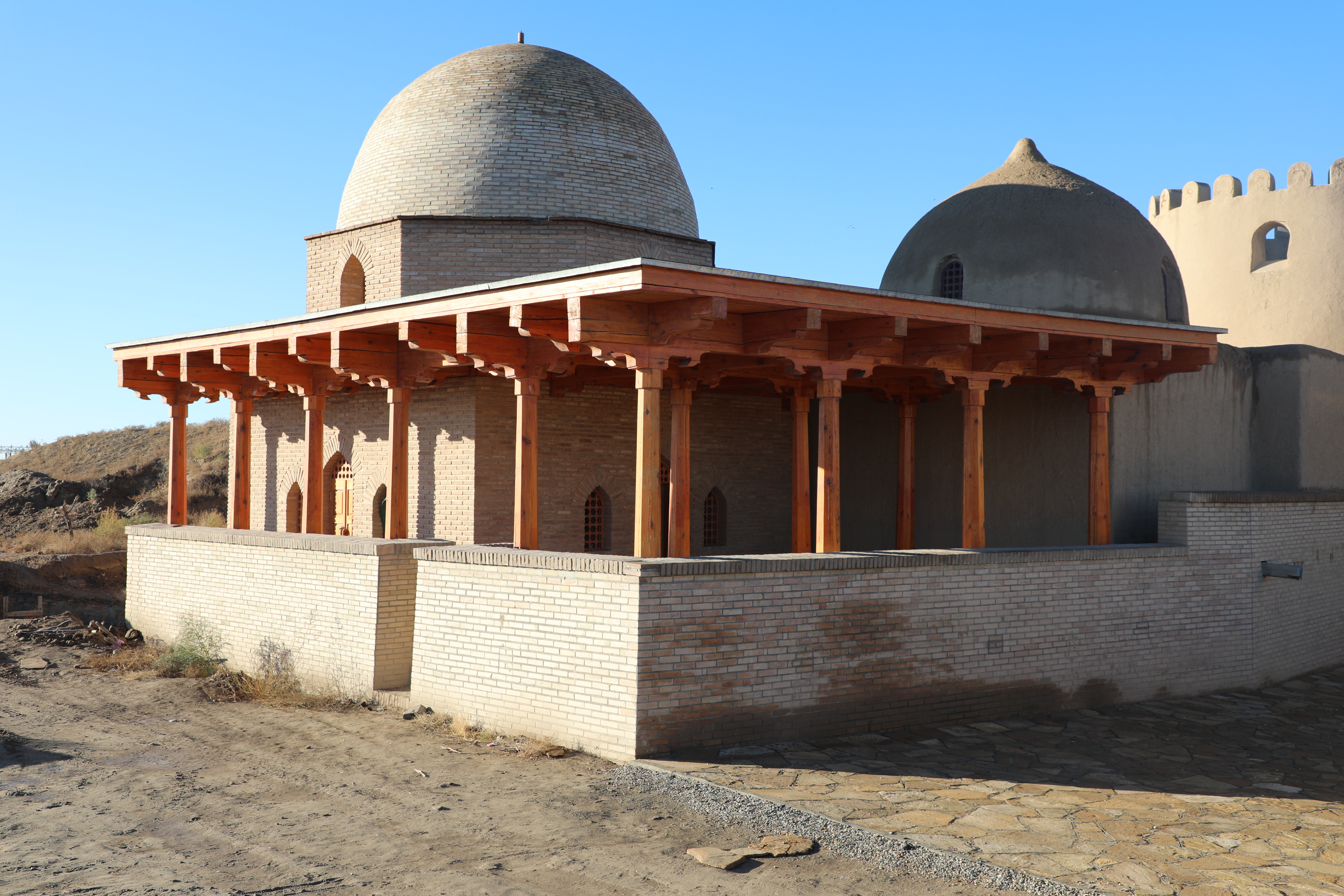
The The mosque of Bab Arab is located 620 meters from the Mausoleum of Khoja Ahmed Yasawi. Coordinates: 43.2966337, 068.2622416. The Bab Arab Mausoleum and Mosque were restored based on historical data collected during theodolite surveys of the gate in 2009 and archaeological excavations of the Zheti Ata Gate in 2011. During these works, the walls of the mosque built of baked brick were uncovered. Traces of the mosque and parts of its floor, paved with rectangular bricks, were also found. Due to many years of archaeological and archival research, in 2017, following the signing of a contract for design works within the territory of Turkestan, began the restoration of the Bab Arab Mausoleum and Mosque. In 2018, the mausoleum was completely rebuilt with the raising of its foundation.
Concerning “Bab Arab”, Orynbai Dastanov in his book “The Truth about the Holy Places” cites the following account of the spiritual elders: A man from Turkestan once went on a pilgrimage to Mecca, but he ran out of money for the return journey. Exhausted, he came to the tomb of Prophet Muhammad, embraced it and wept. One day, a man appeared to him and said that during the next Friday prayer, a black horse would be tied to a certain tree, and its owner could fulfill any wish. The pilgrim went to the tree, found the horse, and took hold of its reins, waiting for its owner. When the owner came after the Friday prayer, the pilgrim begged him to take him home. Feeling compassion, the man seated him behind himself and instructed him to close his eyes and open them only at his command. When the pilgrim opened his eyes, they were already in Turkestan. When asked about his name, the rider headed toward the “Hazrat Sultan” Mausoleum, and replied to the pilgrim’s question: “I am Bab Arab”, and immediately disappeared. The man returned home and told everyone what had happened. In honor of Bab Arab, he built a mosque on the spot where he had got off a horse.
The Baba Arab Mosque is situated on the southeastern side of the Zheti Ata Gate, near the mausoleums of “Baba Garip” and “Undemes Ata”. Beyond the city gates, over the moat, stood the “Babyrat Ata” Bridge, the names “Baba Garip” and “Babyrat Ata” are shortened and changed forms of the name “Bab Arab” Ata.
Archaeological excavations conducted in 2011 at the mosque site found the brick-built walls of the mosque at a depth of 2 meters, and remains of its floor. The walls measured 6х6 m, and a section of the floor, 4.6х3 m in size, paved with bricks measuring 28х28х5 cm, was preserved. The floor had been re-laid three times, indicating three major renovations of the mosque. The last renovation took place in 1908, when the small courtyard gate was rebuilt using so-called “royal bricks”.
In A. I. Dobromyslov’s work “Cities of the Syr Darya Region”, it is mentioned that in 1908, the The mosque of Bab Arab was rebuilt at the expense of Atakhan khoja Askar Kozhynov, who sought the title of sheikh al-Islam. Dobromyslov also notes that Bab Arab was a disciple of Ahmed Yasawi and the person who built a renowned madrasa in Bukhara. During the 1930s repressions, the mosque was destroyed, and the site began to be used as a burial ground. Such graves are also found within the mosque’s courtyard. The The mosque of Bab Arab was restored in 2015–2018, based on the excavations of 2009–2011.
The genealogical record (“Nasabnama”) of Baba Arab’s lineage is preserved by his descendant, Otegen Yskakuly Zholdybayev, who lives in Kyzylorda. According to this document, Bab Arab’s real name was Sabyr Malik, while Bab Arab and Baba Garip were his additional names, or, in Arabic terms, “nisba”.
Литература:
- Тұяқбаев М., Өсеров Т., Күмісбаева Ұ., Мұсабаев Қ., Мүташев Е. Ескі Түркістан қаласының Жеті ата қақпасы маңында 2009ж. жүргізілген археологиялық зерттеу жұмыстарының есебі. Археология және ескерткіштерді қорғау бөлімі архиві.
- Мұсабаев Қ. Баб Араб мешіті мен кесенесі орынында жүргізілген археологиялық зерттеу // «Қазақ хандығы тарихындағы Түркістанның орны» атты халықаралық ғылыми-теориялық конференция материалдары. Түркістан, 2015. 279-285 бб.
- Добромыслов А.И. Города Сыр-Дарьинской области. Чимкент, Туркестан. Ташкент, 1912. –С.46.