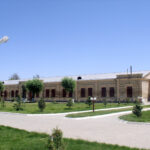
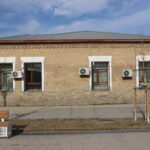
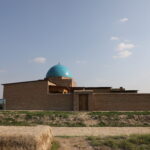
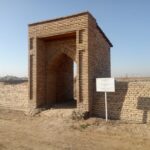
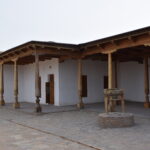
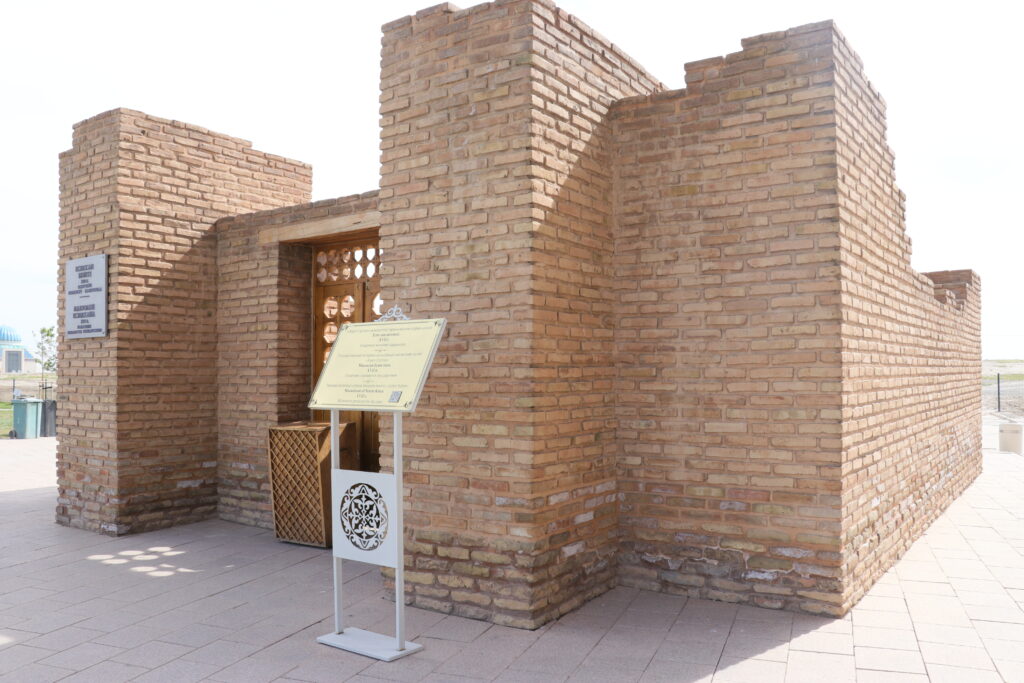
The Mausoleum of Yesim Khan is located 12 meters southwest of the southern tower of the Mausoleum of Khoja Ahmed Yasawi. It is a monument of national significance. Coordinates: 43˚17.835΄, 068˚16.275΄ This medieval architectural monument has been partially restored. The height of the tomb is 3.2 meters, and its width is 8.9 meters. Yesim Khan was a prominent political figure in the medieval Kazakh Khanate. In the memory of the Kazakh people, he remains an enduring symbol of courage, often referred to as “Yesim the Tall and Brave”. He passed away in 1628. In 1960, archaeologist G. I. Patsevich was the first to identify this burial site as the “Tomb of Yesim Khan”. Architecturally, the mausoleum is a modest square-shaped structure. Its main façade has been preserved in the form of a portal, adorned with glazed tiles featuring geometric patterns. The floor is laid with square bricks. No traces of plastering were found on the walls or the dome of the burial chamber (sagana). The preserved structural elements of the mausoleum reflect widespread funerary construction techniques typical of the region. The upper part of the structure was completely destroyed, and only the lower burial chamber (murdekhana) has survived. The first archaeological study of the mausoleum was conducted in 1958. Partial restoration was carried out in the 1980s. In 1994, the mausoleum was included in the Register of Historical and Cultural Monuments of Kazakhstan (South Kazakhstan Region edition) under number 590.7 and placed under state protection.
As for Yesim Khan himself, he was one of the twelve sons of Shyghai Khan. His mother’s name was Zhanimbike. He was born in 1578 and, at the age of 10, took part in the Kurultai (council) held in Sozak in 1588. During this gathering, his 26-year-old brother, Tauyekel Sultan, was proclaimed khan.
In 1598, the Kazakh army led by Tauyekel and Yesim reached a strength of nearly 100,000 engaged in campaigns for Tashkent, Samarkand, and Bukhara. This campaign involved 120 sultans who brought their own troops. Twenty-year-old Yesim Khan led a 20,000-strong army toward Samarkand, while 36-year-old Tauyekel Khan laid siege to Bukhara with a force of 70,000 to 80,000 men. The vanguard of this army was commanded by Kainar-Kushek Sultan, the son of their elder brother Ondan Sultan (who had died in 1583). The conflict, which is traditionally divided into spring and autumn campaigns, ended tragically: Tauyekel Khan was wounded and died in Tashkent, while Kainar-Kushek fell in battle. As a result of the war, Tashkent, Turkistan, and 30 towns along both sides of the Syr Darya came under the control of the Kazakh Khanate. The fallen warriors were initially buried temporarily in Tashkent. After Yesim Khan assumed full authority, around 1599–1600, he reburied his brother Tauyekel and the other fallen sultans and warriors in Turkistan. In 1603, Abd al-Ghaffar, a Karakalpak leader, proclaimed himself khan in Turkistan and defeated Yesim in a 12-day war. However, in 1605, during a battle near Tashkent in the Karakamys area, Yesim Khan personally killed Abd al-Ghaffar. Although Yesim ruled from Turkistan, Tursun Khan was still recognized as the senior khan in Tashkent. Later Yesim Khan moved to East Turkistan, where he lived until 1623. That year, at the invitation of Tursun Khan, he led his own troops in a campaign toward Andijan, after which he settled permanently in Turkistan.
Yesim Khan was a military leader frequently engaged in campaigns. During one of such campaign in 1626, Tursun Khan attacked his camp and capturing his mother, wives, and children. Tursun Khan had always mistrusted Yesim and feared his influence. Eventually, this distrust led to open war between the two army. Their forces clashed near the Sayram. Tursun Khan suffered defeat and retreated to Tashkent, where he was later killed by his own allies. This internal conflict led to war among the Kazakh tribes. Tribes such as the Naiman, Khongirad, Argyn, Dulat, Qataghan, Sirgeli, and others split and fought on opposing sides. The Qataghan tribe, which had fully supported Tursun Khan, was devastated. It was nearly wiped out — around 200,000 people perished, and the survivors either fled to Afghanistan or assimilated into other tribes such as the Khongirad. In 1626, Yesim Khan was once again recognized as the ruler of the Kazakh Khanate. He declared Turkistan the capital and carried out a series of state reforms, including the codification of laws known as “The Old Path of Yesim Khan”.
Earlier in his life, Yesim Khan, along with his brother Tauyekel and over 40 sultans, pledged allegiance to the Naqshbandi Sufi order in Bukhara. This decision was influenced by the fact that the Yasawi order, which prioritized the institution of biys (judges) in governance, limited the khan’s authority. Therefore, Yesim rejected the Yasawi tariqa. Renown scholar and Yasawi follower Z. Zhandarbek believes this affiliation with the Naqshbandi order explains why, except for Ablai Khan, Kazakh khans were buried not within the mausoleum of Khoja Ahmed Yasawi, but outside, nearby. As the scholar Kh. Tursun observed, this allegiance was reflected in Yesim Khan’s reforms: “The code of laws “ The Old Path of Yesim Khan ” marked a departure from the Turkic legal tradition laid down during the reign of Kasym Khan.”
Yesim Khan died in 1628 at the age of 50. He was buried in an underground chamber built opposite the Yasawi mausoleum, and a separate mausoleum was built above his grave in his honor.
Yesim Khan had many wives, but the exact number of his children remains unknown. His most prominent sons were Zhanibek and Zhangir, both of whom ruled as khans after him. His grandson Tauke Khan later ascended the throne. After Tauke’s reign, the throne passed to Qaip Khan (1715–1719), a great-grandson through another son of Yesim Khan named Syrdak. Later, his other descendants — Bolat, Sameke, and Abylmambet — also ruled the Kazakh Khanate.
References:
- Karibayev B. Yesim Khan. [Booklet] Published by the Azret Sultan Museum-Reserve. Turkistan, 2011. – 24 pages.
- Tuyakbayev M. The Historical Pantheon of Turkistan. In: Materials of the Conference Dedicated to the 70th Anniversary of M. Eleuov. Almaty, 2016. pp. 191–197.
- The Mausoleum of Yesim Khan // Register of Historical and Cultural Monuments of Kazakhstan. South Kazakhstan Region. Almaty, 1994. – p. 278. №590.7.
- Yesim Khan. The Mausoleum of Yesim Khan // Encyclopedia of Turkistan, Vol. I. Astana, 2023. pp. 66–67.
- Tursun. Yesim Khan // Turkistan — the Cradle of Spirituality: A Linguo-Regional Encyclopedia. Nur-Sultan, 2019. pp. 155–157.