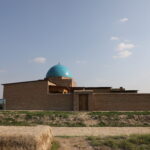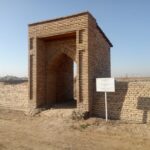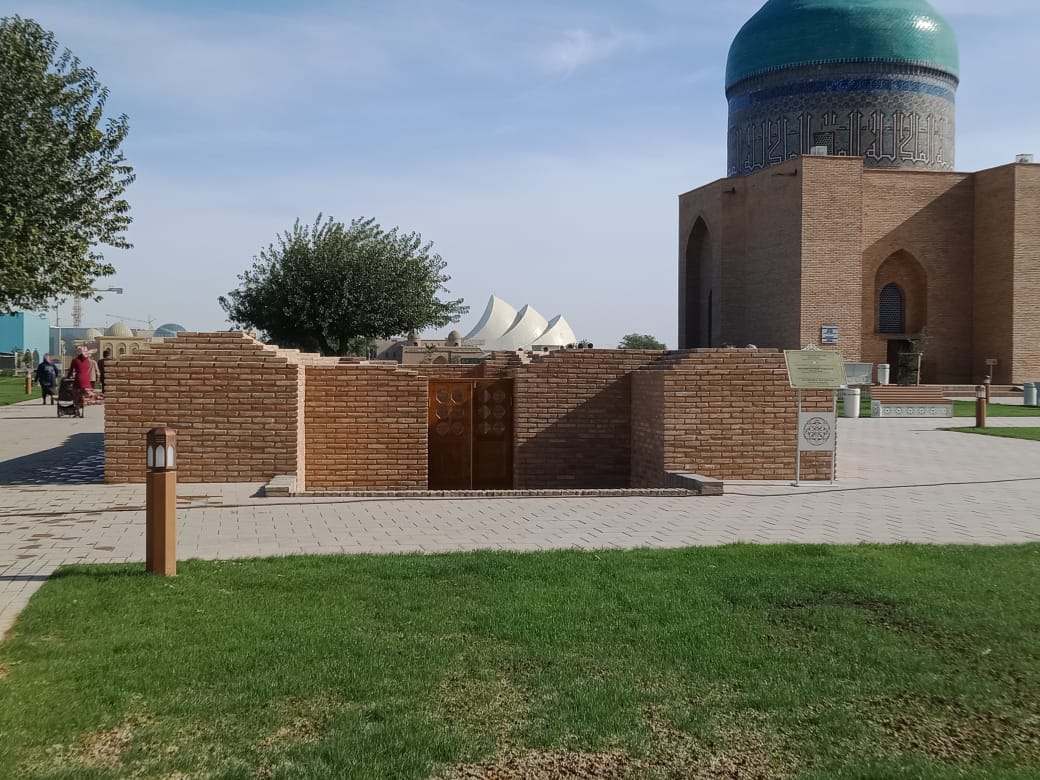
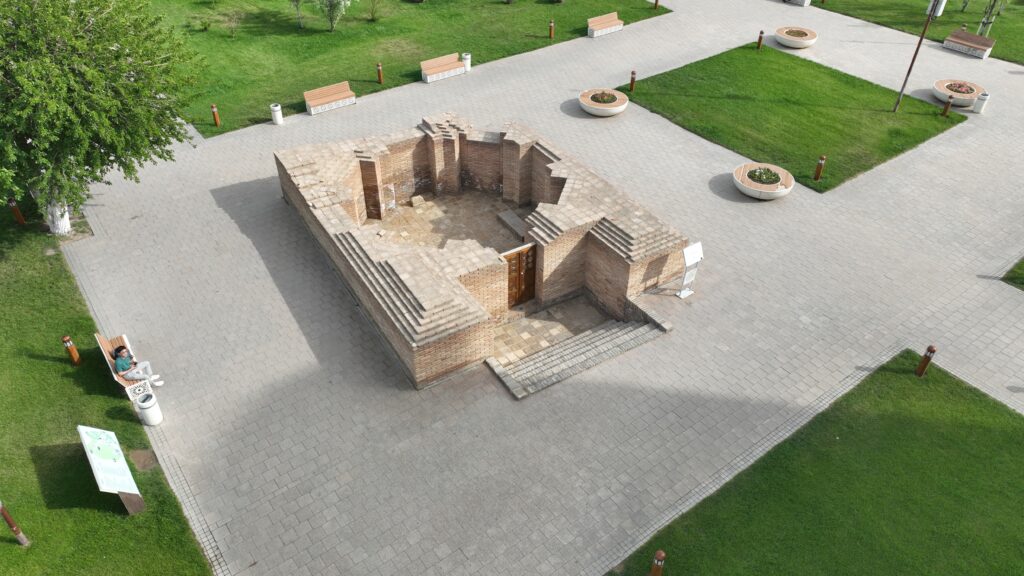
The Mausoleum of Tauke Khan is located 40 meters south of the eastern minaret of the Mausoleum of Khoja Ahmed Yasawi. Coordinates: 43˚17.837΄, 068˚16.301΄. It is a monument of Republican significance. Archaeological excavations in 1958 by N.B. Nemtsova, and in 1974 by T.N. Senigova, and in 1997 by Ye.A. Smagulov and M. Tuyakbayev revealed three burials inside the octagonal mausoleum. According to the research of archaeologist M. K. Tuyakbayev, the mausoleum was constructed in the 18th century in honor of Tauke Khan. At that time, the country faced increasing threats of Dzungar invasions, political decline, and a lack of unity among the rulers. In this difficult era, marked by economic decline and the lack of unity among sultans, khans, and biys, Tauke Khan died in 1715. Constructing a monumental structure would have been a considerable challenge at the time. It is believed that the original design envisioned a height of about 10 meters, but due to the absence of a solid foundation and unfavorable circumstances, the construction was likely left incomplete. This assumption is supported by the presence of simple sandstone gravestones and the absence of elaborate decorative elements. Furthermore, the mausoleum itself is merely a replica of the nearby Mausoleum of Rabia Sultan Begim, which points to a shortage of skilled stone carvers (bädīzshi), poets who inscribed elegies (marsiya), and experienced architects and dome builders.
The mausoleum’s final height reached only about 6.9–7 meters. It was topped with a single dome, while the portal reached approximately the same height. Construction began shortly after Tauke Khan’s death, and later his sons were also buried here — Bolat Khan, who died in 1727, and his younger son Sameke Khan, who died in 1738. In 2020, restoration works were carried out by Kazrestavratciya, during which the mausoleum walls were raised to a height of 2.5 meters.
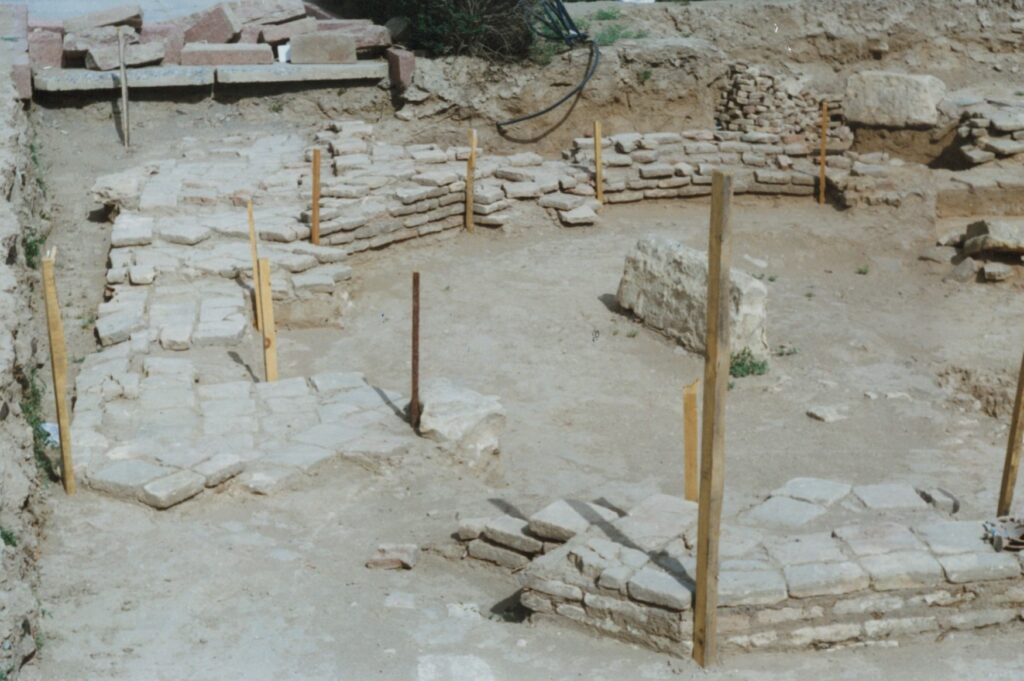
During excavations in 1958, archaeologist N. B. Nemtsova discovered human remains at a depth of about 0.5 meters. Anthropologist V.Ya. Zezenkova determined that the remains belonged to a man of the Mongoloid type, typical of Kazakhs and Kyrgyz. For a long time, scholars debated the dating of the mausoleum’s construction. N. B. Nemtsova dated the structure to the 16th–17th centuries, while A. N. Proskurin believed it belonged to the 14th century. However, both researchers overlooked the depth of the burials. Nemtsova based her conclusion on ceramic fragments found near the surface, while Proskurin assumed that the original entrance was located at the southern corner, suggesting a 14th-century origin, with the portal later shifted toward the northwest. More recent studies, conducted in 1974 by T. N. Senigova and in 1997 by E. Smagulov and N. Imazhanov, revealed that the current mausoleum was indeed built on top of an earlier structure. After Tauke Khan’s death, he was initially buried in the old mausoleum, and later after his sons were interred beside him, the structure was eventually rebuilt.
During the reconstruction, the floor level was lowered to a depth corresponding to the 16th century, as evidenced by the shallow positioning of the remains and the removal of a soil layer up to 1 meter thick. Therefore, the present mausoleum is dated to the 18th century.
References
- Tuyakbayev, M. Pantheon of Turkistan // Proceedings of the Conference Dedicated to the 70th Anniversary of M. Yeleuov. Almaty, 2016, pp. 191–197.
- Octagonal Mausoleum // Historical and Cultural Monuments of the Turkistan Region. South Kazakhstan Region. Almaty, 1994, p. 279, No. 590.9.
- Octagonal burial chamber // Historical and Cultural Monuments of the Turkistan Region. Almaty, 2016, p. 18.
- Tuyakbayev, M., Urkinbayeva, A. Mausoleums and Necropolises of Turkistan. Manuscript // Centre for Research on Islamic History, Art and Culture (IRCICA), 2023.