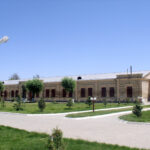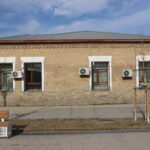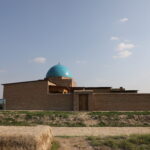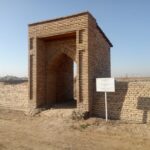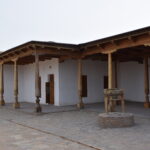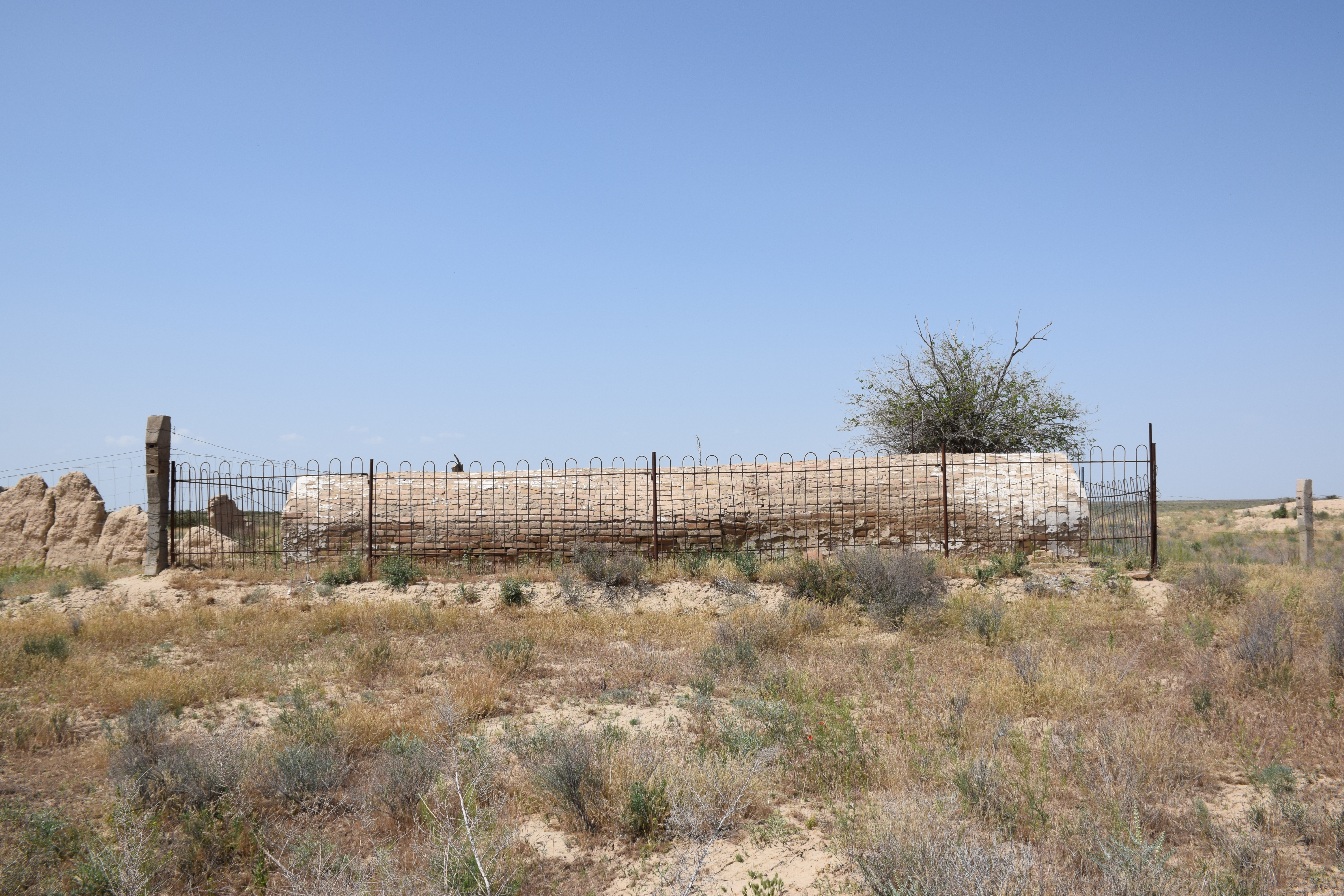
The Mausoleum is located 41 km northwest of the city of Turkistan, within the territory of the Zhibek Zholy rural district, about 600 meters southeast of the “Karatobe–Sauran” monument. Coordinates: 43˚28.952΄, 067˚47.081΄. The original structure has not survived; today remains only the tombstone made of fired brick. It is enclosed by a metal fence, nearby is located a well, the surrounding area has been landscaped. Dimensions of the tombstone: length — 10.2 m, width — 1.6 m, height — 1.5 m. In the surrounding area, the remains of ancient walls made of adobe bricks are visible. There are very few sources about Saduakas Ata. In one of the Timurid “waqf” (endowment) documents, he is referred to under the name “Hazrat Saghdi Waqqas”. There are two versions of his origin: according to one, he was a sahaba of the Prophet Muhammad and a prominent military commander; according to another, he was a descendant of Khoja Ahmed Yasawi. Apparently, earlier here were a mausoleum and a mosque, but today has survived only, the southern wall of the complex. The overall area of the necropolis is about 2.0 hectares, while the mausoleum itself occupies approximately 1–1.5 hectares. Here five rectangular areas enclosed by a wall, known as hazira, each containing mound shaped graves. These tombs oriented from north to south, and feature entrance openings on the southern side, and were probably family burial crypts. The central feature of the complex is the tombstone of Saduakas Ata. According to a waqf document issued by Timur during the construction of the mausoleum of Khoja Ahmed Yasawi, the descendants of Saghdi Waqqas were granted 10 hectares of land along the “Mir Karasu” canal for perpetual use. This document indicates that among the many revered saints of the region, only the descendants of three figures — Khoja Ahmed Yasawi, Sidak Ata (Shaidayi Sheikh), and Saduakas Ata (Saghdi Waqqas) — were allocated special waqf lands and water sources, highlighting their distinguished status among the numerous righteous figures of the Turkistan region in the 14th–15th centuries. According to local traditions, Saghdi Waqqas was engaged in the meat trade, and to this day he is revered as the patron saint (in Kaz: Пір (Pir)) of butchers in the Turkestan region. Saduakas Ata is also regarded as one of the nine revered saints (babs) of Sauran.
References:
1.Сәдуақас ата мазары // «Әзірет Сұлтан» энциклопедиясы. Түркістан, 2021. 286-287 бб.
2.Сәдуақас ата мазары, ХІІғ. // Түркістан өңірінің тарихи – мәдени ескерткіштері. А., 2016. 119-120 бб.
3.Қала төңірегіндегі // Байпақов К.М., Смағұлов Е.Ә. Ортағасырлық Сауран шаһары. А., 2005. 16-19 бб.
4.Смагулов Е. Древний Сауран. А.,2011.-С.32-40.
5.Добросмыслов А.И. Города Сырь-Даринской области. Чимкент, Туркестан…Таш.,1912.-С.38-43