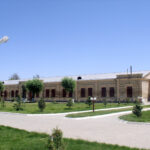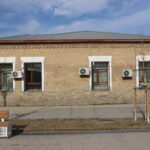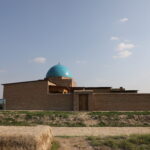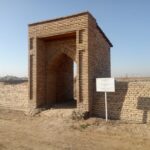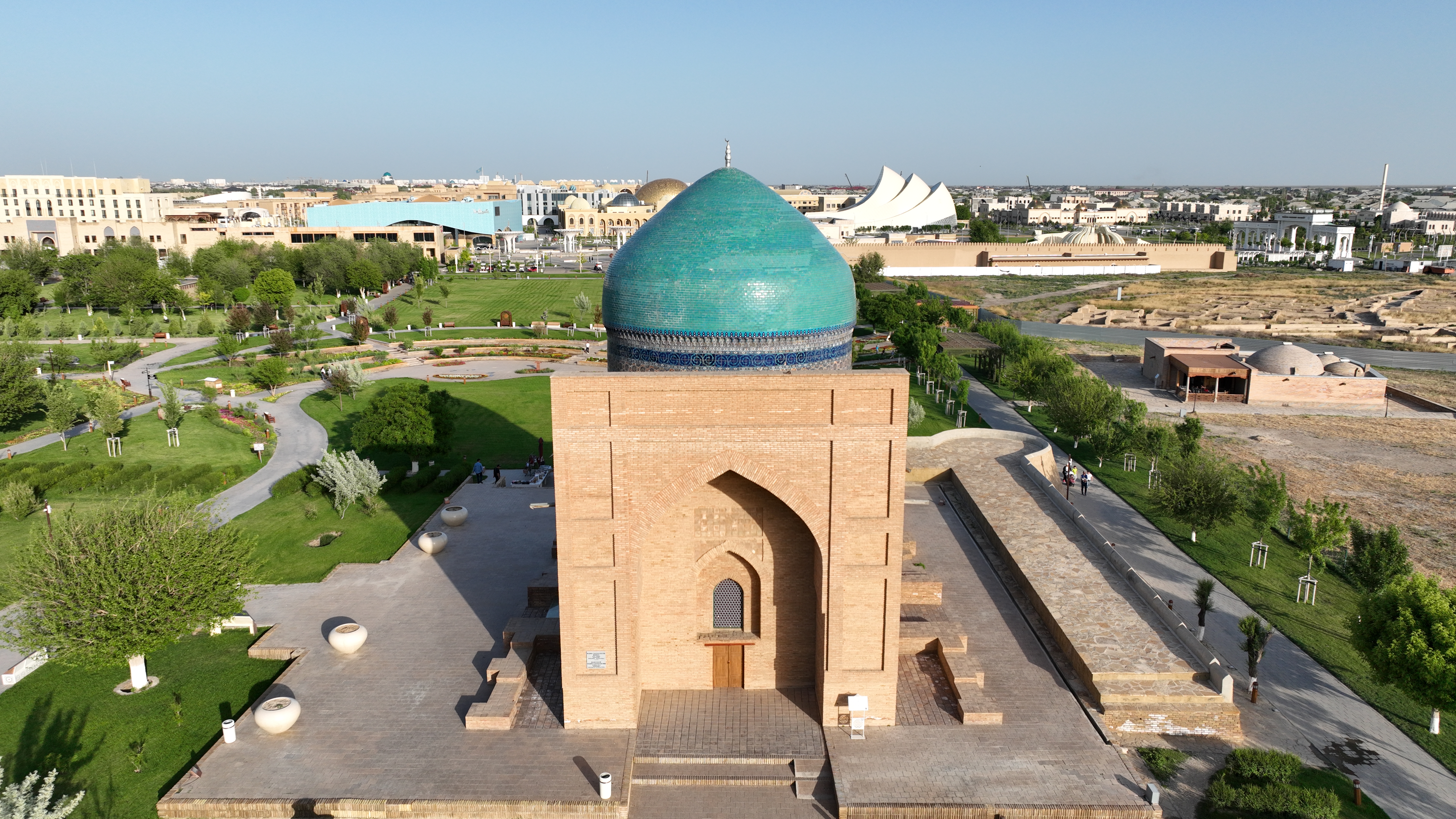
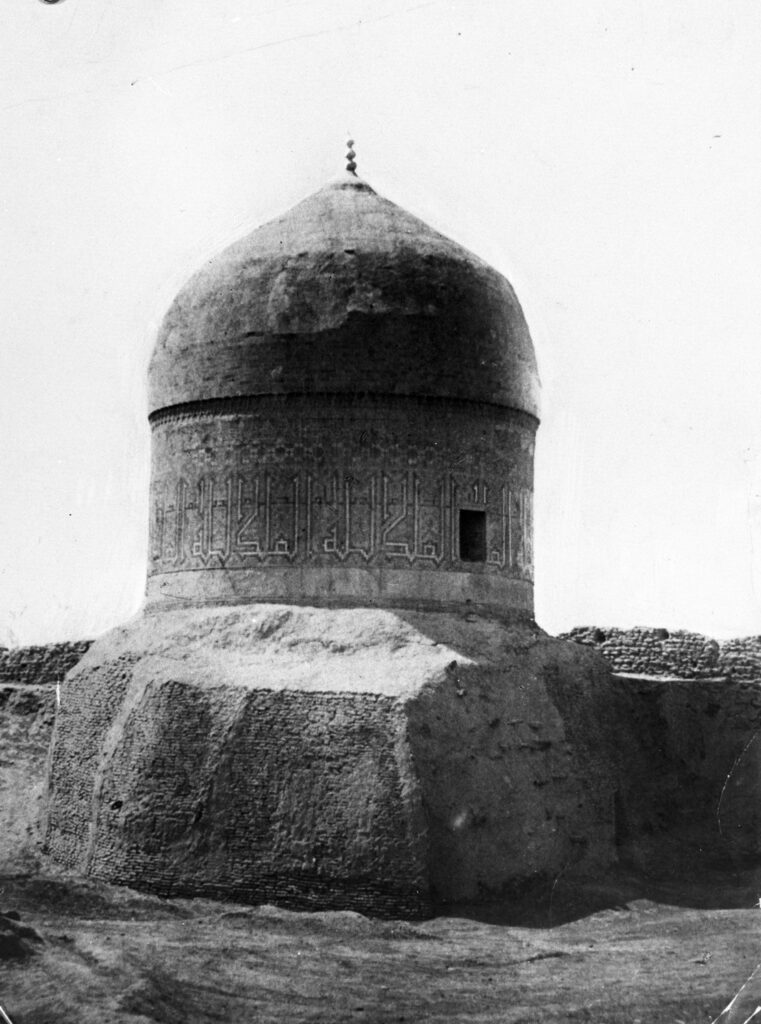
The Mausoleum of Rabia Sultan Begim is located 60 meters southeast of the Mausoleum of Khoja Ahmed Yasawi. It is a monument of national significance. Coordinates: 43˚17.830΄, 068˚16.317΄. Rabia Sultan Begim was a descendant of Amir Timur, the daughter of the renowned astronomer and scientist Ulugh Beg. She was married to Abu’l-Khayr Khan of the Shaybanid dynasty and was the mother of Khoshkinchi and Suinish Khans. After Abu’l-Khayr Khan’s death, she lived in Turkistan for 17 years, where she also passed away. She was buried in a specially constructed mausoleum, alongside her grandson and three great-grandchildren.The inscription on her tombstone reads: “This is the final resting place of the noble Rabiga Sultan Begim, the daughter of the powerful, great sultan Ulugh Beg Guragan, the son of Timur Guragan. God bless all their graves before the Day of Judgment.”
The façade of the mausoleum is built in the form of a high, pointed arch. Its height reaches 20.6 meters, and the width of the façade is 11 meters. The arch measures 6 meters across, and the distance between the adjoining sides is 3.5 meters. The middle part is made in the form of a cylinder and is covered with domes. The tomb consists of five rooms: an eight-sided central hall and four adjoining chambers. Other façades feature five arched niches each. The monument has survived to our time in a very poor, ruined condition. Archaeological research revealed large quantities of majolica and glazed tiles, suggesting that the entire structure was once richly adorned with polychrome ceramic cladding. K.A. Shakhurin conducted the first scholarly investigation of the site in 1954. Thanks to restoration work in 1980, the monument regained its original appearance. In 1994, the monument was included in the collection “Chronicle of Historical and Cultural Monuments of Kazakhstan” for the South Kazakhstan Region under number 590.7 and placed under state protection
Historical sources indicate that Ulugh Beg had five wives and thirteen concubines, from whom he had ten sons and ten daughters. His tenth son, Abd al-Latif—who would later rebel against him and his sisters Bakht Sultan, Ak Bash and Rabia Sultan Begim—were from Rukaiya Khatun (Sultan), a concubine and not a legal wife. She was the daughter of the chief of the Arlat tribe. Ulugh Beg’s mother, Gawhar Shad Begum, raised Rukaiya’s children. Since Rabia was the youngest daughter, her grandparents likely raised her as their own child. This could explain why her name is absent from official genealogies of the Timurid dynasty and lists of Ulugh Beg’s daughters. Nonetheless, she is mentioned as his daughter in works such as Tarikh-i Abu’l-Khayr Khani, Sharaf-name-yi Shahi, and other sources. Ulugh Beg was born in 1394 and at the age of ten in 1404, he married to Uka Begim. Over time, he took four more wives and thirteen concubines. Rabia Sultan Begim, most likely born between 1420 and 1430, was the tenth daughter born to Rukaiya.
Rabia Sultan Begim married Abu’l-Khayr Khan in 1451. At the time, the he was 39 years old, and Rabia was approximately 26–30. Abu’l-Khayr Khan died in 1469 at the age of 57. Rabia lived 17 years and passed away around the age of 60, in 1485.
Their sons, Khoshkinchi and Suinish Khans, held important state positions in their time. In 1508, when Muhammad Shaybani Khan arrived in Bukhara, he distributed territories among his relatives: Khoshkinchi Khan was given authority over Turkistan and its surrounding region, while Suinish Khoja Khan received Tashkent.
After Shaybani Khan’s death in 1510, his cousins Suinish Khoja Khan and Khoshkinchi Khan governed the state for the next twenty years. Khoshkinchi resided in Bukhara, while Suinish ruled in Tashkent and Turkistan.
Rabia Sultan Begim died in 1485. Her son Suinish Khan passed away in 1525, and his son Keldi Muhammad Sultan died between 1529–1533. Keldi Muhammad’s sons—Kul Muhammad Sultan (d.1523), Mubarak Shah Sultan (d.1519), and his daughter Mastura Khanum (d.1519)—all died young and were buried in Turkistan. Except for Suinish, the rest were interred in the mausoleum of Rabia Sultan Begim. Excavations by Uzbek specialists (1951–1957) revealed a woman and a man buried side by side, with three children between them. These three children likely died in early childhood, as their grandfather Suinish outlived them. The eldest appears to be Mastura, as the title khanum was usually given to married women, and girls were often wed as early as 9–10 years of age. Her great-uncle Ulugh Beg himself married Uka Begim at age ten.
The claim made by some historians (e.g., A.A. Semenov, L.Yu. Mankovskaya) that Rabia spent her entire life in Turkistan is likely inaccurate. A reference in the poem Tarikh-i Abu’l-Khayr Khani mentions Rabia’s high reputation and respect both among the peoples of Abu’l-Khayr’s khanate and his relatives. During her years with Abu’l-Khayr, Rabia was politically active and took part in state affairs. Historical sources even compare her to the wise Queen of Sheba (Bilqis) mentioned in the Bible.
References:
- Tuyakbayev, M. Historical Figures Buried in Turkestan. — Almaty, 2000. — p. 53.
- Tuyakbayev, M. Mysteries of Turkestan. — Almaty, 2000. — pp. 65–70.
- Historical and Cultural Monuments of the Turkestan Region. — Almaty, 2016. — pp. 8–9.
- Encyclopedia of Azret Sultan — Almaty, 2021. — pp. 279–281.
- Tuyakbayev, M. The Turkestan Branch of the Shaybanid Dynasty // 8th International Annual Conference “Industrial Technologies and Engineering” JCJTE-2021. — Shymkent, 2021. — pp. 283–287.
- Bobozhonov, B., Muminov, A., Paul, J. Inscriptions on the Shaybanid Tombstones. — Wiesbaden, 1997. — p. 119. (In three languages: Uzbek, German, and Russian), total 190 pages.
- Akhmedov, B.A. The State of the Nomadic Uzbeks. — Moscow: Nauka, 1965. — 194 pages.
- , pp. 128–133.
- Fazlallah ibn Ruzbihan Isfahani. Mihman-name-yi Bukhara. — Moscow, 1976. — pp. 142–143.