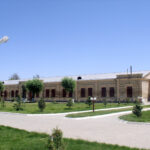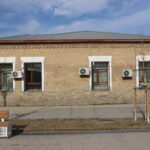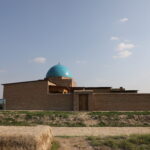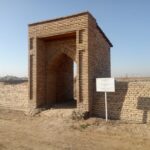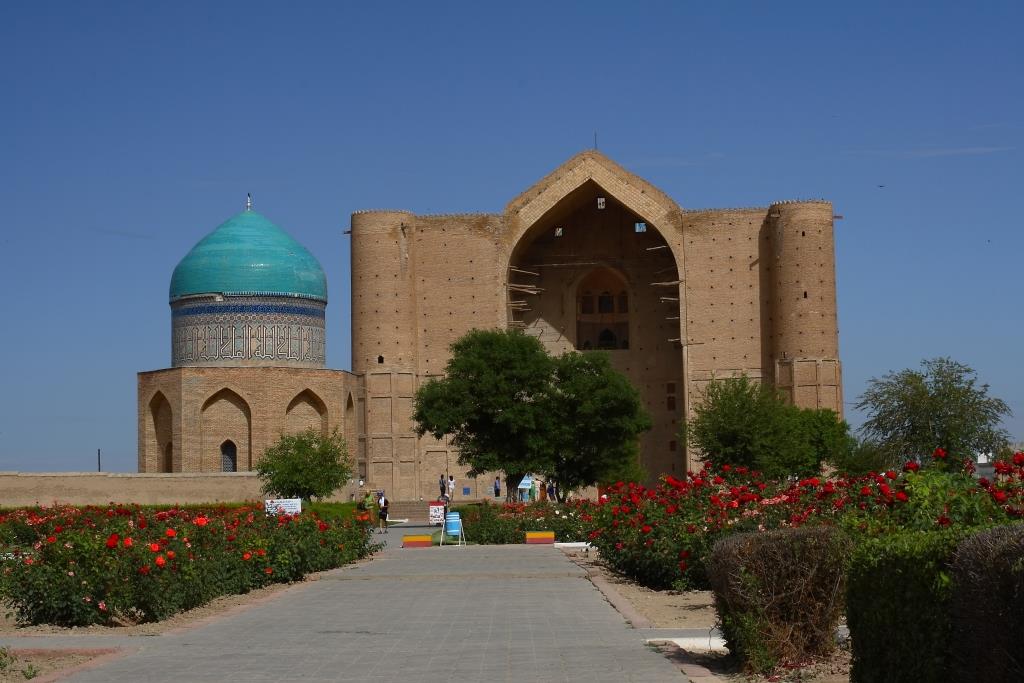
The Mausoleum of Khoja Ahmed Yasawi is a unique architectural and historical masterpiece located in the city of Turkestan, Central Asia. Built in honor of the revered Muslim saint, known during his lifetime as Sultan-ul-Arifeen (the king among those who have Knowledge (of God), Sultan of Saints). This is a monument of international importance. Coordinates: 43.2977396, 068.2706328, it serves as the final resting place for many prominent khans, sultans, biys military leaders, and warriors who played a pivotal role in the foundation of the Kazakh nation.
As long ago as 1928, M.Ye. Masson, conducting research on the monument, proposed the presence of the first mausoleum of Khoja Ahmed Yasawi: «…on his grave was built a small mausoleum… It is very possible that five carved, unpainted bricks from the revetment of the main façade, found in 1923 during the restoration of the roof of the mausoleum, belonged to precisely this small building». During the restoration works of 1939-1941, in the course of clearing the roof, terracotta tiles and bricks, which adorned the more ancient mausoleum above the grave of Khoja Ahmed Yasawi, were recovered among the debris. In October 1957, during the restoration of the plinth on the western edge of the northern portal, a wall of the first mausoleum of Khoja Ahmed Yasawi was revealed in the western pylon. A fragment of revetment was found — a simulated facing of paired bricks with an arrangement of vertical «bows» (about 1 sq. m), in a checkered pattern, inserted between them. The remnants of these constructions — 2-3 m high walls — were revealed in the course of restoration work in 1975 in the area of the ziyarat-khana. During renovations in 1994, around 60 fragments of engraved terracotta of various sizes were collected from the roof of the architectural complex of Khoja Ahmed Yasawi, among which were angled and flat plates with dual engraving. Analysis of these facts allowed the archaeologist E.A. Smaghulov to make the following conclusion: the first mausoleum of Khoja Ahmed Yasawi, in terms of its decorative characteristics, equaled the most elite and modern monuments of its time. As a whole the décor of the first mausoleum of Khoja Ahmed Yasawi displays a mastery of veg-etal-geometric compositions exceeding that of all of the distinctive monuments of the second half of the 12 century; its nearest analogues are the most prestigious monuments of the epoch of the Qarakhanids — the mausoleum of Uzgent, the tomb of Ibrahim ibn Husayn and the burial chamber of «D», which is located in the complex of Shah-i Zinda in Samarkand [32, p. 96]. Some of its decorative plates, which M.B. Kozha has published, have building inscriptions on the inner side of the floor tiles.
Construction of new facilities at the end of the 14th and beginning of the 15th centuries
Yasi remained a modest city at this time in the 14th century. The diffusion of Islam in the spaces of the Dasht-i Qipchaq, and the acceptance of Islam by the Chingizids, furthered the rise of the status of the settlement of Yasi.
New monumental structures grew around the early mausoleum of Khoja Ahmed Yasawi, as evidenced by finds characteristic of fragments of carved, glazed terracotta of the 12’h-14th centuries. In the city were built mosques and other religious structures. From the city of Yasi emerged splendid, carved wooden columns, with which one of the mosques of the city was built. Inscribed on a column is the date April 7 1352.
In the last quarter of the 14t century, Amir Timur established his control over the lands along the Sir Darya.His Governor-General took up position in Otrar. The city of Yasi is first mentioned in Timurid historiography in connection with the war waged between Amir Timur and Toqtamish khan (1376-1395). Both conducted an extended campaign for possession of the cities situated in the middle Sir Darya basin. After this, Toqtamish khan, who had been unable to take Sawran, advanced to Yasi and laid waste to it in 1388. According to local tradition, Toqtamish, the khan of the Golden Horde, at the time of one of his raids, pillaged the grave of Khoja Ahmed Yasawi and robbed the shaykhs living near it. Amir Timur, acting to avenge the desecration of the sacred site, destroyed the forces of the khan and took his plunder. As a result of the extensive spoils of this war, construction of a new, large mausoleum was begun over the grave of Khoja Ahmed.
According to the Zafar-nama of Sharaf al-din ‘Ali Yazdi, in 1397: «..Hazrat Sahib-i Qiran deigned to go to the village Yasi (garya) on a pilgrimage (ziyarat) to shaykh Ahmed Yasavi, who was one of the descendants of imam-zada Muhammad-i Hanafiya, may Allah the Supreme be happy with them, and has given the highest instructions for the reconstruction of that mazar, which is noted with high blessing… And the construction has a thorough foundation, which is subdivided into an extensive and spacious arch with two minarets in front of the large gunbadh adjoining it». Timur himself defined the basic dimensions and composition of the buildings: «structures noted here: an elevated cupola with an inner circumference of 130 gaz and a diameter of about 41 gaz with a similar elevation.
According to the opinion of M. Ye. Masson, Timur, at the same time, was making a subtle political calculation: «to draw the attention of the nomads to their national shrine, to underscore the political unity of their peoples, who confess Islam, to impress the nomad with the grandeur of the plan, and in carrying it out to represent the might of the empire — here are the practical goals which were taken into consideration in building, on the marches of the state at the end of the 14th century, an unparalleled monument of Central Asian architecture»
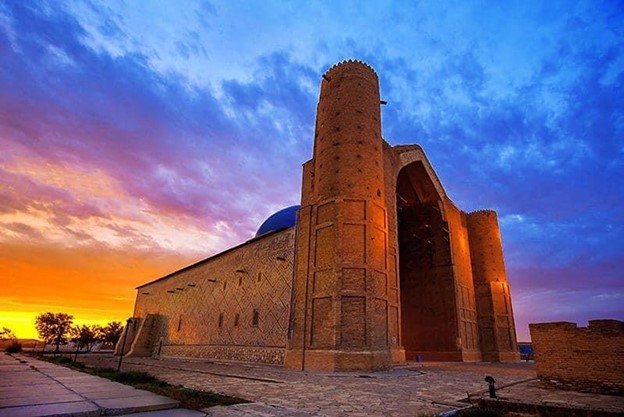
It is not possible, however, to consider 1397 as the start date of the construction of the new mausoleum of Khoja Ahmed Yasawi. It is known that Sharaf al-din ‘Ali Yazdi was not an eyewitness of the described events and began to put together his own account in 1425, 20 years later, after the death of Timur. Restoration work shows that construction of the complex dates to the beginning of the last decade of the 14th century. Owing to the death of Timur, which took place in the beginning of 1405, the main portal of the mausoleum remained unconstructed.
Architecture and construction of the building
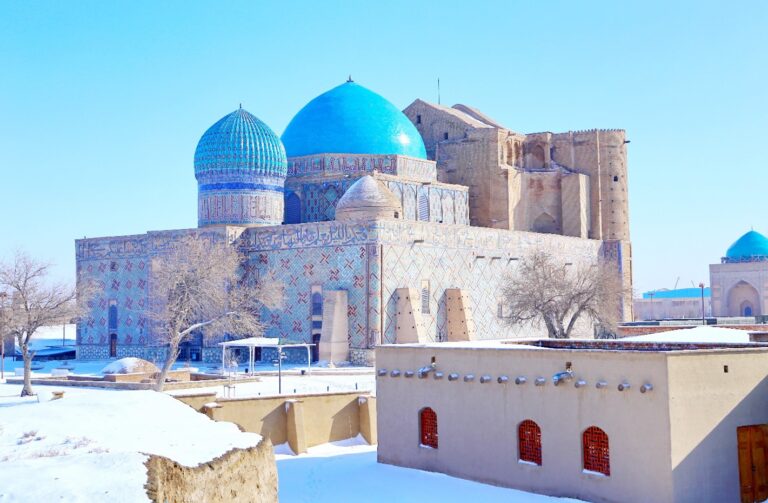
The construction of the mausoleum of Khoja Ahmed Yasawi, an enormous religious complex that contains a mosque, burial chambers, and a madrasa, allowed those devoted to Islam to live a separate life united beneath one roof. Within the structure, there are 34 rooms of various sizes. Standing in line from south to east is a great entrance, a central hall and cauldron room, and burial chamber for saints.
According to the plan, the construction’s general dimensions were 65.5 by 46.5 m. The appearance of such a large and independently constructed mausoleum was at that time a new and celebrated step in the development of architecture.
Visitors who stepped over the thresh hold of the main door immediately found themselves within the building’s central hall. This was a square hall rising on all sides to the towering height of 18.5 m. In the center of the hall stood a wondrous achievement of medieval bronze metallurgy: the cauldron of the craftsman ‘Abd al-‘ Aziz ibn Sharaf al-din Tabrizi.
The cauldron hall was enclosed within what was the largest domed roof in the territory of Central Asia and Kazakhstan. The dome was covered in green-colored painted tiles. The dome of the cauldron hall was, at its highest point, 39.9 m above ground level. The inside of the dome was decorated with ornamental stalactites.
As a part of the Russian Empire
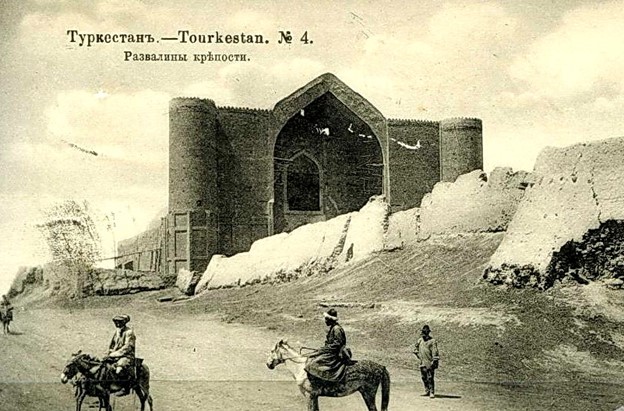
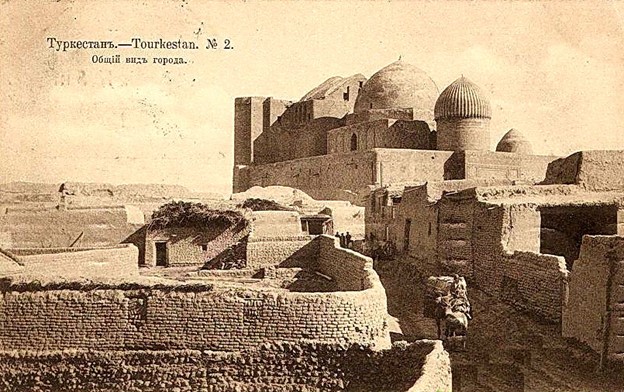
The mausoleum of Khoja Ahmed Yasawi appeared again at the centre of military operations in 1864, during a siege of the town by Russian armies. 12 artillery shells were unleashed on the defenders, who had taken cover in the mausoleum, of which 11 reached the building and left holes in the walls and destroyed the arches in the well and dining room. With the inclusion of Southern Kazakhstan in the structure of the Russian empire, the monument became accessible to European researchers. The enthusiastic responses to the mausoleum and the anxiety over its condition found reflection in the work of the Frenchwoman Maride Uyfalvi-Burdon: «The Miracle of Turkestan is the mosque Hazrat… The architecture of the arch, which allows narrow rays of light to pass into the building, amazes with the harmony of its lines. The architect who assembled this creation was at the same time an ingenious master and person of discriminating taste. Large portions of it surprise with the boldness and originality of its lines, and its details were treated with great care… Today millions would be needed to restore this fine monument; the time when it will turn to a heap of shapeless ruins is not far off»
In 1872, the first repairs, which cleared the building of the detritus that had accumulated in it over many years, took place. In 1884 the revetment of the plinth was carried out, four counterweights were built in the northwest corner of the mosque, the mausoleum roof was cleared and leveled, and reservoirs were organized.
In 1910, attendants of the mausoleum, with the help of donations collected on their own initiative and under the supervision of the naval technician N.A. Kozlovsky, disassembled the raked arches and walls of the dining room and then accurately restored the constructions using rectangular bricks.

During the period of the Soviet Union
Historical and archaeological efforts to study the complex were carried out in 1920-1930 (A.A. Semenov, M. Ye. Masson, N.M. Bachinsky).
In 1938, under the decision of the Kazakh SSR Council of National Commissars, the Republic Administration of Reserves and the Protection of Ancient Monuments created a special oversight committee for the repair and restoration of the Turkestan monument, which was led by I.Z. Polyakov. B.N. Zasipkin, who had experience in restoration works in Central Asia, became the scientific adviser. In the course of these efforts the dome of the qazandiq and the roof of the building were covered with small tiled brick, lost fragments of décor were partially and selectively restored, drains were equipped, and the foundations repaired. In 1951-1959, by request of the Department for the Protection of Monuments of the Kazakh SSR, a massive restoration effort was conducted, carried out by a scientific restoration and industrial workshop of the Uzbek SSR. During these years, foundations were laid under unsupported walls, facades and domes were renovated, the ancient stone paneling and apertures along the whole perimeter were restored, and the level of the land within the security zone was lowered to two meters, among other tasks. In 1955-1959, L. Yu. Man’kovskaya, who has thoroughly studied the architecture of the monument and, in 1963, defended a dissertation on the restoration and research of the Khoja Ahmed Yasawi mausoleum, worked as the leading architect and curator of restoration works.
In 1966 a scientific restoration workshop, affiliated with the Ministry of Culture of the Kazakh SSR, was created.
The establishment in 1980 of the Design Institute for the Preservation and Restoration of Monuments of Culture, «Kazproyektrestavratsiya», of which B.T. Tuyaqbayeva was the first director, made a substantial contribution to the study and preservation of the mausoleum of Khoja Ahmed Yasawi. For example, the territory adjoining the mausoleum was developed and improved. Starting in 1978, the mausoleum began to function as a quality museum. In 1989, the museum was reorganized as the State Historical and Cultural Museum Preserve «Azret Sultan».
Restoration works conducted during the Soviet period revived the memorial from its damaged state. Special ar-chitectural, archeological and engineering research was carried out, the initial ornamental layout of the mausoleum was re-established scientifically, and personnel experienced in restoration were reinstated.
In the time of independent Kazakhstan
Kazakhstan took extensive measures concerning the preservation of its national cultural heritage after attaining independence. The Republic of Kazakhstan, being a sovereign state, acceded to the Convention for the Protection of the World Cultural and Natural Heritage of 1994. According to agreements made between Kazakhstan and Turkey in 1993-1995, Turkish specialists completed efforts to reinforce the base and foundations of the mausoleum of Khoja Ahmad Yasawi. In 1995-2000 a great effort in the restoration of the mausoleum of Khoja Ahmad Yasawi was carried out by the Turkish company «Vakif Insaat».
The first monument, which Kazakhstan entered in the «Preliminary World Heritage List of Monuments» from the Republic, was the mausoleum of Khoja Ahmad Yasawi. During the 27th session of the General Conference of UNESCO, held from the 30th of June to the 5th of July 2003, the Committee of the World Heritage arrived at the unanimous decision to include the mausoleum of Khoja Ahmad Yasawi in the World Heritage List of UNESCO.
Since the mausoleum is a monument of world historical and cultural heritage, its preservation is under the direct supervision of UNESCO. In accordance with the agreed commitments of the Convention, the State Party ensures the proper protection and conservation of the complex.
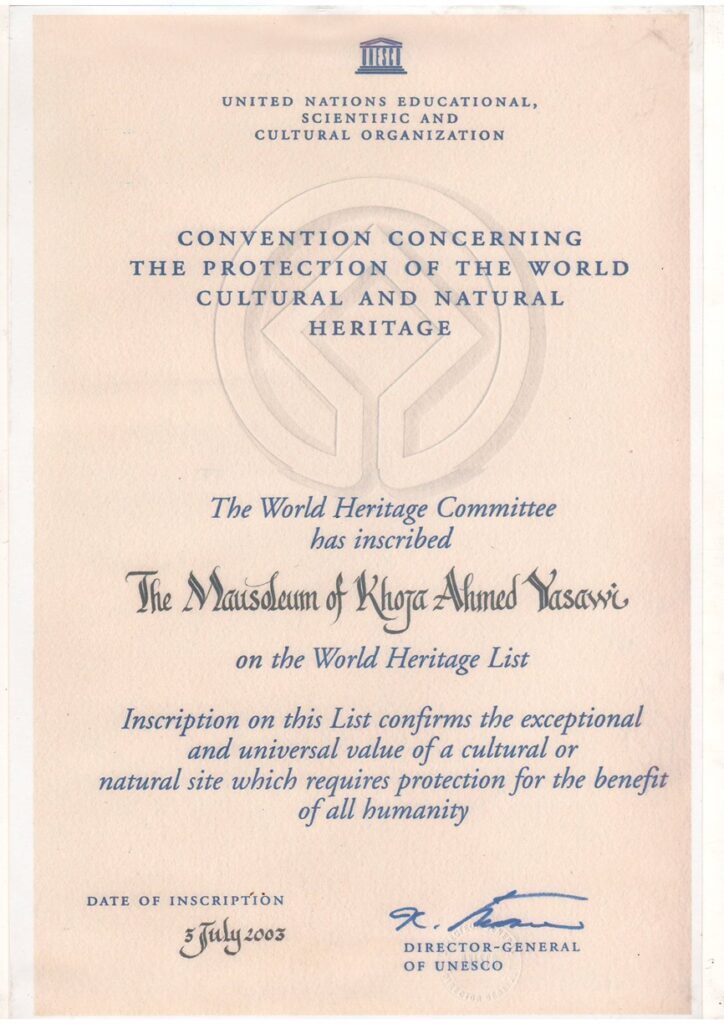
The document confirming the inclusion of the Mausoleum of Khoja Ahmed Yasawi in the World Heritage List.
References:
- Masson, M.Ye. About Construction of the Mausoleum of Khoja Ahmed in the City of Turkestan // Proceedings of the Central Asian Geographical Society. Vol. XIX. Tashkent, 1929. pp. 39–45.
- Patsevich, G.I. Repair and Restoration of the Khoja Ahmed Yasawi Mosque-Mausoleum in 1939–1941 // Proceedings of the Academy of Sciences of the Kazakh SSR. Architectural Series. 1950. Issue 2. pp. 95–100.
- Man’kovskaya, L.Yu. Some Architectural and Archaeological Observations on the Restoration of the Khoja Ahmed Yasawi Complex in Turkestan // Proceedings of the Academy of Sciences of the Kazakh SSR. Series of History, Archaeology and Ethnography. 1960. Issue 3 (14). pp. 52–69.
- Tuyakbayeva, B.T., Proskurin, A.N. On the History of the Construction of the Khanaka of Khoja Ahmed Yasawi // Proceedings of the Academy of Sciences of the Kazakh SSR. Social Sciences Series. 1985. No. 4. pp. 63–69.
- Smagulov, E. The First Mausoleum of Khoja Ahmed Yasawi // Industry of Kazakhstan. 2004. No. 1. pp. 94–96.
- Kozha, M. The History of Yasy-Turkestan (from Ancient Times to the End of the 18th Century). Almaty: Kazakparat, 2000.
- Masson, M.E. The Mausoleum of Khoja Ahmed Yasawi. Tashkent: Syr Darya Branch of the Society for the Study of Kazakhstan, 1930.
- Sharaf al-Din Ali Yazdi. Zafar-nameh / Prepared for publication, with introduction, notes, and indexes by A. Urunbaev. Tashkent: “Fan” Publishing House of the Uzbek SSR, 1972.
- Vitkin, V. Historical Note // Turkestan Gazette. 1906. No. 93.
- Man’kovskaya, L.Yu. Study of the Architectural Complex of the Mausoleum of Ahmed Yasawi in Turkestan and the Issue of Its Restoration. Abstract of the dissertation for the degree of Candidate of Art History. Tashkent, 1963.
- French Researchers in Kazakhstan / Translated from French by O.V. Rublyova. Compiled by I.V. Yerofeyeva. Almaty: Sanat, 2006.
- Man’kovskaya, L.Yu. Repairs and Restorations of the Mausoleum of Khoja Ahmed Yasawi in the City of Turkestan // Methodology and Practice of Architectural Monument Preservation. Moscow, 1974. pp. 96–104.