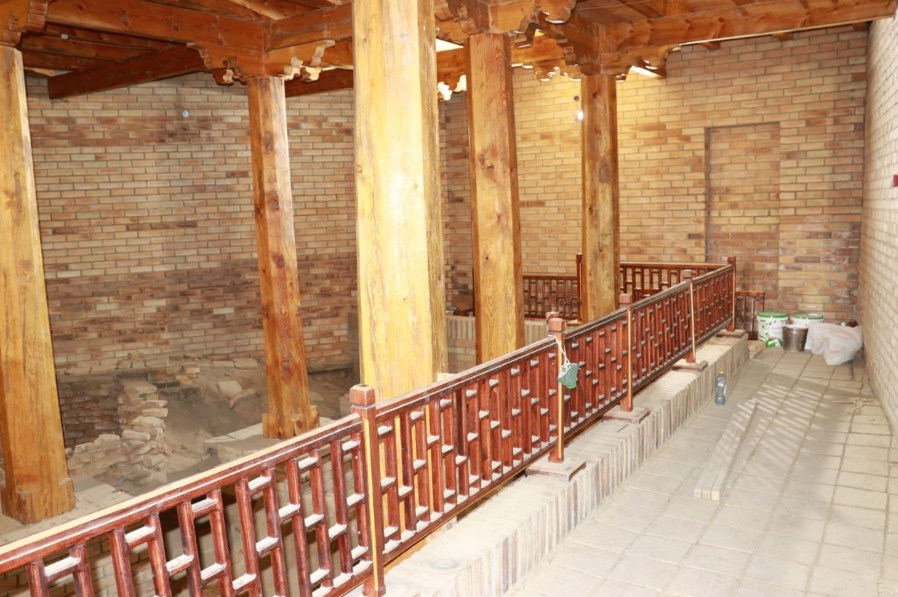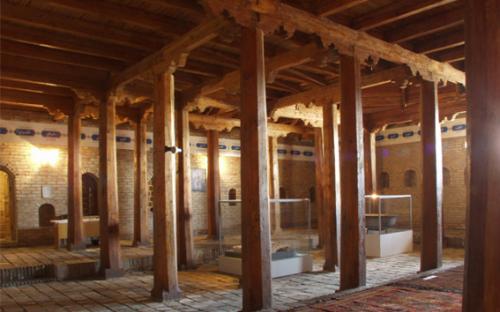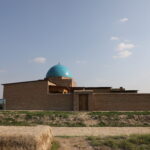
«Kyluet Underground Mosque» is one of the priceless historical monuments in the National Historical and Cultural Museum-Reserve «Aziret Sultan», created around the mausoleum of the great ancestor of our people, a precious source of inexhaustible wisdom and holiness of the Turkic world, a symbol of honor and purity, a major representative of the Islamic Sufi teachings of Khoja Ahmed Yasawi.
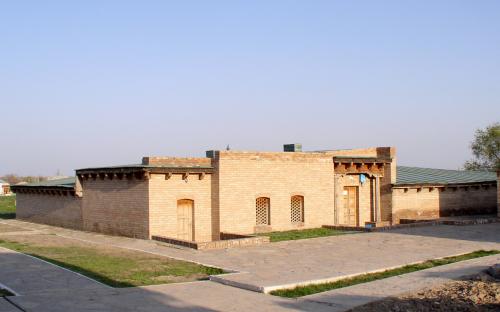
The founders of the underground cult spaces revered by our ancestors, filled with holiness, power and grace, were the «Underground Kyluets» — the places of their birth, formation and development. On the territory of the museum-reserve there are four such «Gar» — mosques. Among them: the restored and now open to pilgrims «Big Kyluet Mosque», as well as «Aulie Kumshik Ata», «Shildehana» and «Small Kyluet» — an underground structure excavated in 1972-1973 by archaeologist T.N. Senigova approximately 20 meters to the west of the hall of the Mosque of the mausoleum of Akhmed Yasawi. After the excavations, valuable data were obtained, and the object was put into conservation.
“The underground mosque “Big Kyluet” in question was destroyed in 1942, and before its bricks were used to build another structure, in 1941 the sculptor-architect A.L. Schmidt made a model of the authentic appearance of this underground mosque “Kyluet”.
The first article about the medieval structure based on this model was published by archaeologist A.N. Proskurin, and later by B. Tuyakbayeva. In 1994, this monument was included in the section on the South Kazakhstan region of the publication «Collection of Historical and Cultural Monuments of Kazakhstan». In 1996, archaeologist M. Tuyakbayev devoted a separate scientific article to this monument.
The model, made of clay, wood, paper and papier-mâché, was initially in the auxiliary fund of the museum collection, and in 2003, based on the results of a scientific expert commission conducted in the museum funds, and in accordance with the letter of the Culture Committee of the Ministry of Culture, Information and Public Consent of the Republic of Kazakhstan No. 02-4/1705, it was transferred to the main fund.
The dimensional proportions of the model, made with high precision, were subsequently confirmed by the results of archaeological excavations: by T.N.Senigova in 1972–1973, E.A.Smagulov in 1979, and M.K.Tuyakbaev in 1999.
Archaeological excavations have shown that this multifunctional structure was built in three construction stages. Its oldest part, the underground “Gar”, dates back to the 12th century, several adjoining rooms were built in the 15th–16th centuries, and the remaining part of the structure dates back to the 17th–19th centuries.
It is known from history that underground Kyluet mosques made a significant contribution to the spread of Islam and Sufi ideology in the Kazakh lands. In this sense, Kyluet played the role of a kind of workshop for the formation of national ideology and the image of the «Perfect Man» (Kamil adam).
The word «Khalu’at — خَلْوَة» comes from the Arabic verb خلو and means «to remain alone», «to retire», «to be isolated». The construction of underground mosques was laid in the 10th century by one of the directions of Islamic Sufism — the Khalu’atiya tariqa. When orthodox Islamic movements, disagreeing with the ideology of Sufi orders, began to consider them heretics and persecute them, Sufis were forced to build their places of preaching in secluded, hidden corners — that is, to dig them underground.
The word «خِلْوة – Hiluet» in Arabic also means «free, empty». That is, a person who has entered the Sufi path is freed from worldly vanity and, having become «free», establishes a connection with Allah.
Later, this custom became one of the main conditions of the Sufi path. However, if we understand the word «KYLUET» in the meaning of «solitude, removal from people» as one of the main principles of Sufism — a temporary withdrawal from society, when a person remains alone with himself in order to know his «I» and reveal the secret in himself, find the way to meet Allah — then it becomes clear that digging these structures underground meant not only a prayer hidden from persecutors, but also a unique way of improving the spirit within the Sufi teaching.
Underground Qyluet — mosques are built on the basis of underground rooms «Gar». Initially, the followers of the Sufi movement descended into these «Gar» rooms to spread and develop the teachings of the murshid and improve their spirit. Later, the followers of this teaching began to build full-fledged temple structures over the «Gar» rooms.
In Arabic, the word «غَار» (ghar) means «cave». In Sufi terminology, it carries the meaning of «shelter», «dissolution», «search for an individual path». When the Prophet Muhammad turned 40, he received his first divine revelation — five verses of the Holy Quran, and all this happened in the cave of Hira. Apparently, it was this historical episode that inspired Sufi masters to dig underground «ghar» rooms for secluded worship of Allah.
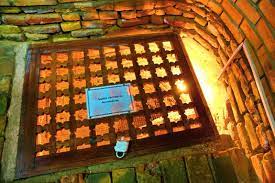
Underground Kyluet mosques are built on the basis of «gar» — rooms — cave prayer halls: this is confirmed by the findings of archaeological excavations carried out at different times by T.N. Senigova, E.A. Smagulov and M.K. Tuyakbaev. According to the copy of A.L. Schmidt, the complex included 18 rooms, and its most ancient part — «gar» — room and above it a round prayer space of the mosque — dates back to the 12th century. The rest of the complex, as established by archaeological research, was built as needed until the 19th century. As we can see, underground «Kyluet» mosques were initially built on the basis of «gar» — caves, and over time, various auxiliary structures were added to them.
Our people have always revered caves in the mountains and rocks as abodes of secrets and miracles. It seems that the followers and preachers of the Sufi teaching in the west of our country carved temples in rock grottoes for this very reason. In any case, this is a topic that requires deep and thorough research.
The Underground Kyluet Mosque we talked about is a multifunctional religious and spiritual structure. Its restoration work was based on the results of archaeological excavations and a model made by A.L. Schmidt in 1942. They became the foundations thanks to which our precious shrine met the people again and continued its path as a spiritual guide of the nation.
Т.Zholdasov, Junior Researcher