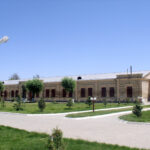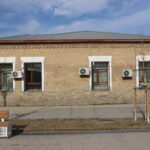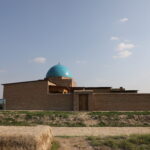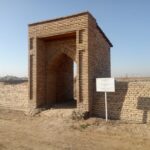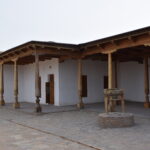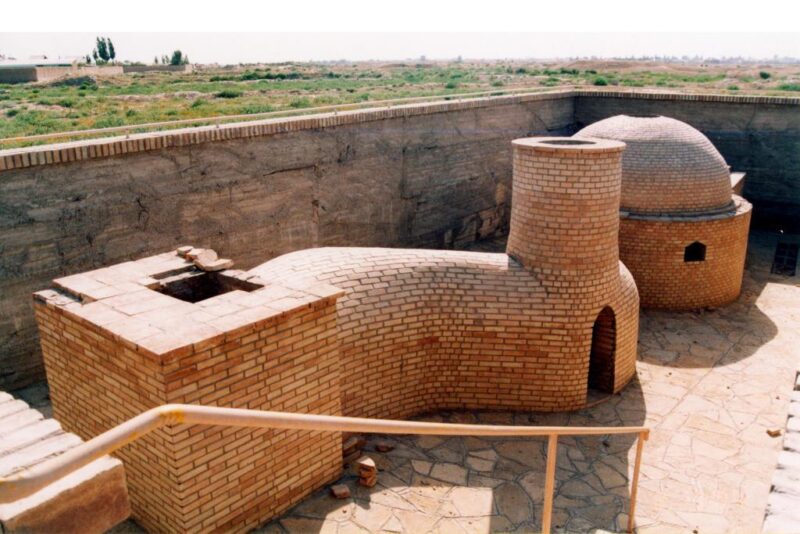
A monument of republican significance. It is located 1 km southeast of the Mausoleum of Khoja Ahmed Yasawi. Coordinates: 43˚17.421΄, 068˚16.523΄. This architectural structure of baked brick belongs to the type of constructions characteristic of Central Asia and the southern regions of Kazakhstan. Religious and spiritual monuments are invaluable artifacts of our history, full of mysteries reaching deep into the past. In southern Kazakhstan, the construction of underground cells (Khilvets) began in the 10th–12th centuries. One of such structure is the Khilvet of Aulie Kumchik Ata, dated to the 12th–19th centuries, which today belongs to the National Historical and Cultural Museum-Reserve “Azret Sultan”. According to oral tradition, Khoja Ahmed Yasawi deeply respected Aulie Kumchik Ata and regarded him as his mentor. He follow his teaching, practiced strict asceticism and spent the last years of his life in an underground cell, devoting himself entirely to the service of Allah. 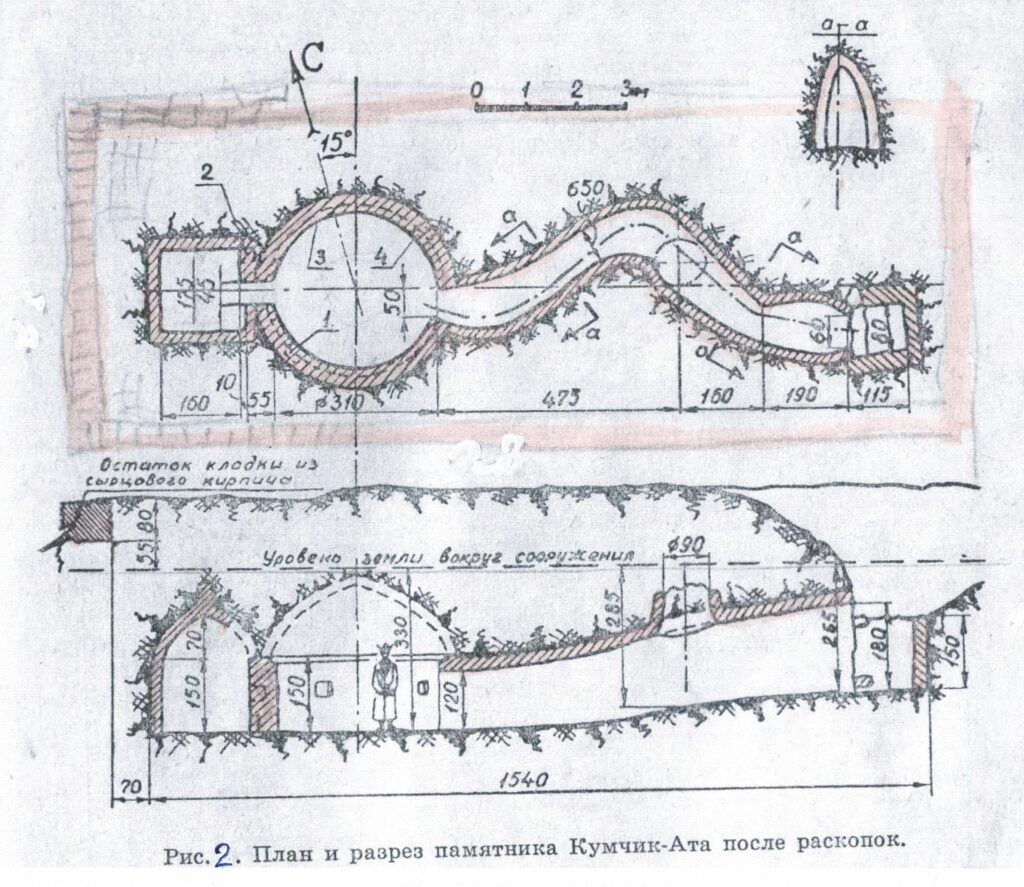 The height of the cult structure is 3.3 m, its length 15.4 m, and the diameter of the domed chamber 3.1 m. At the entrance there is a rectangular opening serving as a doorway to the Khilvet, connected to a winding narrow corridor. The corridor leads to a circular chamber, the main room of the Khilvet. This circular room ends with a rectangular final chamber. The ceiling of the circular room is covered with a dome, while the rectangular room is roofed using the “Balkhi” technique. Into the walls are built small niches for oil lamps. The corridor is covered as arched way and, like the main chambers, constructed of baked brick. In the middle of the corridor, there is a well-shaped opening for natural light. The structure was studied in 1972–1973 by a joint archaeological expedition of the Institute of History, Archaeology and Ethnography of the Academy of Sciences of the Kazakh SSR and the Ministry of Culture of the Kazakh SSR. In 1985 was carried out restoration works. In 2013, the monument was again restored, the interior was conserved and the upper section was reinforced. In 1994, it was included in the Historical and Cultural Monuments of Kazakhstan for the South Kazakhstan region under №590.12 and taken under state protection.
The religious-spiritual structure of Aulie Kumchik Ata was primarily used for Sufi rituals, including the recitation of dikhr, receiving guidance and instruction from a local shaykh, and for disciples (murids) newly admitted into the tariqa, who underwent their initial forty-day retreat in seclusion. This monument is not a mosque but represents a type of Khilvet, combining underground chambers “Ghar” and “Zikrkhana”—rooms for prayer and Sufi practices. The circular chamber was used for dikhr, while the rectangular “Ghar” room served for preaching and solitary worship.
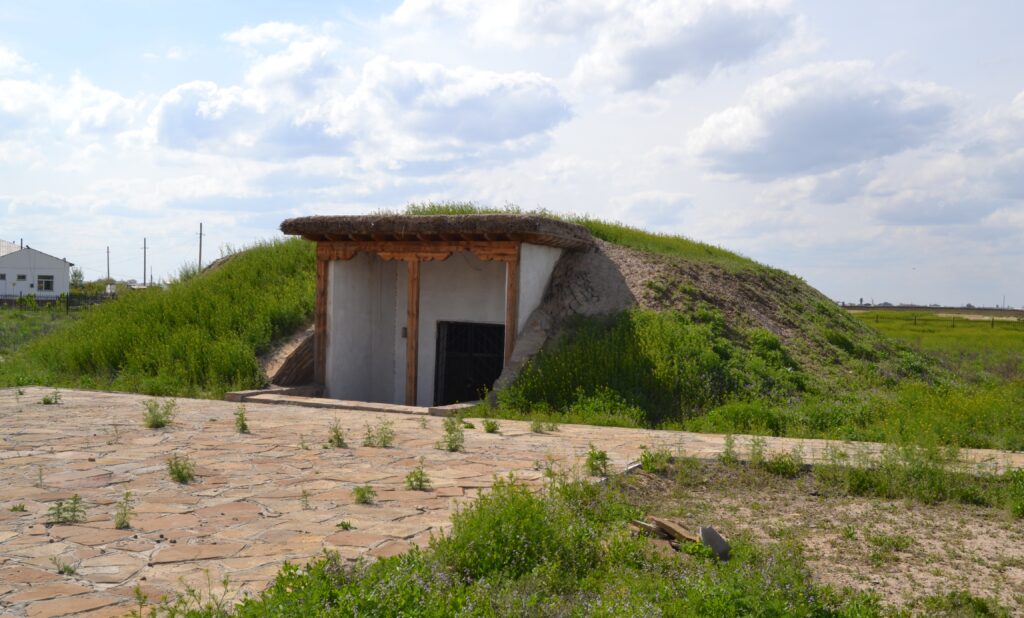
The local residents of the mahalla performed the five daily prayers and recited the Qur’an in the Jami Mosque, while the Friday prayers were held in the neighborhood mosque, which had been built directly above the Khilvet and completely covered it (see Fig. 2). The mosque was a square structure measuring 9×9 m with a mihrab and domed roof. From its entrance, there was access to a large hall measuring 15.4×8 m, beneath which lay the Khilvet of Aulie Kumchik Ata. Entry to the underground section was through a square hatch leading into a 9.5 m corridor. At its fourth meter, a circular opening 90 cm in diameter, raised 1.5 m above the floor and projecting 20 cm upward, provided light and ventilation. The corridor’s total length was 9.3 m, width 1 m, height at the entrance 1.8 m, and at the far end 1.2 m. The circular chamber measured 3.1 m in inner diameter (4.1 m outer), with walls rising 1.5 m before the dome began. The dome itself was 1.4 m high internally, and including the vault thickness, the total interior height reached 3.3 m (see Fig. 2).
From the circular hall, one could enter the rectangular chamber “Ghar”, measuring 1.6×1.7 m inside. The dome was 2.2 m high internally and 3 m externally. The “Ghar” chamber predates the circular Zikrkhana (dhikr chamber). Its doorway measured 45 cm wide and 1.5 m high. Externally, the chamber measured 2×2 m. The dome, beginning at a height of 1.5 m, was built not in a conical “tent” style but in the “Balkhi” method, smoothly curving upward into a keystone-like crown 70 cm high (see Fig. 2).
After construction, the entire Khilvet was covered with earth (the layer above the dome was about 60 cm thick), leveled, and a superstructure 16.2 m long and 8 m wide was built above. Long corridors ran on either side, with a mosque and vestibule on the southeast. The entire structure measured 28×15 m. Outside the mosque there was a courtyard, rooms for ablutions (takharatkhana) and additional rites (mustahabkhana), all enclosed by a wall with a gate. The overall size of the complex was 50×30 m (see Fig. 1).
In 1973, T.N. Senigova thoroughly studied the monument and concluded that it was built in the 12th century, while also suggesting that the area had been inhabited since the 8th–10th centuries. In 2002, southeast of the hatch-chamber leading into the corridor of Kumchik Ata, was discovered a well belonging to a karez system. Inside, it was reinforced with short and long clay pipes, the upper edges bent outward by 7–8 cm, allowing them to fit securely one atop another. The wellhead was covered with large flat stones, and at the top were placed two short pipes one above the other, measuring 40 and 45 cm in height, with internal diameters of 62 cm and external diameters (with rim) of 78 cm. Below these, numerous long pipes of 62.5–78 cm diameter and 77 cm height were laid. Three such pipes were fully recovered, while the others could not be lifted due to groundwater, mud, and flooding. The wellhead was located 1 m below the floor level of the hatch, indicating that the karez system predated the construction of the complex. Ceramic fragments found at the wellhead dated to the 10th–11th centuries, while those at lower levels belongs to the 8th century. Based on this, it can be concluded that the karez system was constructed in the 8th–9th centuries and functioned until the 10th–11th centuries. By the early 12th century, when began the construction of the religious complex Aulie Kumchik Ata, the karez had either ceased to function or was redirected upstream. This practice was common in karez systems: if a shaft collapsed and blocked the water tunnel, the old shaft would be bypassed and new ones connected. Nevertheless the Khilvet of Aulie Kumchik Ata was built in the late 11th–early 12th century, which lends historical credibility to the tradition that Khoja Ahmed Yasawi visited this place.