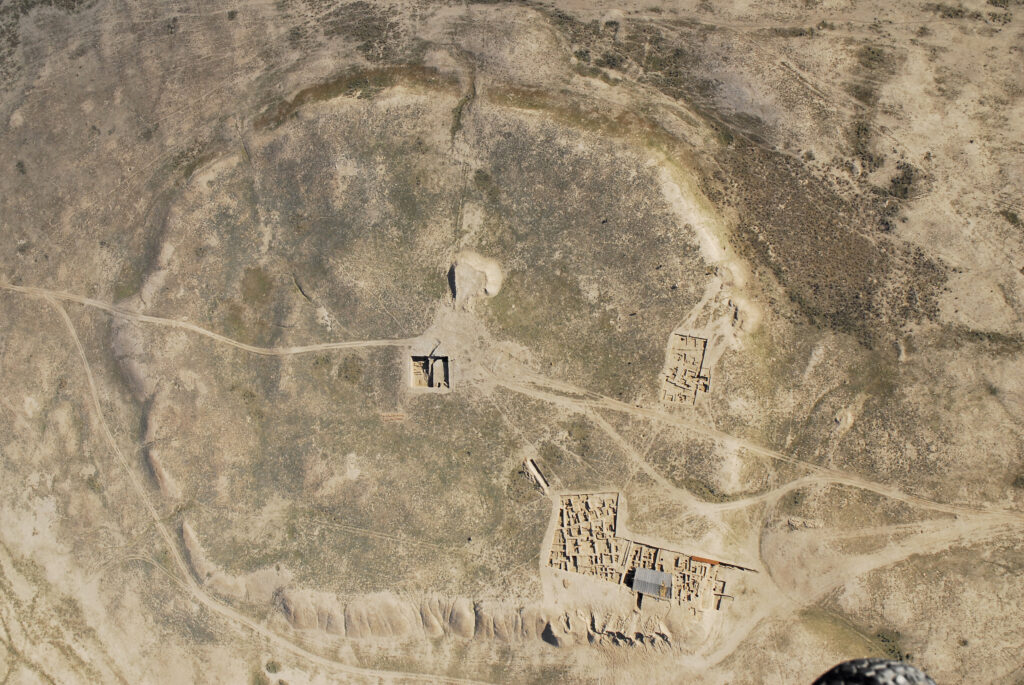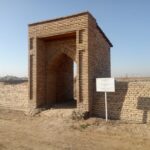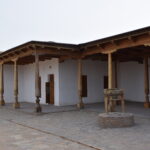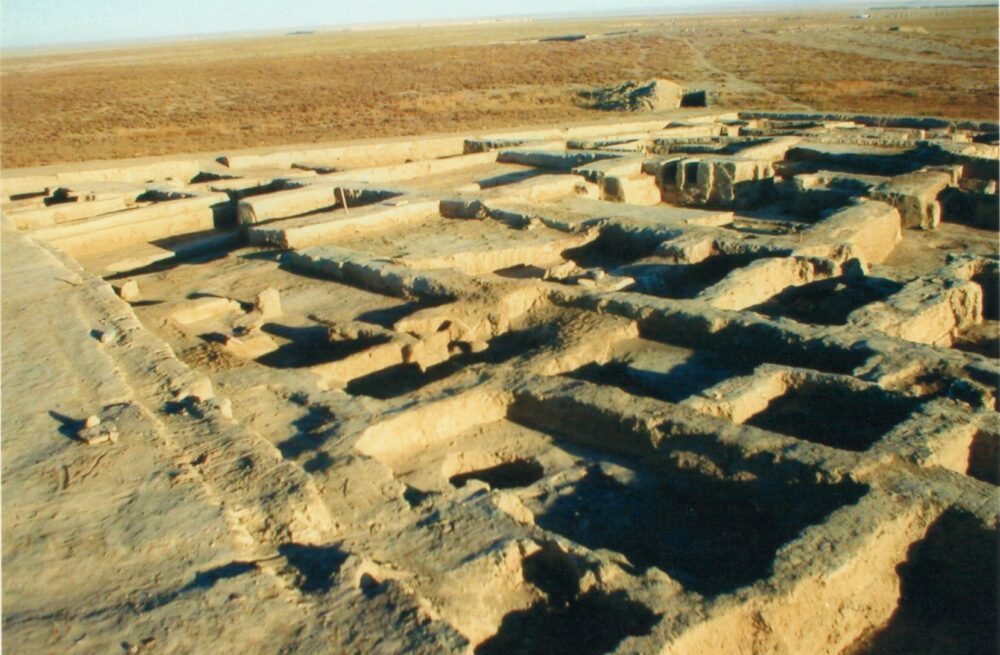
A monument of republican significance. Coordinates: 43˚29.203΄, 067˚46.829΄. The earliest references to the city are found in the works of 10th-century geographers al-Maqdisi (al-Muqaddasi), al-Istakhri, Ibn Hawqal, in the writings of Mahmud al-Kashgari (11th century), as well as in the accounts of 13th-century authors such as al-Athir, Yaqut al-Hamawi, and in the travel notes of the Armenian king Hetum. Sources of the 15th–16th centuries refer to the second period of Sauran, the late medieval “Great Sauran”, of which have survived fortress walls. However, information that in the first half of the 14th century Sauran was the capital of the White Horde (Ak Orda) and that its ruler Sasy-Buka was buried there, relates specifically to Karatobe-Sauran. At the same time, already in the last quarter of the 13th and the first half of the 14th centuries, the construction of Great Sauran had begun. It is assumed that after the death of Khan Sasy-Buka in 1320, he was buried in one of the graves near Karatobe-Sauran—Karakhan Ata, Saduakas Ata, or Zhalauly Ata. The mosque, madrasa, and khanakha known from historical records, built by the order of his son, Erzen Khan (reigned 1320–1345), were already erected in Great Sauran. The outer defensive wall of Karatobe-Sauran was located 700–1000 meters from the edge of the elevation, enclosing the settlement. It is likely that this was the outermost of the seven lines of fortifications described by al-Maqdisi. The enclosed area covered about 252 hectares—the so-called rabad, where residents engaged in horticulture and agriculture. Two deep ravines and one karez system crossed this area from the north. The total length of the fortifications reached 5.4 km. The South Kazakhstan Archaeological Expedition (A.N. Bernshtam) conducted the first archaeological studies of the site in 1947. In 1986, the Institute of Archaeology (K.M. Baipakov) jointly investigated the Sauran and Karatobe settlements. From 2003 to 2008 Turkistan Archaeological Expedition (E. Smagulov, M. Tuyakbayev, A. Yerzhigitova) were carried new excavations.