(XVIІI century) (born approximately 1701–1705, died 1779–1780)
Argyn, -Bolatkozha-Karakesek-Aksha-Boshan-Shanshar.
(Z. Sadibekov. Kazak shezhiresi. — Tashkent, 1994. — 103–104 pp.)
Ablai Khan met with the Shanshara people of the Karakesek clan during a funeral dinner while en route to the Alatau. At this gathering, some rascals loitering about made a bet to knock the borik off the khan’s head with a stick: they were curious to see if the khan would be angry. Ablai Khan did not publicly display his anger when picking up his borik from the ground and calmly left, as if nothing had happened. However, some time later, at the Kyzylzhar market, Ablai Khan suddenly remembered his offenders for daring to knock the borik off his head. He decided to bury them alive, placing two of the rascals, one from Karakesek and one from Tortauyl, in a deep pit. The man from Karakesek whom Ablai Khan decided to bury turned out to be Kazybek’s grandson, Zhanai the son of Kazymbet, and Botakan the son of Tortauyl. Upon learning of this, Abylai Khan, his anger changing to mercy, decided to rescind the punishment, to which Botakan responded: he had been buried alive in the grave, so he should be here after his death. Botakan, uttering his last words: «Here is my death, it is better to truly die now than to appear alive in public,» died, slashing his stomach with a dagger. It is said that upon hearing this news, Kazybek bi’s son Bekbolat and Suindik Edige mounted their horses and gathered a detachment of Bes Meyramites. Mashhur Zhusip Kopeyuly described this in detail in his work.
«Kazakh Genealogy.» Thus, it becomes clear that Syrt Boshan – Tolemisuly Karamende bi – was also part of the college of biys under Bekbolat at the time. In 1779–1780, the hero of this event, Bekbolat bi, was 65 years old, while Karamende Tolemisuly would have been between 75 and 79 years old. This means that Karamende bi was born in 1701 or 1705
and died in 1779–1780. Based on ancient sources, Karamende bi died six months before Ablai Khan. If he died six months before Ablai Khan, then this would have been early 1780 or late 1779, as Ablai died in the autumn of 1780 (R.B. Suleimenov, V.A. Moiseyev, p. 132). The children of Akmyrza and Akzhigit buried their father,
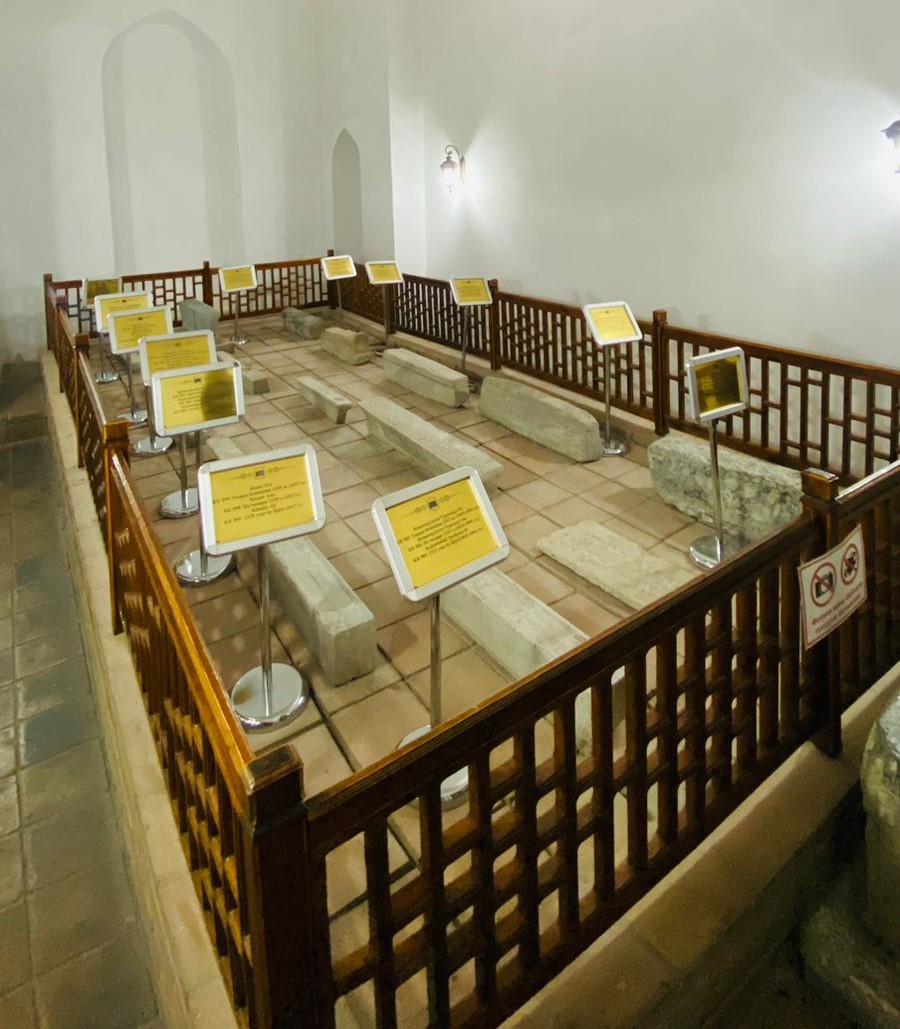
Karamende bi, in Turkestan in the Khoja Ahmad Yasawi mausoleum. Today, Karamende bi’s tombstone is kept in the «Small Aksaray» room. Saken Sairan Kerimuly’s 2006 book, «The Genealogy of Karamende» (Karaganda, «Bolashak-Baspa»), tells of Tanai’s descendants. Tanai had three wives.
From his first wife—son Kuttykadam.
From Kuttykadam—son Zhadik.
From Zhadik—sons Tastemir and Bolat.
From his second wife—son Arykpan.
From Arykpan—son Tilep.
From Tilep—sons Tinetey, Tilmanbet, and Bimanbet.
From his third wife—sons Otes and Zhetes.
From Otes—son Omirtayu.
From Zhetes—sons Karamende and Tolebay.
According to stories from that time, Tanai changed his residence every fifteen days, migrating to a new place. One of his main qualities was that he always filled his earthen hearth with salt, kurt, cottage cheese, and sometimes bread when people migrated to the places where he lived. He did this so that newcomers and travelers could use these provisions. Tanai gave his grandsons Sazanbai and Tolemis, instead of their shares of the property, only two horses, a spear, and a bow. He left the main share of the inheritance—livestock—for his youngest grandson, Keshubai. Tolemis was a skilled archer, so Tanai said, «Your descendants can grow; I will help expand the territory,» and gave him the land beginning with today’s Karakemer Kurozek, the territory of Anzhan, the graves of Azhem, and the lands from Tazbas to the Kazykurtin Tatybulak. Tolemis’s son, Karamende, was a contemporary of Kazybek biy’s son, Bekbolat; Tuitey’s son, Zharylgaba; Senkibai batyr’s son, Syngyr; and Omirtai’s son, Bigeldi. During the Dzungar invasion, Karamende, along with his fellow batyrs, participated in numerous military campaigns. In 1726, he participated in the Battle of Shubarteniz; in 1727, in the Battle of Bulanty-Bileuti in the Ulytau region; and in the battle against the Kalmyk invasion from 1740 to 1742. Thus, Karamende, born in the Syr Darya region of Karatau, spent his youth fighting against the Kalmak-Dzungar invasion. During the harsh invasions, he served day and night in a Kazakh detachment alongside the batyrs. Having gained experience, he became one of the biys’ advisors. In his work, Shokan Valikhanov wrote numerous articles defining the place of biys in society. According to him, biys were expected to know the norms of Kazakh tradition and master the art of oratory. They were recognized as judges (biys) only after they had spoken in the biys’ courts, at the ru meetings, thereby demonstrating their eloquence. In those same notes, Shokan Valikhanov wrote: «The children of biys remained the heirs of their fathers because they had a legal mentor.» Numerous similar examples can be cited among the Kazakhs. For example, Kazybek bi’s son Bekbolat was also a biy. Then Tilenshi and his descendant Alshynbay also held the position of biy. Karamende bi’s descendants would also hold the position of biy and be worthy of their family title. For example, Karamende bi’s grandson Akzhigit Karpykbay would become a biy among Koyanshy Tagai and Karakesek. The great-grandsons of Kuykayuly Sokyr (1880–1883) – Tagybayuly Bodyk (1883–1892) and his son Narymbek Bodykov (1892–1914) – were biys. In 1895, Zhaksybek Tursynbekov also held the position of bi – volost governor. From 1898 to 1914, Satkankul Sokyrov, Toleubek Bodykov, Akhmet Tibanov, Karmys Torezhanov, and others served as volost governors. Surviving legends about the time between Karamende bi and Usen bi still retain their significance. In his early youth, Karamende bi went to Usen bi Konyrat to receive a blessing. Usen bi’s people were preparing to migrate. Bi was busy driving cows on a bull, while Karamende simply followed him. Then, stopping, Usen bi asked:
- «Are you that child orator from Saryarka everyone’s talking about?»
- So we finally meet.
- «I’ve come to ask your blessing,» the teenager replied.
- «Don’t drive the ox up the mountain—your arms will tire. Don’t defend
a bad man—the dispute will remain with you. Don’t reject a good man, my son—great spoils will come at the right moment.» «Bon voyage!» Raising his hands in prayer, Usen bi gave his
blessing.
One day, Ablai Khan asked Karamende bi:
- «What interesting things remain in the world, society, and people?»
- Karamende bi answered:
- «If elders are like swans,
If a horseman is like a hawk and a peregrine falcon,
And girls like ducks,
And a horse is tied to a belt,
And a wife doesn’t look angrily,
Then the joy of life is like a snake’s shedding skin.» Another time, Ablai Khan asked:
- «How do you predict that a child will be good, rich, or lazy and poor?»
Then Karamende bi replied: «A good child, an active, rich child, will be goal-oriented and calculating; a bad child will be lazy, stubborn, and sluggish.»