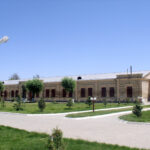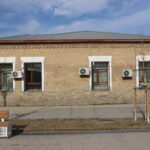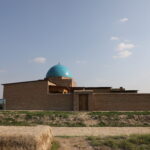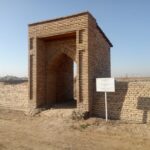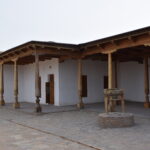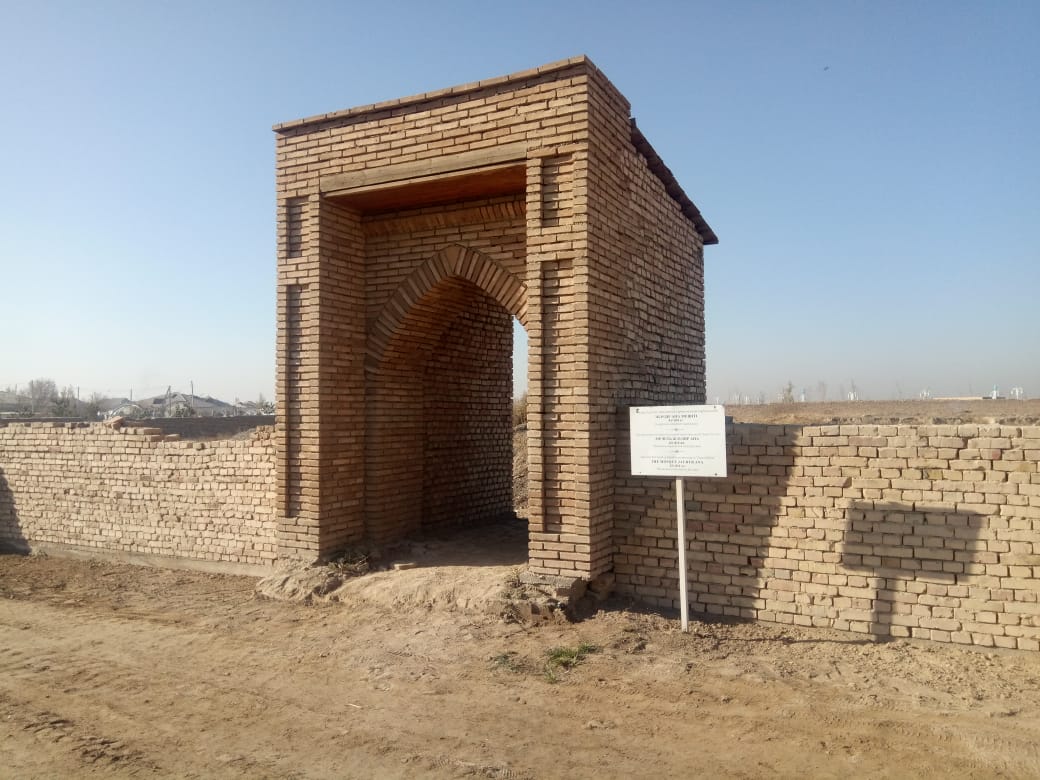
The mosque-Madrasa of Zhaudir Ana is located 1 km southeast of the Mausoleum of Khoja Ahmed Yasawi. Coordinates: 43.29111748, 068.2734985. In the first half of the 20th century, one of the many mosques that functioned in Turkistan and remained in the people’s memory was the mosque of Zhaudir Ana. Information about the mosque-madrasa of Zhaudir Ana has survived to this day in the form of oral traditions and legends passed down from generation to generation.
According to sources, in the 1840s Zhaudir Ana studied literacy in a mosque of Turkistan and became famous as a healer. She spent the rest of her life near the Mausoleum of Khoja Ahmed Yasawi, where she taught at a madrasa and tended a garden. Among the local population, have been preserved memories conserning the “Zhaudir Mosque” and “Zhaudir Garden”.
According to legend, along with the construction of the Ahmet Yasawi Mausoleum (14th–15th centuries), was built a mosque named after the person who erected it from adobe bricks — the mosque of Azhi Akhmet. In the research of S. Baydauletov, based on the memoirs of Kadirbay Sarmoldayev, the following information about Zhaudir Ana is given:
“According to the ancestors of the poet Azbergen, among the descendants of Azhi Akhmet a girl would be born with a physical defect, who would later be healed and become the keeper of the mosque of Azhi Akhmet”. The prophecy came true — in 1810, a girl with a disability was born in the family of Azhi Akhmet’s descendants. Her ancestor was Karagagai Batyr, a companion and contemporary of Khan Abilkhair, a relative and follower of Tailak Batyr of the Junior Juz.
Karakagai Batyr had nine sons, the eldest being Koken, from whom descended Oraz, Duzey, Koibasar, and Tolezhan. Oraz had son Shon and daughter Zhaudir. The girl Zhaudir was born with a disability but was healed at the age of 10, became renowned for her beauty at 15, and married at 18, giving birth to a daughter. During a period of internal strife, she lost her husband and later her daughter. Having experienced deep sorrow, Zhaudir returned to Turkistan, performed the Hajj twice, and around 1840, after receiving education at the Azhi Akhmet Madrasa, became known as a healer and soothsayer. At about 30 years old, she became the head of her ancestor’s madrasa.
In 1850, Zhaudir Ana carried out the restoration of the mosque-madrasa of Azhi Akhmet, after which it became known as the mosque-madrasa of Zhaudir. In 1914, local administrators Satbai and Samurat came to Turkistan and invited the 104-year-old Zhaudir Ana to visit them, asking her to “open the mosque and set an example”. She stipulated that the money be used for the education of children and the construction of a mosque. As per her request, was built a mosque in the Kostanay region, in the Kamysty district, between the Karasu and Kindikti rivers, near the burial site of Azim Aulie. According to sources, Zhaudir Ana died in 1918 at the age of 108 and was buried near Azim Aulie, as it was impossible to transport her body to Turkistan due to the political situation of that time.
The mosque-madrasa of “Zhaudir” built in the Kostanay region was destroyed in 1932 by Soviet authorities. Currently, employees of the Kostanay Regional Archive are conducting research related to this mosque.
Based on the results of archaeological excavations conducted in 2008, the following conclusions were made:
- The mosque of the 14th–15th centuries was called the Azhi Akhmet Mosque;
- In the 17th century, a new mosque was built on the site of the Azhi Akhmet Mosque;
- In the 1840s, Zhaudir came from Kostanay to Turkistan;
- In the 1850s, Zhaudir carried out the restoration of the Azhi Akhmet Mosque-Madrasa;
- Since the 1850s, the Azhi Akhmet Mosque-Madrasa became known as the Zhaudir Mosque-Madrasa;
- At the end of the 19th century, were repaired the gates of the Mosque-Madrasa of Zhaudir;
- The Mosque-Madrasa of Zhaudir was destroyed in 1937–1938.
In our opinion, the site of this mosque, once well known throughout the Turkistan region, should be preserved. Among the 62 mosques of Turkistan and its surroundings in the early 20th century, the oldest (15th century) and most famous was the Zhaudir (Haji Akhmet) Mosque-Madrasa, which evolved from a simple neighborhood mosque into an educational institution that trained hafizes (Qur’an memorizers). The special significance of this mosque lies in the fact that it was the main center for training hafizes — people who knew the Qur’an by heart. Only prominent scholars capable of interpreting the Qur’an, hadiths, and Sharia law in depth taught there.
According to Ye. Suleimenov (born in 1914), who studied at the mosque-Mmadrasa of Zhaudir, the mosque was also called “the mosque of Azhi Akhmet – Zhaudir”. The mosque had four rooms, was decorated with glazed tiles and gypsum carving, and had tall minarets reaching the height of a two-story building. The floor was laid with fired bricks, and the ceiling was adorned with wood carvings. For visiting students, there was a dormitory nearby.
According to N. Abdullayev, the mosque of Zhaudir was located along one side of Khan Street, had a high dome, and looked monumental. Nearby was the “Zhaudir Garden”, which occupied 50–60 hectares of vineyards.
According to K. Sarmoldayev, a descendant of Shon, the brother of Zhaudir Ana, she spent more than 60 years of her life near the Mausoleum of Yasawi. There were existed the mosque of Zhaudir, the street of Zhaudir, and Garden of Zhaudir. People knew her by the names “Sakhi Bai” and “Azhi Akbar”. In sources mention that she performed the Hajj twice (according to other data, 7–8 times) and held the titles “Qaji-Azhi”.
Литература:
- Тұяқбаев М., Өсеров Т., Мұсабаев Қ. Түркістан археологиялық отрядының 2013ж. Жәудір ана мешітінің орынында жүргізген жұмыстарының есебі. Т.,2013. Ескерткіштерді қорғау бөлімінің архиві.
- Тұяқбаев М. Түркістан археологиялық отрядының 2013ж. жүргізген қазба жұмыстары// «Марғұлан оқулары — 2014» Конференция материалдары жинағы. Алматы – Павлодар, 2014. 229-237бб.
- Мұсабаев Қ., Тәшенов Т. Жұрт жадындағы Жәудір. / «Айқын» газеті. 2013, №10, Қыркүйек.
- Мұсабаев Қ. Жәудір мешіт – медресесі орнында жүргізілген археологиялық зерттеу //РМК Археология мұражайының 40ж. арналған «Қазақстан археологиясы: қортындылары және келешегі» атты халықаралық конференция материалдары. А., 2013. 183-190бб.
- Жәудір мешіті // «Әзірет Сұлтан» энциклопедиясы, І-том. Түркістан, 2021.143-144 бб.
- Байдәулетов С.С. Алтын киімді ханзада ұранды қарт қазақтар. А.,2000. -292бет.