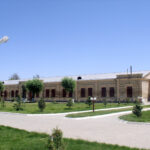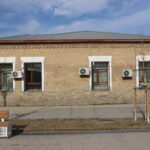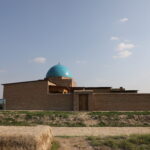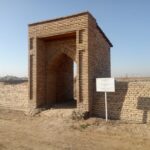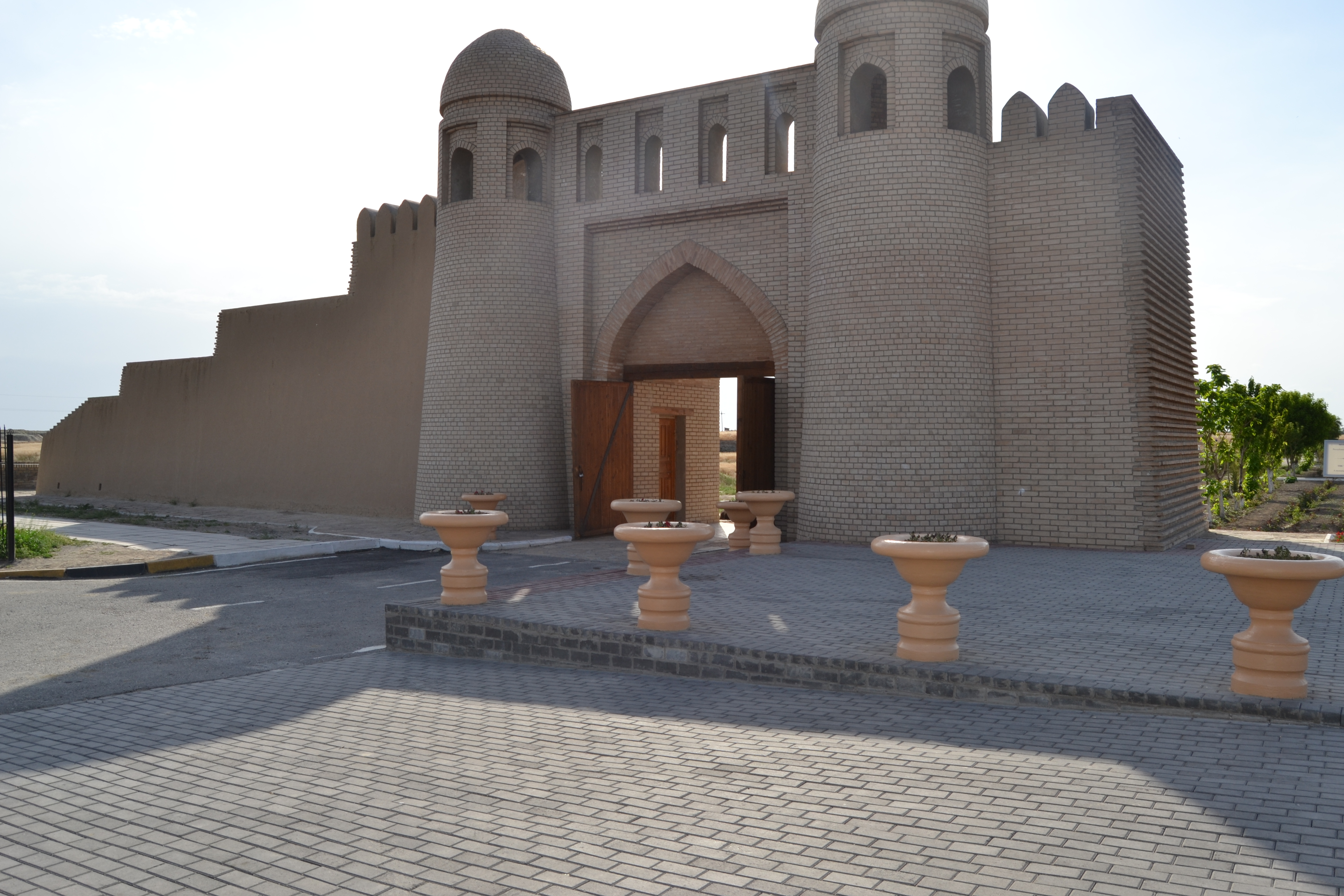
The gate Musalla is located 150 meters in front of the Mausoleum of Khoja Ahmed Yasawi. Coordinates: 43˚17.751΄, 068˚16.409΄.
Within the “Cultural Heritage” program, in Old Turkistan were identified a number of sites due for historical, cultural, and documentary study, as well as for conservation and reconstruction. Among this program were one of the four gates known as the “Four-Gated Turkistan” — the gate Musalla. In 2009–2010, at the site were conducted archaeological excavations, revealing a historical and cultural monument that was subsequently restored.
The name “Musalla” derives from the square in front of the Mausoleum of Khoja Ahmed Yasawi, where were held Friday prayers. In Arabic, “musalla” means “worship” or “prayer”, the expression “musalla al-‘id” refers to the place where performed prayers during religious holidays. The Uzbek scholar B. D. Kochnev devoted his monograph “Medieval Suburban Religious Structures of Central Asia|” (Tashkent, 1976) to “musalla” mosques and their varieties — “namazgah” and “idgaham”. In his work, he notes that in Arabic the word “musalla” literally means “to pray”, but in a broader sense — “a place of prayer”.
For centuries, this word was used in all Muslim countries to refer to juma (jumu’ah)-mosques (congregational mosques). However, “musalla” also has other meanings: it could refer to an ordinary mosque, a prayer house, a place for worship at home, a part of a mosque where the is performed namaz, mosques used for “janaza” (funeral prayers), and even to a stone for a coffin placing or a prayer rug “zhaynamaz” which laid out facing the “kaaba”. Among the various interpretations, the most common were “musalla al-‘id” — a place for prayer during holidays, and “musalla al-‘idayn” — a place for prayer during the two main Islamic holidays. These holidays refer primarily to “Oraza Ait” (“Eid al-Fitr”), “Qurban Ait” (“Eid al-Adha”), as well as “Mawlid an-Nabī” (the birthday of the Prophet) and other Muslim celebrations. In Central Asia, Iran, Afghanistan, and India alongside “musalla” were also widely used synonymous terms such as “namazgah” and “idgah”.
In the 1864 map, the The gate Musalla is shown as a two towered structure surrounded by a moat. On the 1865 plan, which shows this eastern corner of the city, there is a tower with a diameter of 15 m connected by a thick wall to the southern tower of the citadel. The main weapon of that time was a cannon with a long barrel, however its gun carriage was fixed, and upon firing, the gun recoiled away several meters back. Therefore, a tower designed to place several cannons at once had to be of large diameter.
The lower diameter of the tower was 15 m, its height — 11 m, the diameter of the upper platform — 10 m, and the internal diameter — 9 m. The tower faced southeast, as the main threat came from that direction. The Kokand troops advancing from Tashkent, Ikan, Koskorgan, or Chimkent could only approach from there. Due to the long range of the cannons, this tower could also protect other city gates — “Takiya”, “Zheti Ata” and “Darbaza”. Excavations conducted in 2009 shown that at a depth of 170–220 cm under the eastern tower of the gate lay a foundation of dense clay. The gates built by the Kokandis in the 19th century have not survived. However, were discovered the remains of fortress wall and residential foundations of the city at a depth of 160–170 cm. The gate was 7.5 m in height, 5 m in width, and 26 m in total length. The height of the gate tower was 9.5 m.
Литература:
- Тұяқбаев М. Түркістанның төрт қақпасының тарихи негіздері. // «Түркістан нұры», әдеби – мәдени, тарихи журнал. Түркістан., 2009, №3, 112-117 бб.
- Мүсәллә қақпасы. ХІХғ. // Түркістан өңірінің тарихи – мәдени ескерткіштері. Түркістан, 2016ж. 21-б. №13.
- Тұяқбаев М., Өсеров Т., Күмісбаева Ұ., Мұсабаев Қ., Муташеев Е. Ескі Түркістан қаласының Мүсәллә қақпасының тарихи орнында 2009ж. жүргізілген археологиялық зерттеу жұмыстарының есебі. Түркістан, 2009ж. Музей-қорықтың архиві.
- Мүсәллә қақпасы, ХІХғ. // «Әзірет Сұлтан» энциклопедия, А., 2021. 252 б.
- Кочнев Б.Д. Средневековые загородные культовые сооружения Средней Азии. Изд. «Фан». Ташкент, 1976. -С. 3-7.
- Әрәб вә фарс сөзләри лүғати. Бакы, 1966. 128 б.
- Словарь оружия. М., 2000.-С.323-518.