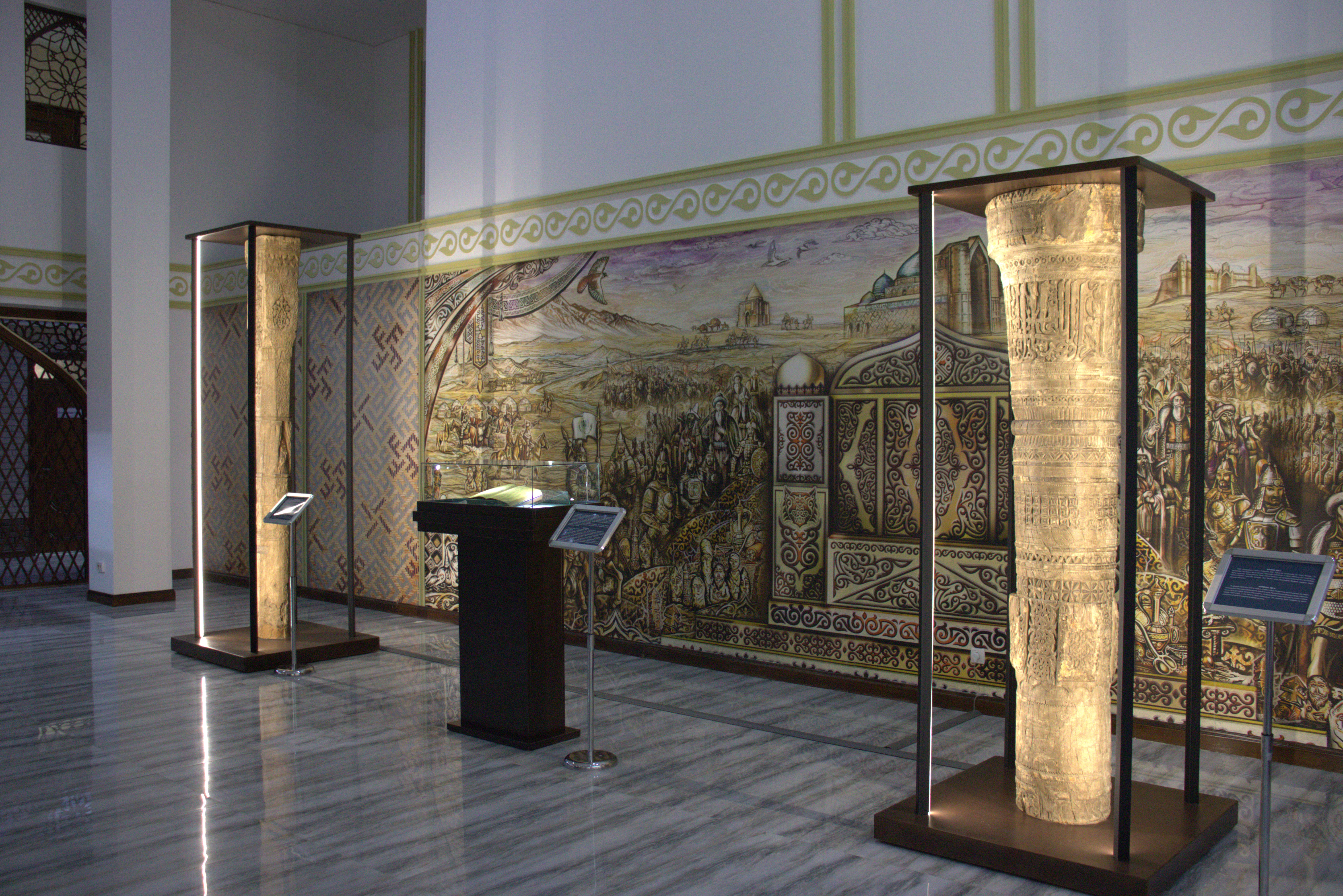
One of the valuable exhibits displayed in the Rare Artifacts Hall of the «Azret Sultan» National Historical and Cultural Reserve Museum is a wooden column originating from a mosque built during the period when Turkistan served as the capital of the Kazakh Khanate. This artifact was added to the museum’s collection in 1954. The column was brought in after the Alkhoja Ata Mausoleum was demolished. According to some sources, Alkhoja Ata was the son-in-law of Khoja Ahmed Yasawi.
The column is made of wood, has a four-sided shape, and its upper part is rounded. Three sides are decorated with floral ornaments, while one side bears a geometric pattern. On one of the belt sections, there is an Arabic inscription reading “1196 sanat”, which corresponds to 1782 in the modern calendar. This inscription precisely indicates the date of the column’s creation.
Before the opening of the Rare Artifacts Hall, the column had long been exhibited in the Juma Mosque exposition. During the restoration works carried out in the mosque between 2018 and 2020, the column was temporarily displayed in the Khiluet Underground Mosque Museum.
The second wooden column
According to the census of the 1920s, the old city of Turkistan had 62 streets, and each street had its own mosque. The Muslim community performed the five daily prayers in these mosques. However, with the arrival of Soviet rule, the appearance and layout of the city changed, and many of those mosques were destroyed.
This wooden pillar (column) was discovered at the site of one of the demolished mosques located on one of the city’s old streets. It is associated with the mosque commissioned by Jihan Sultan.
An Arabic inscription written in calligraphic style is carved on the pillar. The text reads:
Arabic text:
هذه العمارة مسجد العامة بو (…) المغ(فور) المتعالى جهان سلطان /مرسال حاجى/ روضت يسا والسفينة النجاة من الىم عقابه فى عتابه
Translation:
“This structure is a mosque built for the people. It was commissioned by the noble, forgiven, exalted Jihan Sultan. /Mursal Haji/. [It is] the garden of Yasa (Yassy) and the ship of salvation that rescues from torment and punishment.”
This inscription was first read and introduced into academic circulation by researchers from the Yasawitanu Research Center, dedicated to the study of Khoja Ahmed Yasawi’s heritage. Previously, the inscription had gone unnoticed and had not been studied by scholars.
Today, this wooden column is preserved in the collection of the Azret Sultan Museum-Reserve. Its surface is decorated with numerous traditional Kazakh ornaments, each reflecting the artistic taste and spiritual perception of the craftsman. These decorative elements harmonize with the inscription, enhancing the cultural and artistic value of the monument.
Although the exact date is not indicated on the inscription, linguistic and stylistic features suggest that the artifact belongs to a very early historical period. Researchers believe it was created earlier than the second pillar found in the same area.