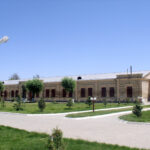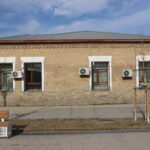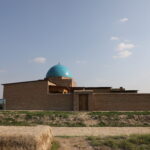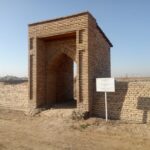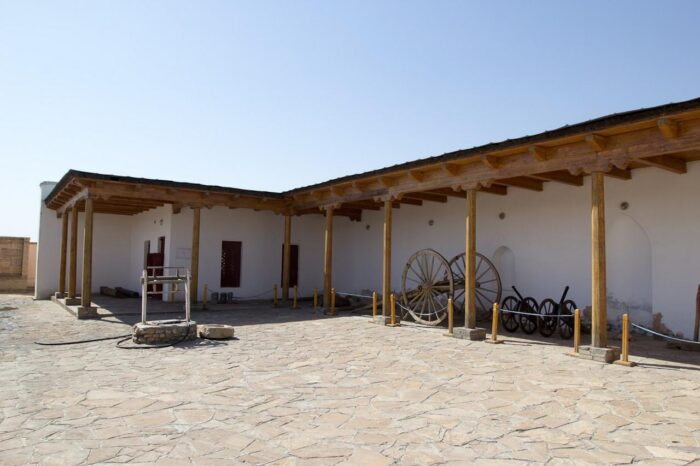
The Friday Mosque is an architectural monument of the 12th–19th centuries, located 120 meters southwest of the Khoja Ahmed Yasawi Mausoleum. According to local tradition, Yasawi himself lived here with his family. Later, a mosque was built on the site, serving the community until 1878. In the 1960s, it was reconstructed and, due to its proximity to the underground Khilvet complex, it became known as the Khilvet Mosque. For many years, it served as the city’s main mosque, but after the transfer of the central mosque to another location, this site functioned only for Friday prayers, which gave it its current name.
The mosque is significant not only as a religious site but also as a historical monument of Turkistan. Despite multiple reconstructions, its decorative features in the Sufi style have survived. A unique characteristic of Sufi mosques is the absence of Quranic verses on the mihrab; instead, motifs of pomegranate branches with nightingales (symbolizing the “bird of paradise”) were painted. In the 1980s, specialists from the Kazproektrestavratsiya Institute documented the surviving traces of these paintings, which may be restored in the future.
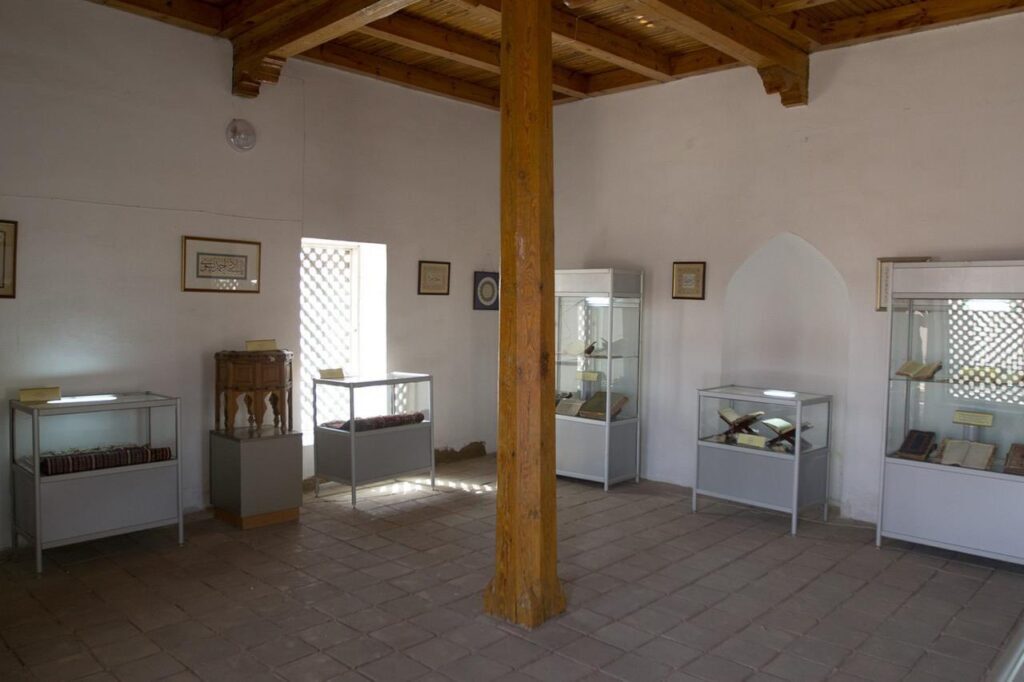
In 1982, the mosque was restored, and under the initiative of Uzbekali Zhanibekov, it was turned into a thematic “Museum of Archaeological Finds.” The core of the exhibition was based on the collection of renowned local historian and teacher Adaskhan Altaev, who, together with students, collected over 3,000 items, 200 of which were transferred to the museum’s collection in 1980.
Artist-designer V.V. Shishkin (Kazmuzeyrestavratsiya) designed the exhibition and created a ceramic panel symbolizing respect for cultural heritage. The panel, though not directly related to the later themes of the museum, has been preserved to this day.
In 2000, ahead of Turkistan’s 1500th anniversary celebrations (under UNESCO), the mosque underwent full restoration. Its main hall hosted a temporary exhibition of mosque inventory from the Yasawi Mausoleum, while the outdoor area displayed stone and wooden columns from Turkistan mosques, traditional millstones, and oil-pressing devices.
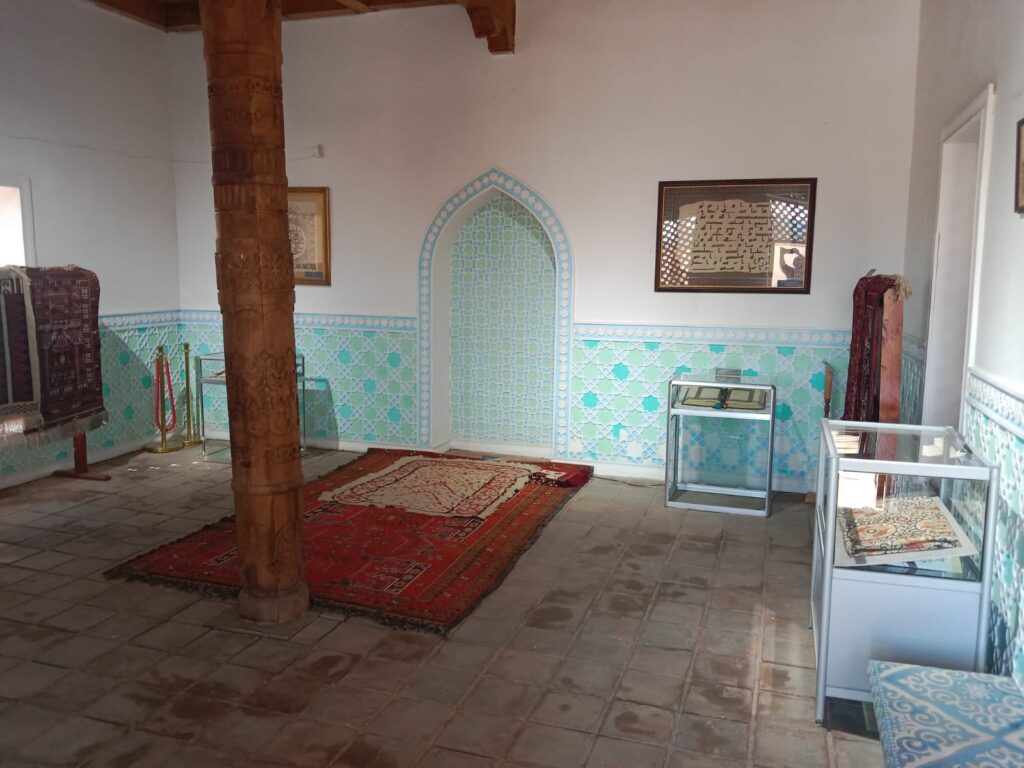
In the following years, temporary exhibitions continued to be held mainly in summer, as the mosque has only one hall without heating, and fluctuating seasonal temperatures make long-term preservation of artifacts difficult.
In 2024–2025, new thematic exhibitions were organized, including one dedicated to the anniversary of the museum’s opening (September 30) and another marking the 65th anniversary of the satirist and museum researcher Muratbek Dyusembekov.
Currently, during the summer season, the hall features a temporary display of prayer rugs from the late 19th – early 20th centuries, including rare camel wool mats preserved from the Khoja Ahmed Yasawi Mausoleum.
In the future, a unified exhibition project is planned, combining the Friday Mosque with the nearby medieval underground Khilvet complex as a continuation of one thematic concept.