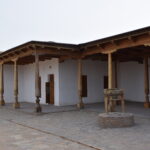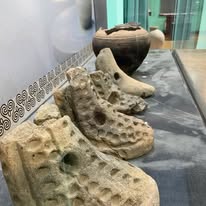
The “Aziret Sultan” National Historical and Cultural Reserve-Museum opened an exhibition titled “Ceramic Products of the Turkistan Oasis.” The display features around 200 clay vessels and household items from the museum’s collection.
The exhibition is divided into three sections:
— Ceramic artifacts from the Bronze Age (15th–10th centuries BCE) and the Saka–Usun period (8th–1st centuries BCE);
— Pottery from the Late Antiquity (1st–5th centuries CE), as well as the Early and High Middle Ages (5th–14th centuries CE);
— Items from the Late Middle Ages (15th–18th centuries) and ceramics of the Modern Era (18th–19th centuries).
The scientific concept of the exhibition is based on the album-collection “Ceramic Products of the Turkistan Oasis” (authors: M.K. Tuyakbayev, A.M. Egeubaeva), prepared by the staff of the “Aziret Sultan” National Reserve-Museum.
Ceramics represent one of the main materials uncovered during archaeological excavations. Widely used in household and economic activities, clay contributed to the development of pottery as an art form. Clay products are considered among the most durable artifacts of antiquity. Pottery first appeared around 6000 BCE in Southwest Asia, and in Kazakhstan during the Neolithic era, approximately 5000 BCE.
It has been established that in early communal societies, women were primarily engaged in pottery-making, while men hunted and herded livestock. Women also participated in agriculture, domestic duties, and metallurgy. Clay for pottery production was carefully selected and sometimes transported from specific sites.