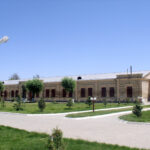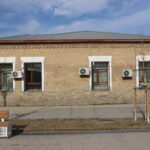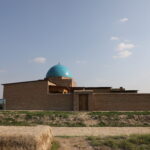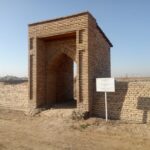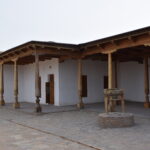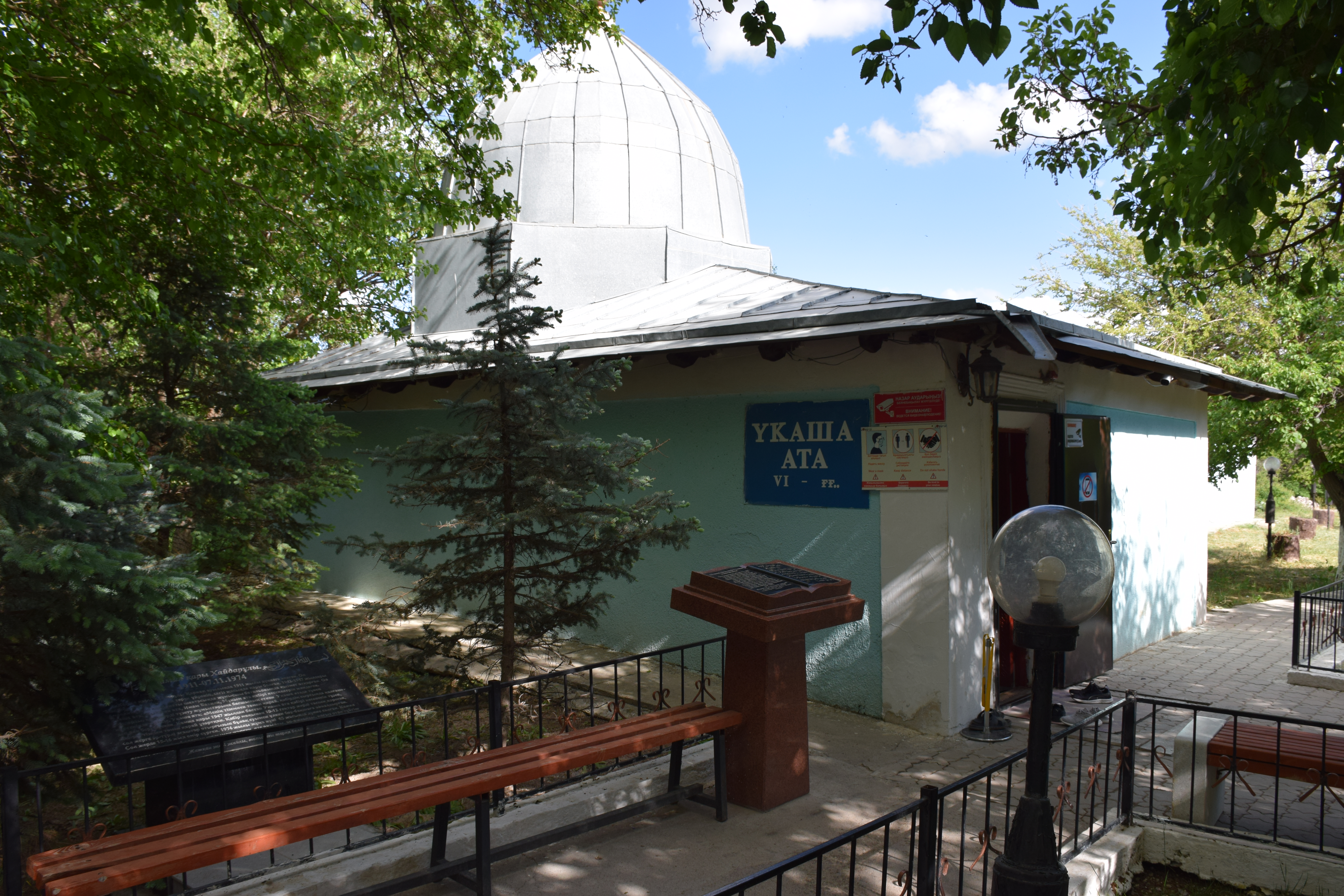
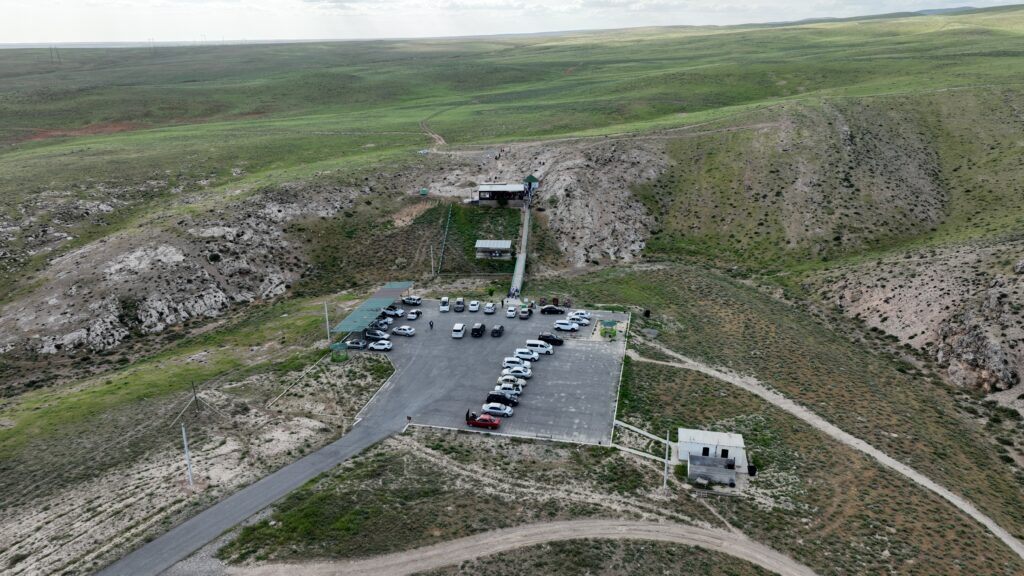
The Mausoleum and Well of Ukasha Ata are located at the foot of the Karatau Mountains, approximately 55 km north of Turkistan. Coordinates: 43˚36.917΄, 068˚15.712΄. The site is classified as a monument of national significance.
According to tradition, Ukasha Ata was a companion (sahaba) of the Prophet Muhammad and one of the first who bring Islam to the territory of Kazakhstan. In popular memory, he is revered as an outstanding Muslim military commander. Legend has it that Ukasha Ata possessed divine power, no sword could wound him, and no arrow could pierce him. He was known for his immense strength and great bravery. The enemies of the religion of his time tried to find a way to kill him. Deceiving his wife, they learned that Ukasha’s body became vulnerable only during the morning prayer. One day while Ukasha Ata doing morning prayer enemies beheaded him. When they attempted to desecrate his head, it miraculously rolled away, leaped over two hills, and disappeared under the ground and at that place was formed a well. According to popular belief, the water of the well is connected to the sacred “Zamzam” spring in Mecca. It is believed that the water is not appear to everyone: if water rises when drawn with a bucket, it signifies that the pilgrimage (ziyarat) and the pilgrim’s wishes have been accepted.
Initially, here were only a burial site. In the 1940s, the first shyraqshy (caretaker), Kamil Qary, built a 32-meter-long tomb chamber, landscaped the surrounding area, enclosed a 5 hectare territory with a stone wall, and planted a garden. Local residents constructed the existing mausoleum in 1989–1990. It consists of two chambers: a small entrance vestibule and an elongated burial room measuring 25 meters in length and 8.6 meters in width.
A small structure resembling a yurt was erected over the well. It measures 4.5 meters in diameter and 3.5 meters in height, the well itself extending to a depth of 23 meters. In recent decades, it became customary to throw coins into the well, which had a negative impact on the condition of the monument.
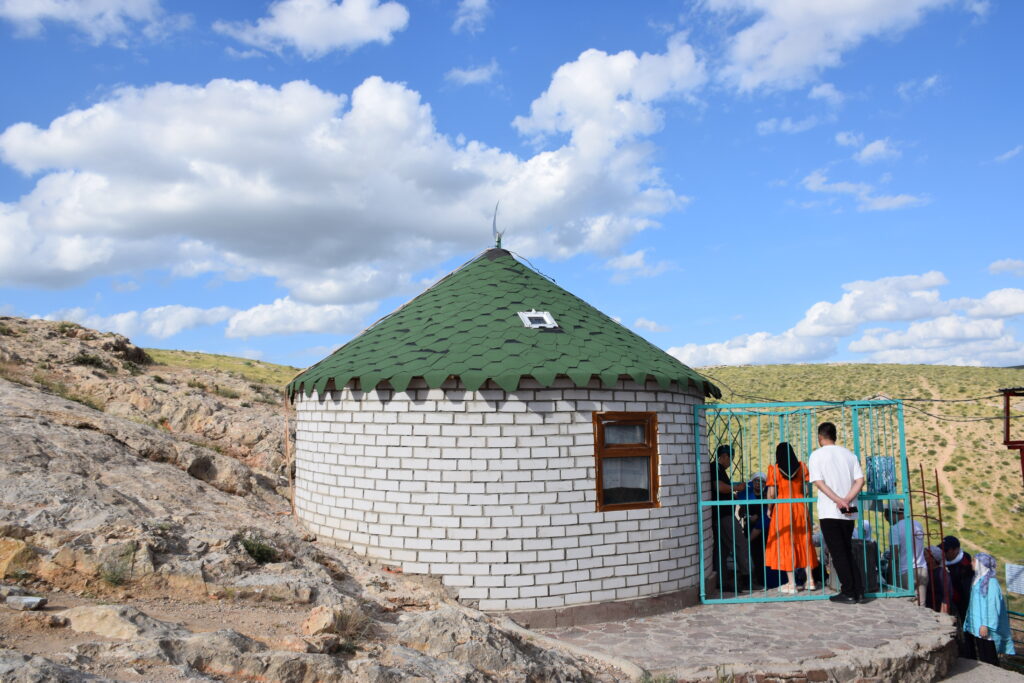
In 1985, following several tragic incidents in which people descended into the well searching for coins, a state commission decided to seal it with concrete. However later the well was reopened and the mausoleum restored.
Today the site is not only a religious and spiritual monument but also a revered pilgrimage place, renowned throughout the Muslim world. Pilgrims from Kazakhstan, Uzbekistan, Tajikistan, Kyrgyzstan, Russia, Turkmenistan, and beyond visit the site year-round. In 2017, within the framework of the program “Course towards the Future: Modernization of Kazakhstan’s Identity” and the project “Geography of Sacred Sites of Kazakhstan” the Mausoleum of Ukasha Ata was included in the list of sacred monuments as a religious and cultic site.
Mentions of Ukasha Ata are found in the works of several noted researchers as Shoqan Walikhanov refers to him as “Okse”, Mashkhur Zhusip records variants such as “Khaziret Ghakasha”, “Akkose Sakhaba”, and “Ghakasha Sahapa”, while Grigory Potanin mentions him under the name “Akash”.
References:
- Үкәш ата мазары мен құдығы, ІХ-Хғғ. // Түркістан өңіріндегі тарихи – мәдени ескерткіштер. А., 2016. 114-115 бб.
- Үкаша ата кесенесі мен құдығы // «Әзіреті Сұлтан» энциклопедиясы, І-том. Түркістан, 2021. 333-334 бб.
- Дастанов О. Әулие жерлер туралы шындық. А., 1967.41-44бб.
- Үкаша ата // Түркістан-руханият бесігі. Лингво-өлкетану энциклопедиясы. Нұр-Сұлтан, 2019. 458-459бб.