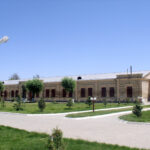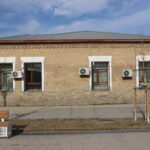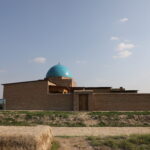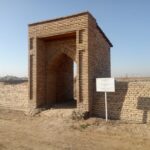
The Mausoleum of Zhalauly ata stands within an extensive necropolis of the same name. Coordinates: 43˚29.619΄, 067˚47.203΄. The necropolis was formed during the early Middle Ages (5th–12th centuries) and served as a burial site for the inhabitants of the ancient city of Karatobe–Sauran, situated **41 km northwest of Turkistan.
Covering an area of about 1 hectare, the necropolis lies 850 meters northeast of the citadel, within the fortress walls of the Karatobe–Sauran settlement. It contains the ruins of mausoleums and four-domed tombs belonging to people buried during different historical periods, as well as later burials, including graves from the 20th century. The necropolis stands is 198 meters above sea level. According to legends, Zhalauly ata was the standard-bearer of Zangi ata, the commander of Arab forces in the 8th century. The title “ata” (elder, spiritual mentor) was usually given to people who spread and preached Sufi teachings (e.g., Tagaiyn ata, Zhusup ata, Saduakas ata). Those who first introduced and spread Islam were referred to as “bab”, meaning “gate to Islam,” such as Ishak bab, Abdujalil bab, Abdurakhim bab, and Arystan bab. Most Sufi preachers known as “ata” lived in the 9th–12th centuries — the period when Sufism spread widely across Central Asia and reached its peak. Among Sufis, there is a saying: “Sufism sprouted in Arabia, blossomed in the Middle East, and bore fruit in Central Asia”.
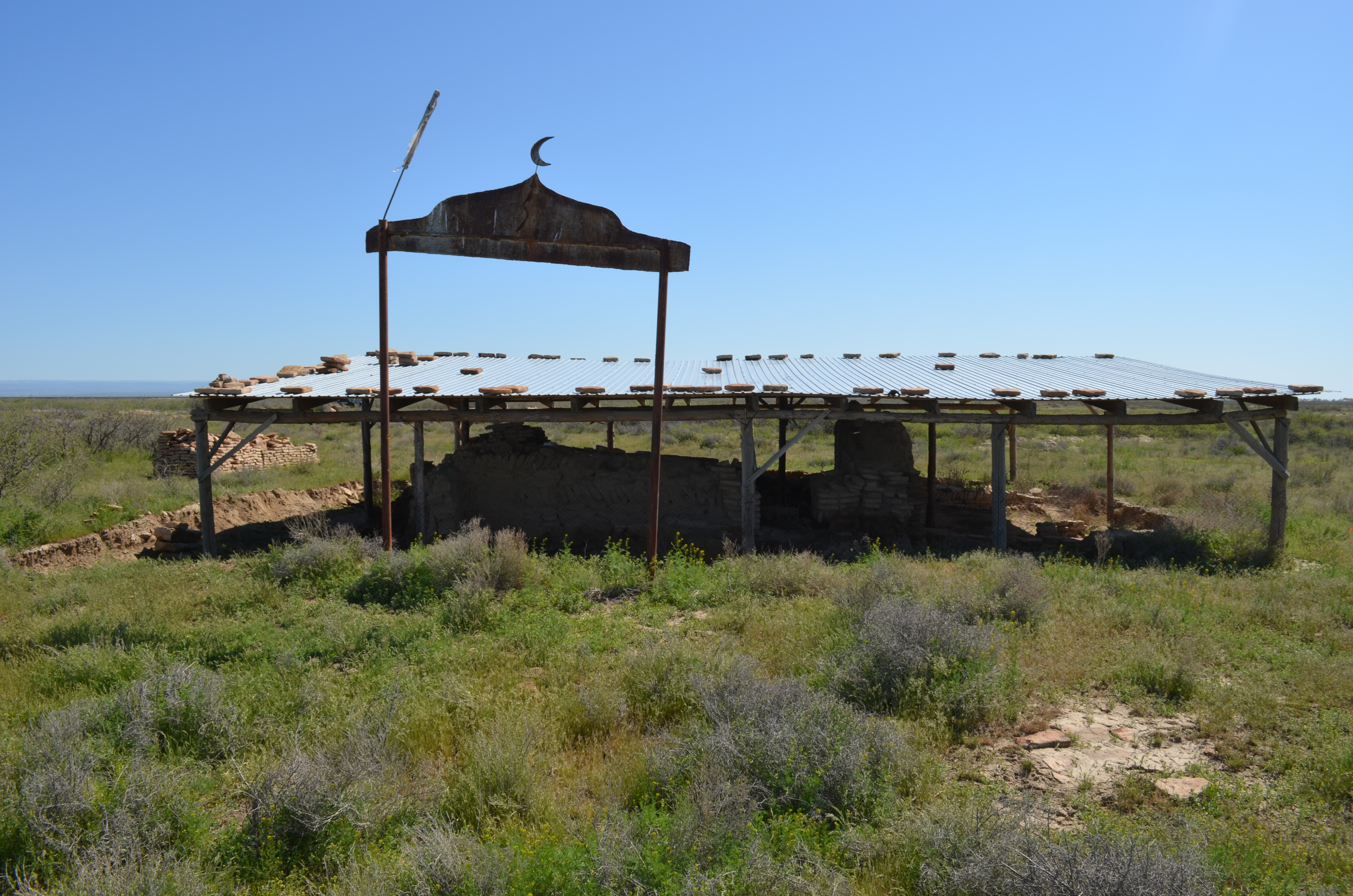
Within the necropolis are the ruins of a structure believed to be the mausoleum of Zhalauly ata, which underwent multiple repairs and renovations. Today, it appears as a square earthen mound measuring 6.5 x 6.5 meters and about 1.2 meters high. The foundation, made of fired bricks (25x25x5 cm), rests on a low mound 1.2 meters high. During excavations in 2010, archaeologists discovered an even older structure beneath a rectangular burial chamber (sagana), approximately 3 x 2 x 1.7 meters in size. Fragments of stone columns and gravestones from the early period of the monument were also found nearby.
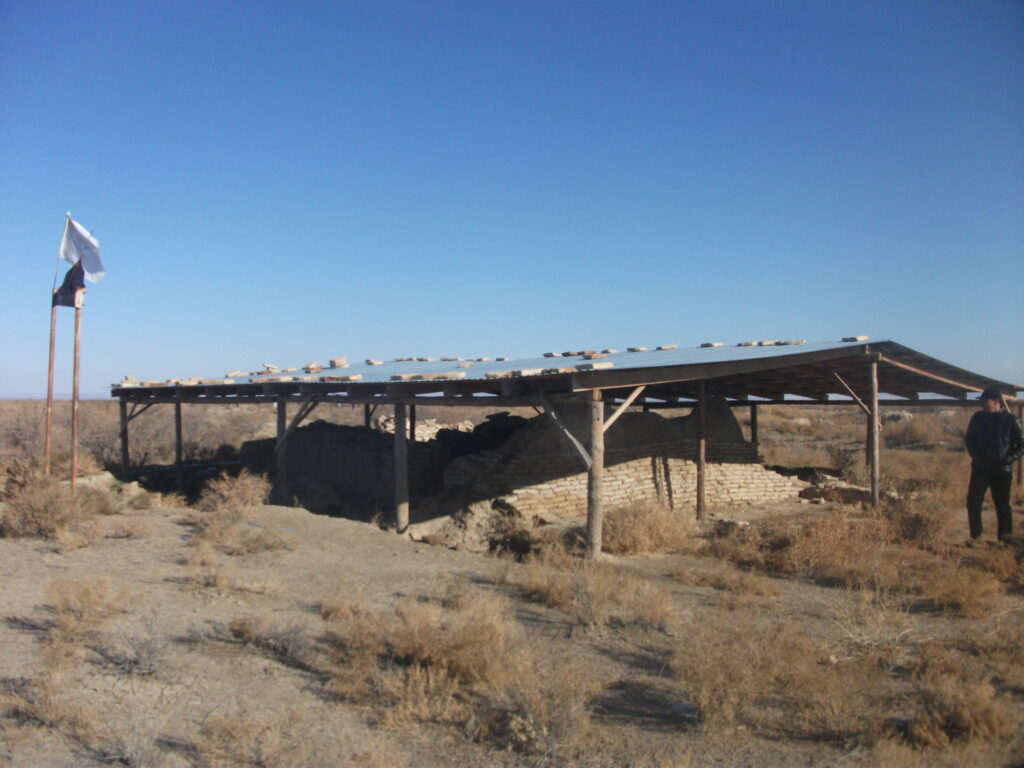
Around the ruins, remnants of a rectangular fence have been preserved, measuring 20 x 18 meters and up to 0.7 meters high. Some areas of the masonry feature fired bricks, indicating later restoration works in the 19th–20th centuries. The last mausoleum was built on a brick foundation, with adobe brick walls and was once covered by a dome. However, the dome collapsed in the 1950s–1960s and over time, the structure turned into an earthen mound. Other mausoleum remains within the territory also show traces of underground burial chambers (murdekhana).
Zhalauly ata is revered as one of the “Nine Babs of Sauran” — saints who contributed to the spread of Islam. He was originally called a “bab” (gate to Islam), but later came to be known as “ata” as a sign of deep respect. According to local residents D. Yesirkepov and K. Abdeshev, these nine babs were buried not only within the walls of Sauran, but also in its surroundings.
- Zhalauly ata — in Karatobe–Sauran
- Saghdi Uaqqas ata (Saduakas) — in Karatobe–Sauran
- Karakhan ata — in Late Sauran
- Azder awliya (“Azder auliye”) — location unknown
- Sarai ata — location unknown
- Shala baksy — 1 km north of the road police post
- Momyn ata — near the village of Satymsai
- Unknown saint — near the village of Aktobe
- Unknown saint — near the village of 1 May
References:
- Smagulov, E. A. Ancient Sauran. — Almaty, 2011. — pp. 308–321.
- Mausoleum of Zhalauly Ata // Encyclopedia “Azret Sultan”, Vol. I. — Turkistan, 2021. — pp. 132–133.
- Surroundings of the city // Baipakov, K. M., Smagulov, E. A. The Medieval City of Sauran. — Almaty, 2005. — pp. 16–19.
- Beisebaev, A. I. The Cult of Saints among the Contemporary Population near Medieval Sauran // Abstracts of the Scientific Conference of Young Scholars “Akhinzhanov Readings”. — Almaty, 2004. — p. 86.