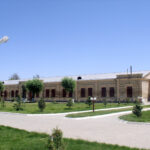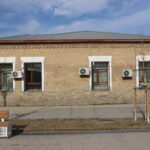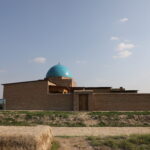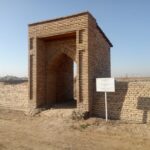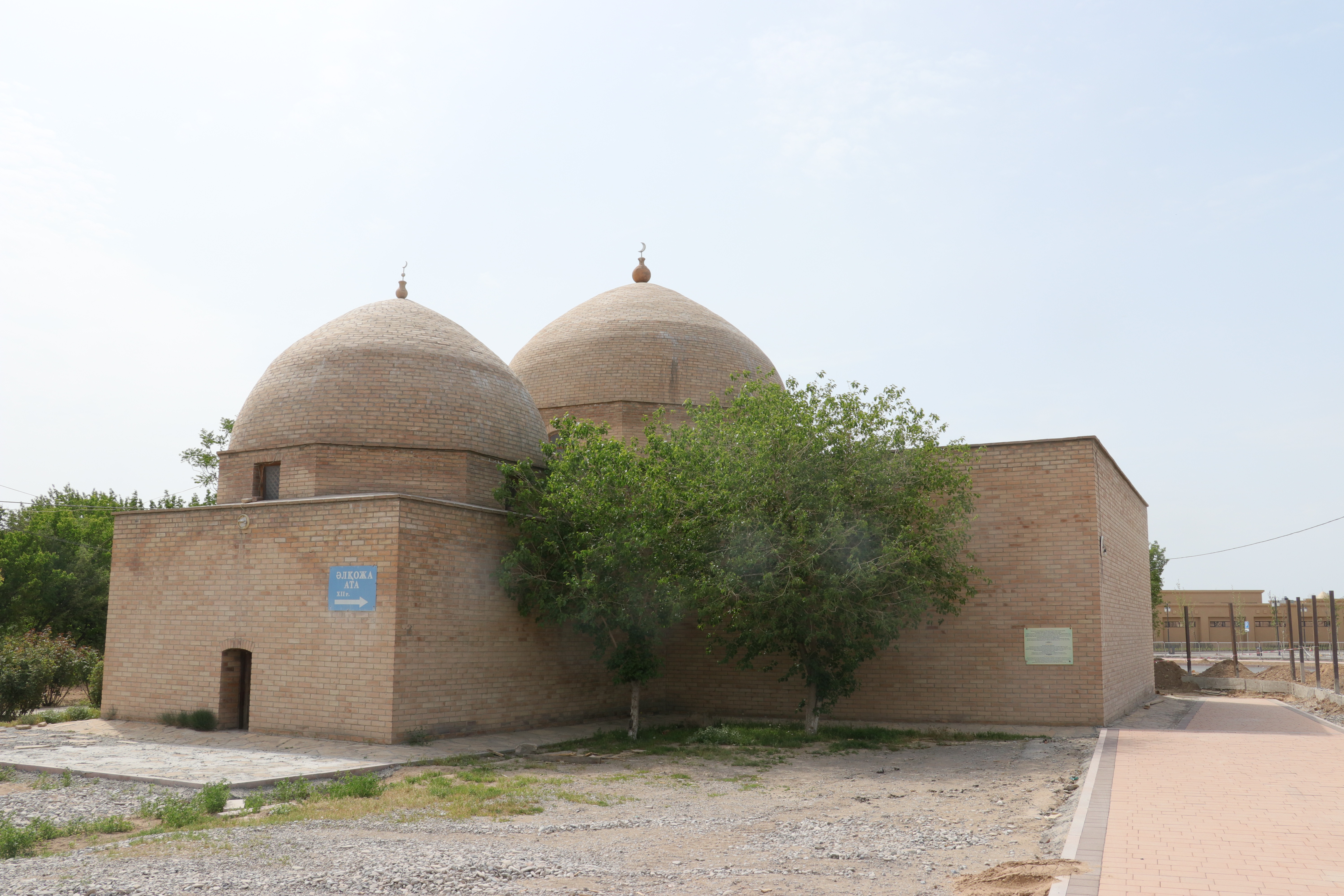
Alkhoja аta was the son-in-law of Khoja Ahmed Yasawi. The mausoleum is located 2.5 kilometers east of the Khoja Ahmed Yasawi mausoleum. It is a monument of Republican significance. Coordinates: 43˚17.437΄, 068˚17.134. Historical sources (such as the genealogical manuscript Nasabnama of Yasawi’s ancestors) offer differing accounts: Alkhoja Ata is sometimes described as the son of Sadyr Shaykh (Yasawi’s brother), and at other times as the son of Artyk Shaykh. His name is also given as Abd al-Malik with the honorific title “Ali Khoja.” The mausoleum consists of two rooms — the ziyaratkhana (pilgrimage chamber) and gurkhana (burial chamber) — and is dedicated to revered individuals. A composition with two domes of different structures has been known in architecture since the 11th century. The two-dome configuration of the Alkhoja Ata mausoleum clearly resembles the mausoleum of Khoja Ahmed Yasawi.
The architectural elements of the interior partly recall the 13th century: there are pendentive arches but no tiers; domes are formed using semi-domes; faceted drums with windows are adorned with frame-like designs; and the domes are built with unique techniques not seen in the 15th century and later. However, in the 13th century it was also uncommon to construct deep niches or complex vaulted connections between two rooms, both of which are present here.
The mausoleum underwent several reconstructions and survived until the 20th century. In 1947, V.V. Konstantinova studied the structure and identified three phases: originally, a one-room burial chamber was built in 15th century; in the 18th century was added a prayer room, then transforming into a mahalla (neighborhood) mosque. The first published image of the mausoleum appeared in 1912 in A.I. Dobromyslov’s work. Kazrestavraciya carried out comprehensive restorations in 1997–1999 and in 2014.
Nowadays the mausoleum has two chambers: the gurkhana (burial chamber) and the jamatkhana (prayer room). Both are topped with domes and have window openings on all four sides. The iwan of the mausoleum is built of from fired bricks in a quadrangular shape.
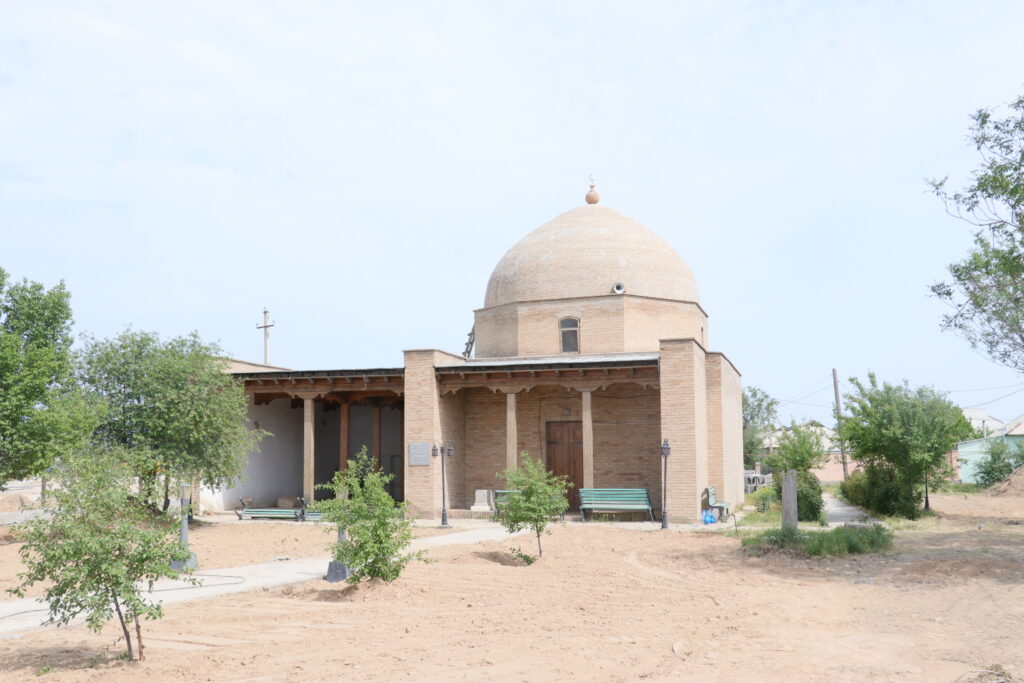
The location of the mausoleum near the multifunctional tourist complex “Keruen Saray”, built in the spiritual-cultural zone of Turkistan, makes the place an accessible and appealing site for future pilgrimage and cultural tourism. To this day, there are families who trace their lineage to Abd al-Malik (Ali Khoja Ata). They preserve a Nasabnama endorsed with the seal of Abdullah Sultan, son of Shaybanid ruler Koshim Khan, who governed Turkistan in 1517–1518.
Details about the burial site of Ali Khoja Ata mentioned in a book of Akhmet Kenesarin “Kenesary and Syzdyk Sultans”, published in 1889. It states that in 1864, Syzdyk Sultan stopped at a garden near the mausoleum with his troops. The first visual representation of the mausoleum was issued in A.I. Dobromyslov’s work “Cities of the Syr-Darya Region — Tashkent, Turkistan…, in a lithograph based on a photograph.
References:
- Alkhoja Ata Mausoleum // Historical and Cultural Monuments of the Turkistan Region. — Almaty, 2016. — p. 25.
- Encyclopedia of Azret Sultan, I. — Turkistan, 2021. — pp. 79–80.